All things Pucci in summer

Emilio Pucci ad campaign s/s 2008. Malgosia Bela by Juergen Teller.

A pick-me-up designer label for me is Emilio Pucci. The ad campaign above is what closest describes my view of all things Pucci and that is, a burst of colours when all things are bland, a burst of energy when you need it most. A nobleman by birth with a fascinating biography, Emilio Pucci (1914-1992) would spend most of his life at the Pucci Palace in Florence, Italy. Most of us would recognize his signature geometric prints in a kaleidoscope of colours.
Continue reading “All things Pucci in summer” →

Galliano for Dior, Fall couture 2008

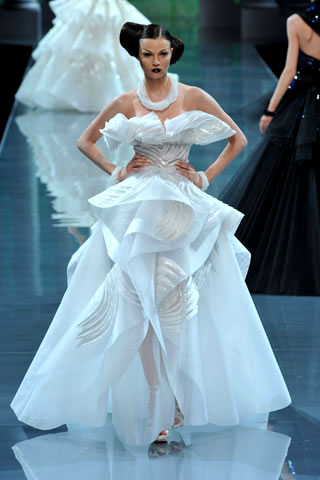
John Galliano for Christian Dior, Fall Couture 2008. Photo by Alessandro Lucione

Collections for Fall Couture 2008 are already out on the runways in Paris and my favourite thus far is John Galliano for Christian Dior. An artist who uses the human form in expressing himself, I have thus far, never tired of Galliano’s creations. Even after the season has come and gone, I find myself constantly drawn back to his creations, to peer over them, to study their expressions and sometimes, wonder if they were user-friendly.

Fifties silhouette with wasp waists, full skirt and lace details. Photo by Antonello Trio.

The soft female form seems to be Galliano’s focus this Fall for couture, drawing inspiration from the fifties with nipped waists, full peplum skirts, and sheer organzas that accentuate the luscious curves of shoulders, thighs and thin ankles. But even with an accent on curves and the use of sheer materials, the overall impression is one that is still proper and demure with knee-length or t-length skirts. Continue reading “Galliano for Dior, Fall couture 2008” →

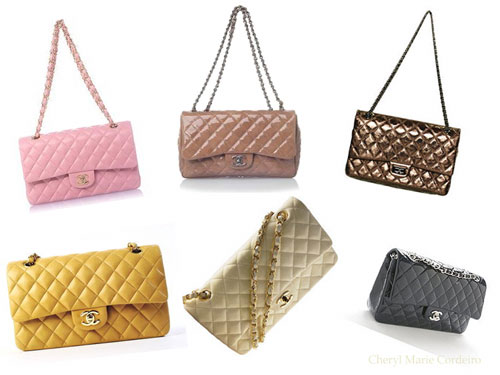
The Chanel 2.55 Classic

The Chanel 2.55 Classics and Reissues, my favourite colour being the one in ivory with gold chains.

What you put in your bag is very important to you…Traditionally, for a woman, a bag holds the things you need for the day, but it’s also your little beauty factory, which is very important to the identity of the woman. …the modern bag …by 1920, …became a symbol of women’s independence. It said she could go where she wanted to go, and didn’t need a man because he held all the possessions.

~ Farid Chenoune, author of Carried Away: All About Bags (2005)

Chanel bags have previously not appealed to me because I found the quilting too much mademoiselle. But I love bags with a story to tell and the Chanel 2.55 Classic quilted flap is one such bag. Launched in February 1955, hence its name 2.55, the quilted flap bag draws its inspiration into being, from many threads of Coco Chanel’s life, most of which came from the orphanage and convent, Aubazine in the south of France.

Coco Chanel wanted a bag that was hands-free, thus the double function of the chained handles to the bag, where one could wear the bag across the body or on the shoulder. The burgundy coloured lining in the original design for the black quilt flap 2.55s, came from the colour of Chanel’s school uniform at the Aubazine convent and the inspiration for the quilting came from several sources, including the stained-glass windows of the abbey at Aubazine, jockeys’ riding coats as well as her own light-brown suede cushions in her rue Cambon apartment in Paris. The open back pocket of the bag was where she stashed extra money and the zippered pocket was where she had her love letters. The original bags came with a Mademoiselle Lock because Chanel never married and the honorific mademoiselle was the custom. The bags with the interlocking Cs are today known as The Classic Flaps, whilst versions of the bag relaunched by Karl Lagerfeld in 2005/6 are known as Reissues. The Reissues have a twist lock without the Chanel logo on the outside. Continue reading “The Chanel 2.55 Classic” →

Maria Gibson, at Midsummer’s in traditional folkdress

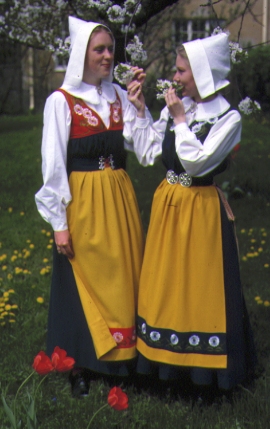
Maria in a traditional Swedish folkdress, hand-stitched and sewn. Photo by Robbie Nordin, Robbiesphoto.com.

For some years now, I have observed that Swedes have several forms of folk dresses and a National Costume, that they use on special, festive ocassions such as Midsummer’s. Sverigedrakten lends a good history of the folk dress, where the dresses displayed the wearer’s province of origin, their distinct style of clothing, their culture and history. Folkdresses went out of fashion around the mid-1800s, where these days, they can fetch enormous prices at auction houses due to that the textile to the dress was usually hand-loomed and then the dress hand-sewn. An approximate cost to a folkdress today would be around 15,000 kr to 20,000 kr, which is about USD $2,500 – $3,000 or SGD $4,000 – $4,500. Continue reading “Maria Gibson, at Midsummer’s in traditional folkdress” →

Superheroes: Fashion and Fantasy exhibition at the Metropolitan Museum

Nibbling the Big Apple X

Outside the Metropolitan Museum, New York.
Text & Photo © JE Nilsson, CM Cordeiro-Nilsson 2008

Since its opening in early May, the Superheroes: Fashion and Fantasy exhibition at the Metropolitan Museum has drawn quite some media attention with numerous write-ups, press conferences and an opening night gala dinner, where all invited were supposed to dress to the superheroes and fantasy theme. My favourite evening wear for the night was an elaborately padded silver gown by Chanel, donned by Anna Wintour.

I couldn’t well pass up on the chance to view this exhibition at the Met, when in New York. Continue reading “Superheroes: Fashion and Fantasy exhibition at the Metropolitan Museum” →

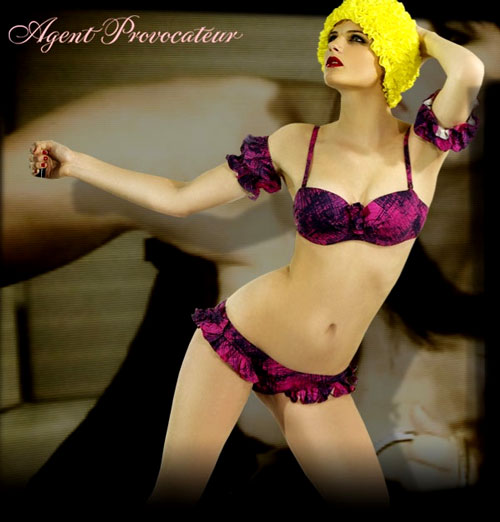
Agent Provocateur: Heating It Up

Putting a whole new meaning to micro-mini and the ‘naked dress’.

Where I am, it’s almost as if we’re experiencing a heat wave of sorts. And Agent Provocateur, maker of exotic lingerie is heating up this summer in their own way, with their 2008 bikini collection.

I thought this frilled cerise Arianna bikini set with detached puff sleeves was most intriguing of their 2008 collection. I’ve only ever noticed frilled skirts on either little girls’ swimwear or swimwear for the more mature figure, the frills being more of a skirt that falls over the bottom, as a cover-up.

In the above bikini, the puff sleeves and frilled skirt throws the bikini into the genre of barely-there dresses, with most everything of the dress removed, save sleeves and mini-skirt. What they’ve produced, is a celebration of sorts, it’s beyond micro-mini.

The cutting looks super and the cups are padded for that extra lift – important details for the day out in the sun!

Très sexy!

Prada along 5th Ave, New York

Nibbling the Big Apple V

A pair of Prada boots from their Runway, RTW S/S 2008 collection.

I couldn’t help but bound into Prada along 5th Ave after spotting it from across the street. Their Spring 2008 collection on the Runway seemed interestingly creative this time around, with inspirations from the 60s and 70s, woven into swirls of fairy mystic. The cut out boots I was trying on in the picture above, are quintessential in exhibiting the spirit Prada in Spring 2008. It’s also one of the more wearable of shoes and boots this season from Prada, without looking too much of a fruit cake. Continue reading “Prada along 5th Ave, New York” →

Fashion: an expression of Hegelian geist

Oyster Dress by Alexander McQueen for S/S 2003. Ivory silk chiffon and silk organza.

I’ve been revisiting Adressing Fashion by the Metropolitcan Museum of Art (the avatar to the left will bring you to the MM’s website) and have picked out my favourite pieces from the their exhibition, to write about in this post. This is a subconscious streaming of thoughts, as it were, back on my favourite ponder on fashion, its connection to language, inspiration, geist and towards an understanding of a people.

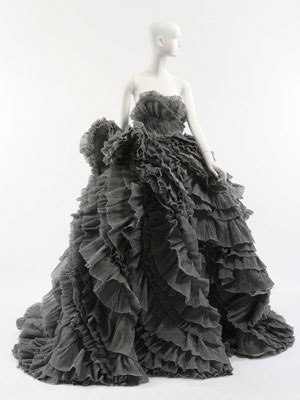
My favourite pieces from this exhibit were the ones with a fuller silhouette, with soft flowing volume; their diaphanous design and characteristic, bordering on the ethereal. Even the ash grey of Theyskens piece below, with tones of grey darker than that of Badgley Mischka’s on Sarah J. Parker didn’t pull down my spirits or enthusiasm for the dress.

Evening dress by Olivier Theyskens for Nina Ricci, S/S 2007 in steel grey crinkled silk organza.

I’ve always thought fashion and personal style as a broad language of sorts. Looking at how the various designers expressed themselves in their pieces and how clothing changed with the times, the pieces in this exhibition called to mind Lars Svendsen’s philosophical take on fashion in his book, Fashion: a Philosophy. Svendsen (2006:64ff) didn’t quite agree with Lurie (1983) when she wrote that clothing was language. He was rather more convinced of Barthe’s (1967) theorizing on fashion as a system, paralleling that of Saussure’s signifier and the signified. I haven’t as yet read Lurie’s (1983) work but in light of Kress and van Leeuwen’s (1996) work on The Grammar of Visual Design, perhaps a more concrete theory on the grammar of clothing isn’t too far away?

As fashion today is so diffused in culture, the grammar of clothing and thus clothing as a concrete language is difficult to assume diachronically. Fashion is studied diachronically, most of the time with regards to their transformation, perhaps as a commentary on the life and times of the people, “an immediate expression of our zeitgeist” as the Met Museum has it. What for example, could have expressed a certain meaning for a sub-culture, is today more diffused. High heels in the late-1800s associated with street walkers for example, are today standard office wear for most women. And most people today would gawk at the thought of one equating wearing high heels solely with prostitution purposes (which tangently reminds me in this instant, of the song Free Your Mind, by En Vogue).

For Halliday (1994, and almost all works from the 1960s ff), the system of language and meaning making is a conscious choice of words, people choose what they want to say it and how to say it, to fit the context. I think that point of view can be broadly associated with the fashion system. The fashion system, in designing and building up a wardrobe within one’s limits and means, is also a choice. It is a choice of textiles, textures, cut, silhouette, colour, function etc. Synchronically, perhaps fashion is an expression of personal spirit, as defined closest to Hegel’s geist.

Madame Grès (French, 1903–1993). A hand-pleated silk jersey dress by Grés herself, from 1971.

The work of Madame Grés (1903-1993) was part of this exhibition and she is to me, the epitome of self-expression in clothing design and manufacture. A tragic biography to behold, Grés reached the peaks and depths of the fashion industry. A legend already in her time with a Golden Thimble award in 1976, she passed on without word and in poverty in 1993.

Madame Grès silk jersey draped evening gown, c.1945. Picture from Vintage Textile.

Grés was a sculptress at heart and in training. In her 50 years or so as atelier, her designs shifted not with the raveling fashion trends of the time, but towards a concretion of a greater sense of personal style, personal achievement and perfection of her technique.

In light of Grés, I see many out there who use fashion as an immediate expression of personal style and spirit. From designers such as Westwood, McQueen and Galliano to individuals on the street who use current trends to their own understanding and purposes. Even those who are uncomfortable with being ‘fashionable’ haven’t missed a beat, as Stella Blum has observed,

Fashion is so close in revealing a person’s inner feelings and everybody seems to hate to lay claim to vanity so people tend to push it away. It’s really too close to the quick of the soul.

And so it goes that to understand a person or a people’s history, in addition to the study of events, language, culture and architecture, one would do well to include a study of the people’s sense of style, their choice of clothing for a particular era or period of time in order to understand their history, their lifestyle. Perhaps likewise in getting to know an individual.

Adressing Fashion in blog format is now closed, and I hope the Met Museum will have more of such showing formats in future, since it allows for an international audience to view and comment on the pieces on exhibit.

References

  • Barthes, Roland, 1967. The Fashion System. Translated by Matthew Ward and Richard Howard. Published again in 1983 and 1990. New York: Hill and Wang.
  • Halliday, M.A.K, 1994. An Introduction to Functional Grammar. London: Edward Arnold.
  • Kress, Gunther and van Leeuwen, Theo, 1996. Reading Images: the grammar of visual design. London, New York: Routledge.
  • Lurie, Alison, 1983. The Language of Clothes. New York: Vintage Books.
  • Svendsen, Lars, 2006. Fashion: a philosophy. Translated by John Irons. London: Reaktion Books Ltd.

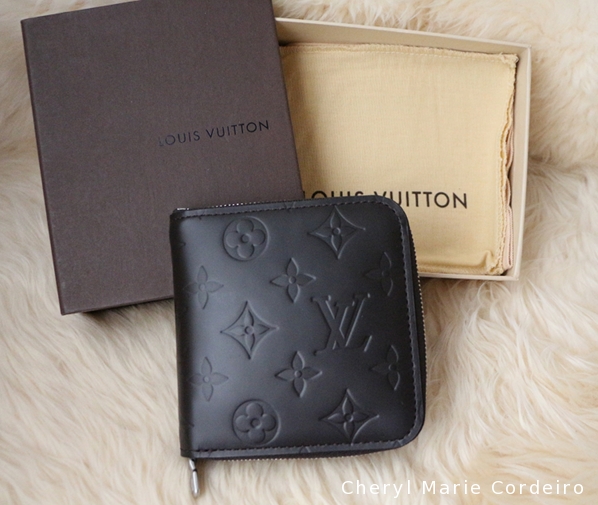
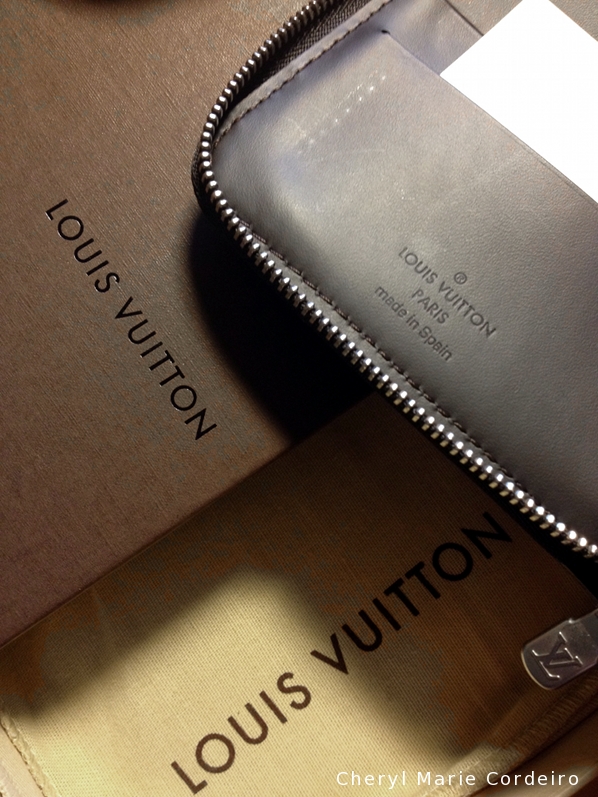
Louis Vuitton Monogram Glacé porte-billets monnaie zippé, Grizzly

Louis Vuitton monogram glacé

Louis Vuitton Monogram Glacé porte-billets monnaie zippé in Grizzly.
Text & Photo © CM Cordeiro-Nilsson 2008

Depending on what you’re looking for in design, this porte-billets monnaie zippé / wallet in collectible Glacé monogram holds bills, change and credit cards – zipped in. So why not that lipstick too between its covers if it fits?

Louis Vuitton monogram glacé
Louis Vuitton Monogram Glacé Grizzly

The colour is Grizzly or a rich dark chocolate brown that under certain light would look a sophisticated matte black. Embossed and soft to the touch, the glacé leather oozes understated luxe.

Measuring a 11×11 cm, it might not sit well in the back pocket of any pair of cigarette jeans but personally, I’m loving the feel of this wallet in the hand and in the bag. It comes from Vuitton’s men’s line for small leather goods, now no longer in production.

This Grizzly is for keeps, as far as androgynous goes.

The Porte-billets monnaie zippé wallet in Glacé monogram features:

  • Monogram Glacé embossed leather
  • Zipper closure
  • Silver grommet pieces, stamped with Louis Vuitton
  • A snap closure inside coin pocket
  • 3 credit card slots
  • Measures 4.5″ x 4.5″ or 11 cm x 11 cm
  • Datecode: CA1014
  • Product code: M66510