© 2026 Photos and text by CM Cordeiro
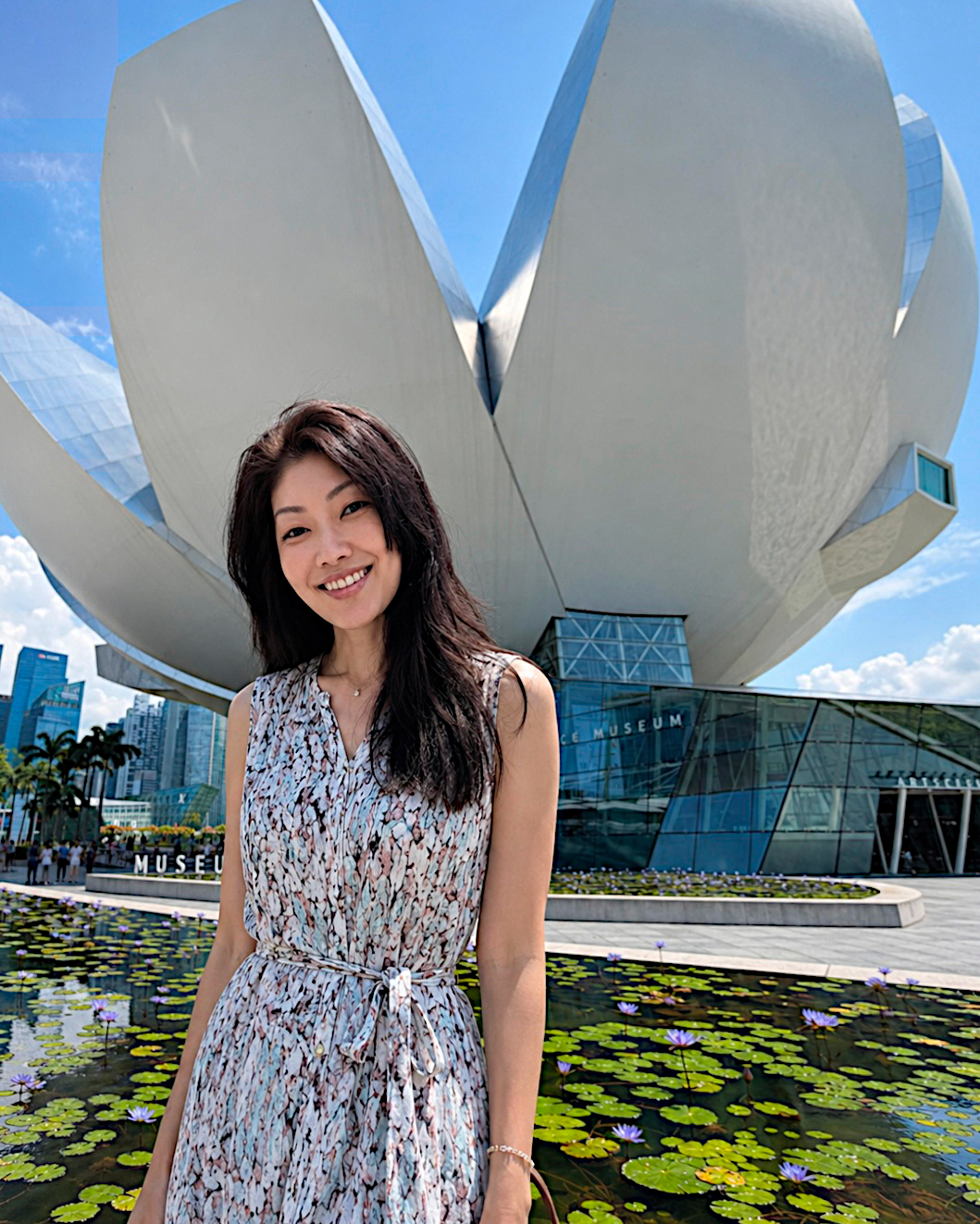
I’d meant to breeze through this museum on my first afternoon at Marina Bay, the way you tick a landmark off a list. Or really, to revisit it, since it sits along the waterfront walk beside Marina Bay Sands that I love, humidity and unforgiving heat and all. But the museum’s lotus-shaped building, all white petals reaching up toward the bay, has a way of slowing you down before you’ve even gone inside. I lasted about twenty minutes of “just a quick look” before I gave in. We had comfortable shoes; it would be a no-agenda day, or rather, a three-exhibition one.
The three shows running during my brief trip to Singapore were about the body, the ocean, and one that lives somewhere between art, science and pure sorcery. I’m always up for a little alchemy and scrying, so we began with Future World.
Future World: Where Art Meets Science
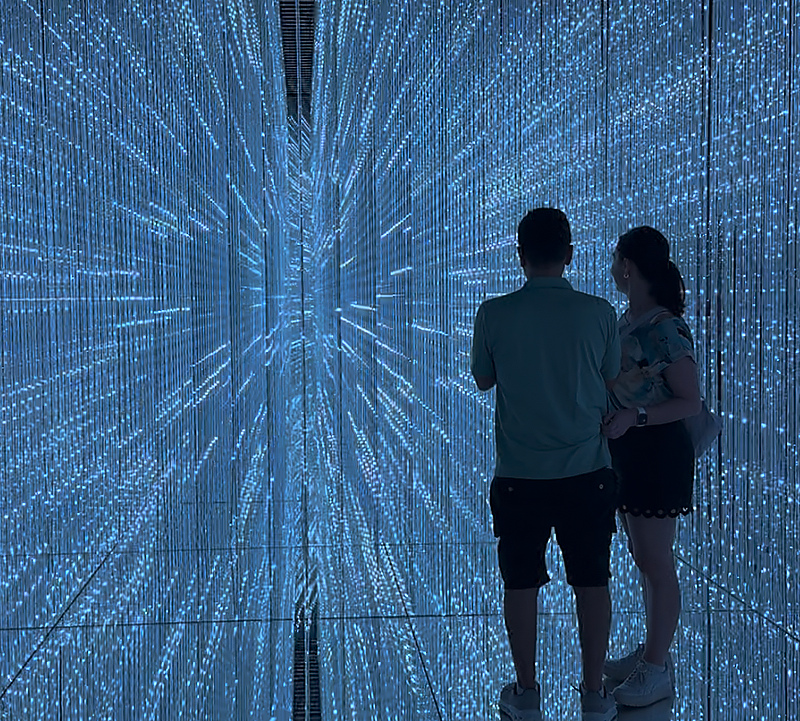
If you’ve seen a photo of someone standing inside a room made entirely of hanging lights, glittering in every colour at once, there’s a good chance it was taken here, if not at Tiffany’s The Landmark. Future World is the museum’s permanent teamLab exhibition, and it is unapologetically a place to feel small, or bedazzled, in the best way.
The other way to feel small, yet highly quantum-connected, is on a breakwater along East Coast beach just past midnight, peering at the sea of lights from the passing port ships until you can’t tell where land ends and sea begins, or where that sea of lights has merged into the galaxy of stars. It’s the place to sit and wonder whether you might be just another grain of sand underfoot, only biological. But that’s a different night. Today, the light room.
The room that undid me was Crystal Universe, a walk-in galaxy of suspended points of light that ripple and shift as you move through them. You might see from the video accompanying this blog that I wavered back and forth; that was me trying to decipher the size of the room. It’s surprisingly small, standing room for maybe fifteen people. If you could have it all to yourself, you’d stand in the middle and turn ever so slowly, watching the colours pour past like the weather. I had to step out almost too soon, undone by a vertigo that owed nothing to height.
Nearby, Sketch Aquarium lets you colour in your own fish on paper, scan it, and watch it swim away into a giant projected sea alongside everyone else’s creations. A genuine delight that had children and grown adults equally transfixed.
A gentle heads-up: the museum was refreshing parts of Future World over the summer, so a couple of rooms were closed when I visited. It didn’t dent the experience, but if there’s a specific installation you have your heart set on, it’s worth checking what’s open before you go. Come with a charged phone. If you’re like me, you’ll take more pictures than you mean to, and none of them will quite capture it.
Flesh and Bones: The Art of Anatomy
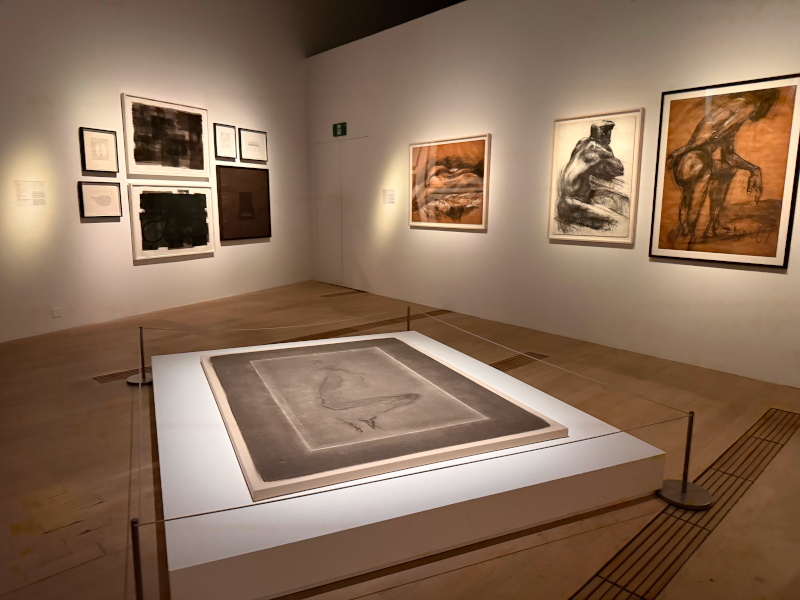
From the cosmic to the intensely personal. Flesh and Bones is the kind of exhibition I’d have walked straight past a few years ago and would now recommend to almost anyone. It’s a sprawling, thoughtful look at how human beings across centuries and cultures have tried to understand what’s happening under our own skin.
Spread across nine sections and around 160 works, it treats anatomy not as a dry medical subject but as a shared language between art and science. A Traditional Chinese Medicine gallery maps the body as a system of flows and balances, sitting in quiet conversation with Western anatomical drawings a few steps away. Contemporary artists turn their own bodies into the subject: Woong Soak Teng reframing her scoliosis X-rays through an Asian lens into something tender, and Mari Katayama’s luminous self-portraits gently dismantling any fixed idea of what a body “should” be.
Then there is the room of real human specimens, actual preserved anatomy presented with care rather than spectacle. I won’t pretend it’s for everyone, and it’s worth flagging if you’re travelling with children or you’re squeamish. But standing there, the abstract idea of “the body” settled into something larger: the cycle of biophysics, of life and death, decay and the endless handing-on of energy.
That room is what had people murmuring in the halls, comparing Flesh and Bones to BODY WORLDS, Dr. Gunther von Hagens’ touring exhibition, which came to the Singapore Science Centre in 2012 with plastinates from his Institute for Plastination in Heidelberg. That’s the famous one: real bodies preserved by plastination, a technique von Hagens invented that swaps the body’s fluids and fat for curable polymers, leaving muscle, skin, nerves and organs intact and posed mid-stride or sliced clean in cross-section.
I can see why some visitors rate it higher, though the two are doing different things. Body Worlds is visceral and singular: whole, dramatically posed bodies, the jolt of “that was an actual person” sustained across an entire show. Flesh and Bones is broader and more curatorial, folding its smaller cast of real specimens into art history, medicine and culture. If what moves you is standing before real preserved anatomy, Body Worlds gives you far more of it; if you like ideas woven around the science, Flesh and Bones wins. And there’s a quiet thread between them: some of the specimens here come from that same Institute for Plastination, so you’re seeing a small dose of the very same lineage.
Into the Ocean: Journey Beneath
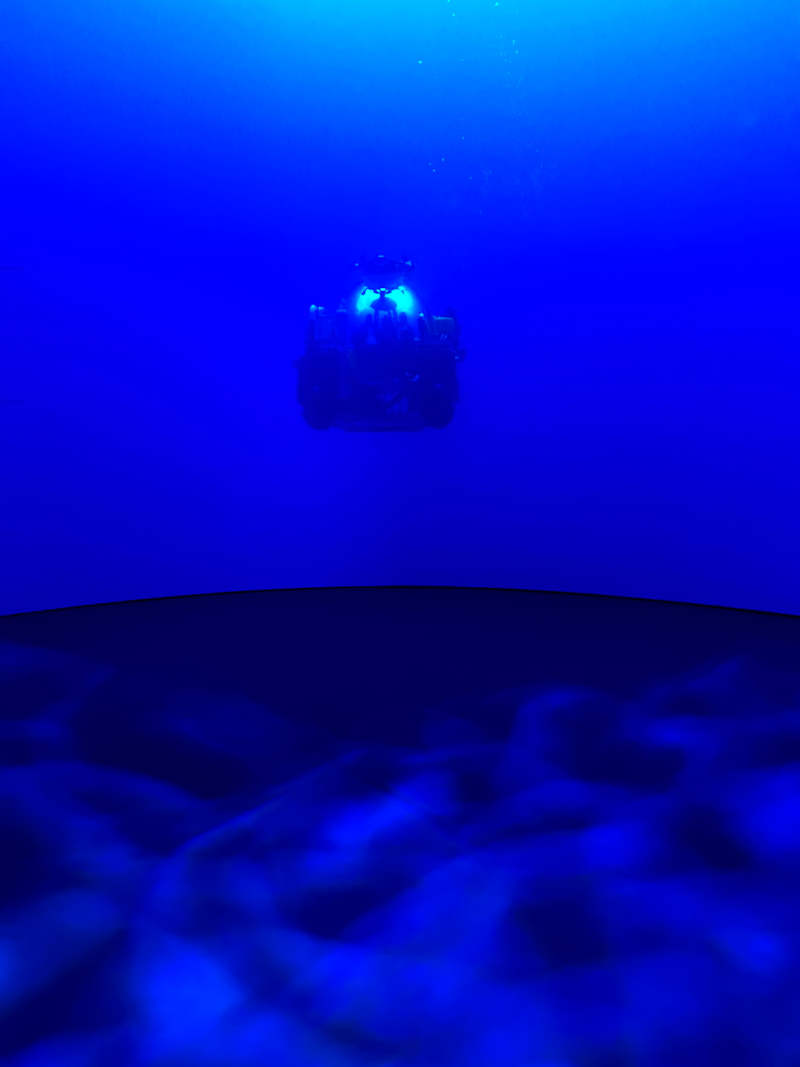
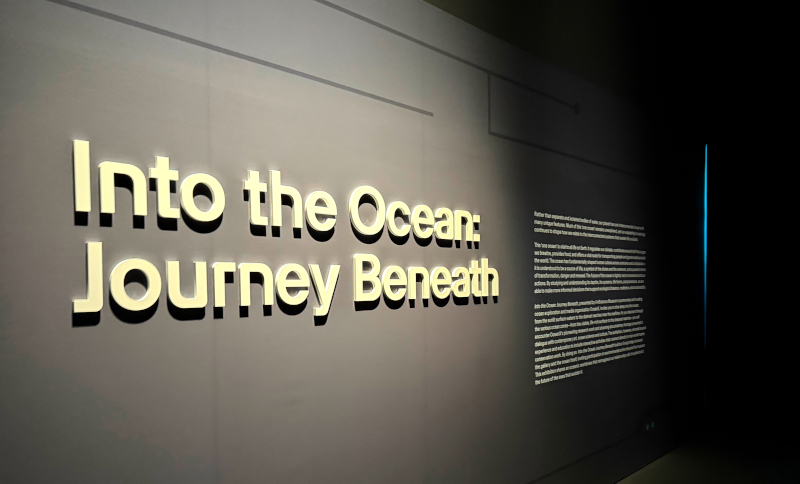
I saved the ocean for last, and I’m glad I did, because Into the Ocean: Journey Beneath is designed to be travelled through rather than looked at. A collaboration with the deep-sea research outfit OceanX, making its global premiere here, it’s built as a descent, six zones taking you from the sunlit surface all the way down to the crushing dark.
You start by walking through a ship’s passageway and “boarding” a submersible; the hatch seals, the light drains away, and you begin to sink. In the Photic Zone, near the surface, a flock of kinetic silver balloons drifts overhead like a school of fish while OceanX footage fills the walls with reef life. Deeper, in the Twilight Zone, an installation by Marshmallow Laser Feast uses real hydrophone recordings to imagine how a whale perceives the world around it, sound made almost visible.
By the Aphotic Zone, past a thousand metres, you’re in permanent darkness with the genuinely alien creatures that live there: vampire squid, the wonderfully named “headless chicken monster,” jellyfish that glow. What surprised me most was the smell. The artist behind it, Sissel Tolaas, is as much chemist as artist: she builds her “smellscapes” molecule by molecule, translating different ocean environments into scents that follow you through the zones, doing something no screen can, making the deep feel close. The journey resurfaces gently in a final zone about seagrass restoration, developed with WWF Singapore, where the takeaway shifts from wonder to responsibility. A lovely, quietly hopeful place to end. The literal place I ended, though, was the Miracle Coffee Café right by the museum entrance; I’ve found that a strong cup of coffee helps neutralise the deep ocean’s lingering scent, so unlike the clean, sun-warmed smell of a sandy beach that I love. This was its briny, primordial opposite.
A few honest notes for your own visit
Give yourself half a day at minimum, a full day if you want all three exhibitions without rushing, which I’d strongly recommend. The building sits right on Marina Bay next to the Sands, so it folds easily into a morning along the waterfront and a coffee afterward. Tickets are sold by exhibition, so decide in advance whether you’re doing one, two or the full set; a combined ticket is kinder to your wallet if you’re going all in.
More than anything, resist the urge to speed-run it. The whole museum turns on a single quiet idea, that art and science aren’t opposites but two ways of asking the same questions, and it only really lands if you let it. I came for a photo of a room full of lights. I left thinking about why a body-exhibition entrance looked like the nest-mouth of the Upside Down in Stranger Things, about the scent of the sea floor that set off my gag reflex, and about the strange privilege of being curious about what lay inside the petals of the lotus by the bay.
Flesh and Bones: The Art of Anatomy runs until 16 August 2026. Into the Ocean: Journey Beneath runs until 1 November 2026. Future World is permanent. Check the museum’s website for current opening hours, ticketing and any gallery closures before you go.