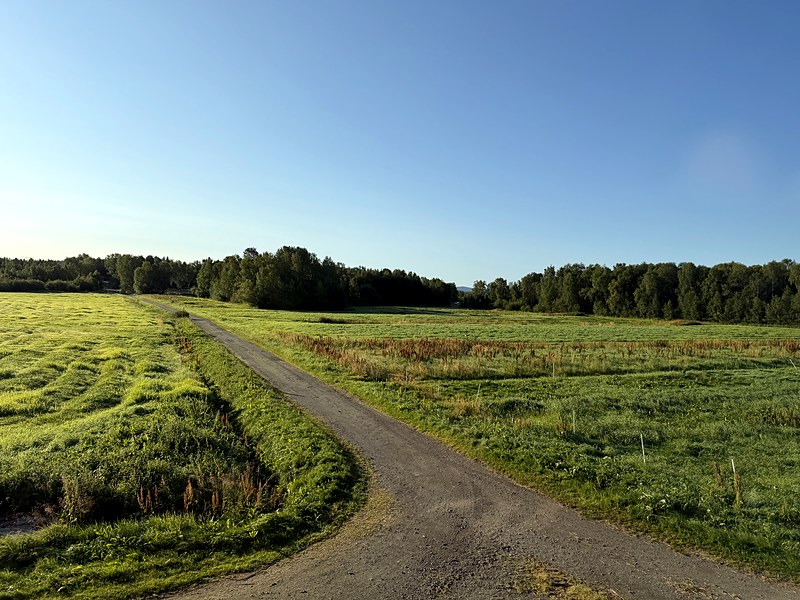
Svanhovd sits in the Pasvik valley in Sør-Varanger, a little under an hour’s drive south of Kirkenes and a few hundred metres from the Russian border. I was there for three days in August. Svanhovd as a place is magic, calm, introspective and resonant. Amongst all impressions, what I remember distinctly too is not the border, and not the pine forest that runs unbroken to the horizon in whichever direction you care to look. It is a yellow post-it with my name on it, written by the head of kitchen, stuck to a bowl of boiled eggs in a fridge.
The office is the visitor centre
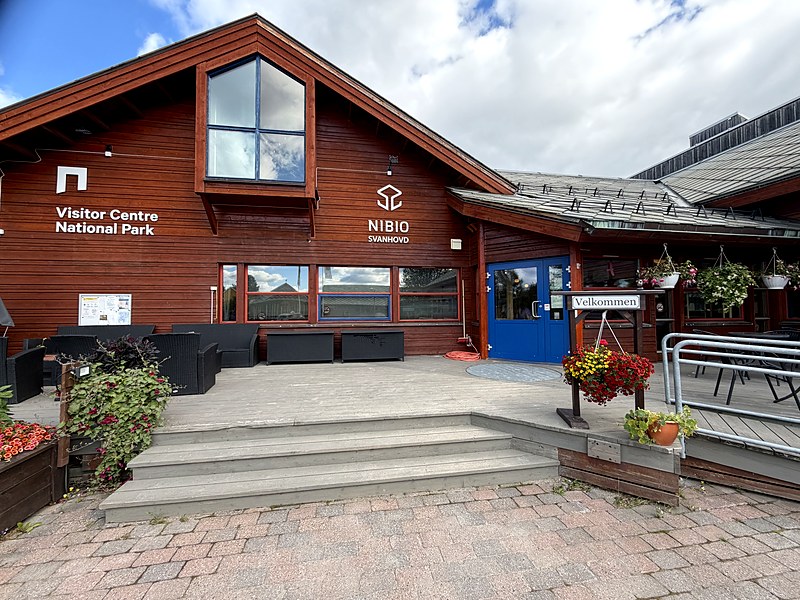
NIBIO Svanhovd is a research station, and its office building is also the visitor centre for Øvre Pasvik National Park. Before arriving, I had the impression that it was two institutions in different locations within the same wildlife park. It was not. When I arrived, I met in sight with one long red timber building where the researchers’ offices, the meeting rooms, the guest rooms and the public exhibition all open off the same corridor, and where the person behind the reception desk is as likely to be answering a question about a bear to visitors to Svanhovd, as about a sampling permit. Do you want to know more about the native to the Pacific Ocean Pink Salmon species that is currently abundant in Northern Norway? Your tour guide is likely the same lead research scientist of the field in Svanhovd. Last I heard, they were measuring different spawning points of the same river of the Pink Salmon, trying to figure out why it is that the same river bed would have different hatching conditions that allowed eggs to hatch almost six months apart. That insight piqued my interest no end as to localized water and environmental conditions.
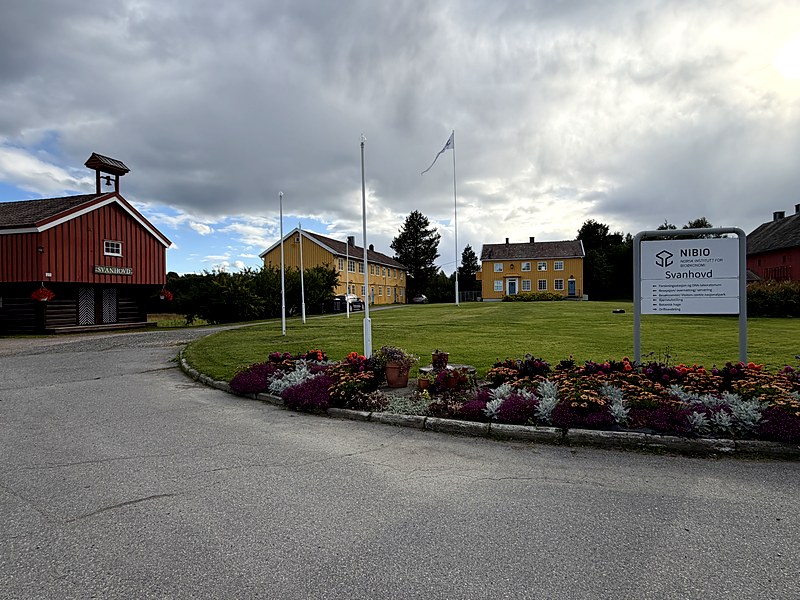
And a field station has a particular problem to solve. People arrive at odd hours, on the last flight or after a long drive. They stay for three days or three weeks. They keep hours set by daylight, by fieldwork, by whatever the sampling schedule demands, and almost never by the clock a hotel runs on. The usual hospitality answer is to give up and put out a vending machine. Svanhovd has gone the other way, and the same instinct runs through the public half of the building too.
A forest with the lights turned down
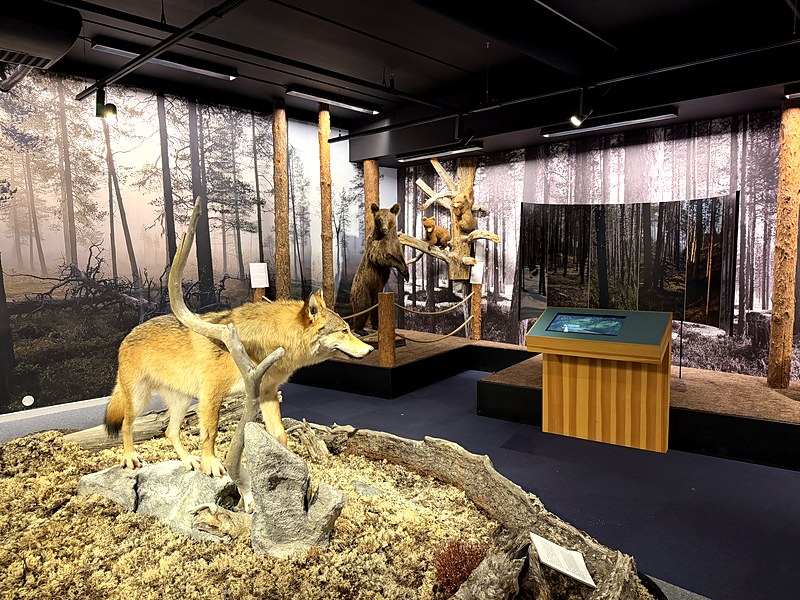
On the second floor of the Visitor Centre is the exhibition hall. The exhibition is dark, quiet and full of trees. Photographic pine forest runs floor to ceiling along every wall, real timber posts stand in front of it, and the animals are placed in it rather than lined up in cases: a wolf on a hummock of reindeer moss, a brown bear standing at a rope fence with two cubs up a tree behind her, a golden eagle, a wolverine, a bear lying full length beside the path. There is a den you can crawl into. The labels are in Norwegian and English throughout where most exhibits are interactive, encouraging learning through visuals, scent and touch.
A striking exhibit to me was the stack of twelve ordinary household buckets, lidded with a printed layer of blueberries. The panel beside them explains what they are for. A bear eats up to 90 litres of blueberries a day in autumn. That converts to about 20 kg of fat, and after the bear has burned 80 to 90 per cent of that energy, 3 to 5 kg remains as the layer it draws on through the winter. You can read that as a sentence and forget it. You cannot forget twelve buckets, and the fact that if eating, albeit plenty, blueberries keeps bears padded through winter hibernation, what that would do to humans who sleep, but not hibernate.
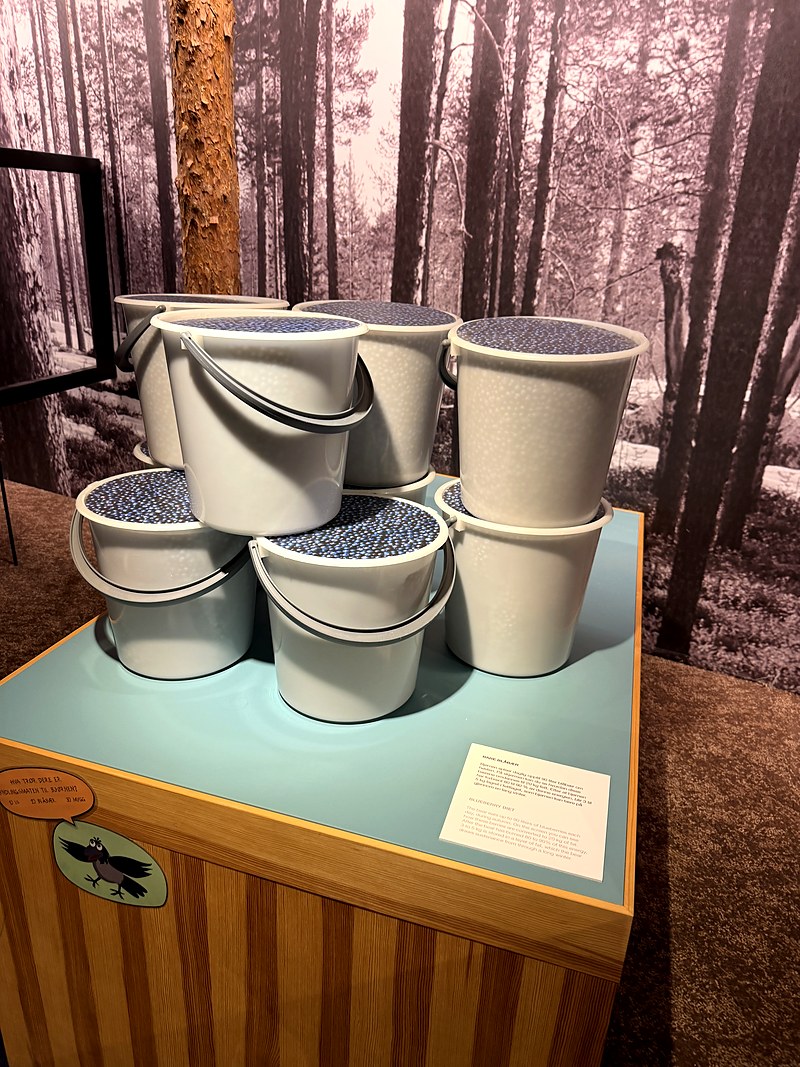
Part of what makes it exciting to explore the exhibition is that it was not designed for visitors in the abstract. It was made with the people who live here, school students among them, who worked with the station on what the displays should say and how they should say it. This illustration logic shows in small decisions: the teddy bears hung at child height next to the ceremonial bear-dance headdress, the touch table you kneel at rather than lean over, the question printed on the side of a plinth instead of on a wall panel. Co-creation is an easy word to put in a project proposal but harder to see in a finished room. Here, you see the intent of co-creation communicated through the design of the exhibit.
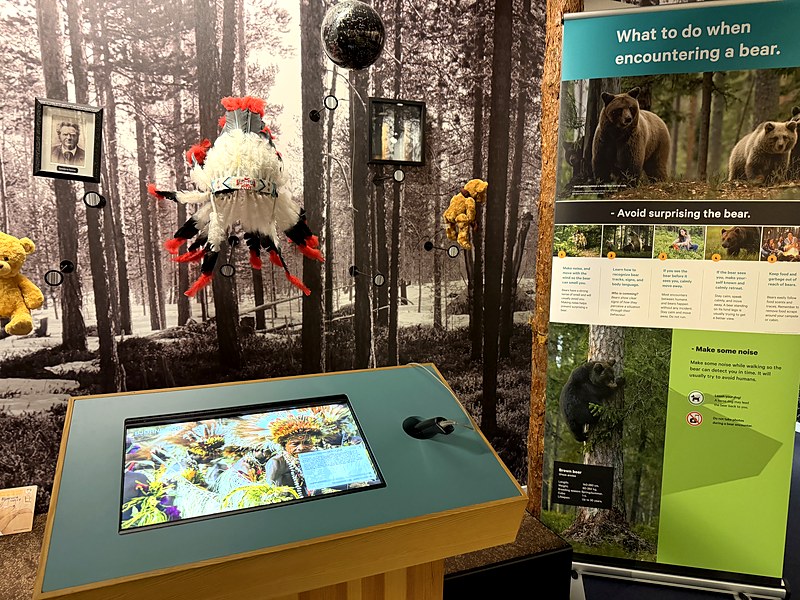
As you move along the exhibition, you’ll also find register inter-changes from storytelling to research. The wildlife work the station is known for is on display there, and among it are nest cameras that let you watch birds without going anywhere near them: uninterrupted for the birds, uninterrupted for the person watching. It is the cleanest possible statement of what the building is for.
Breakfast, Cheryl M. Cordeiro
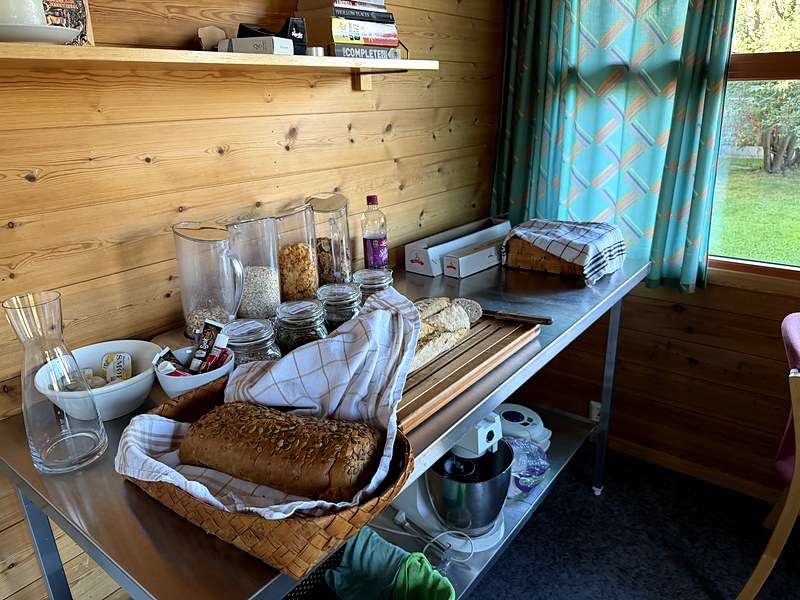
The guest kitchen is self-service, which is unremarkable. What is remarkable is what is waiting in the fridge. The kitchen had made up a breakfast for each guest in advance and labelled every part of it by name. Four boiled eggs in a covered bowl. A plate of ham, salami and cheese under film. Each with a bright yellow post-it and a name written in marker pen.
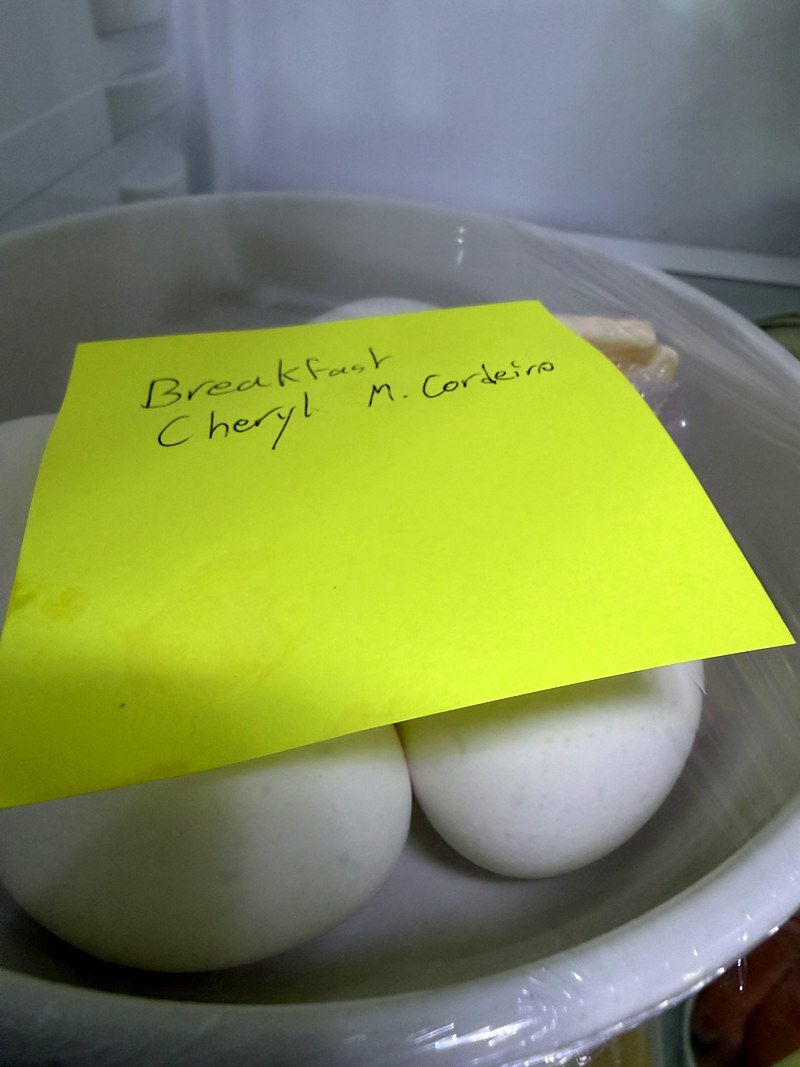
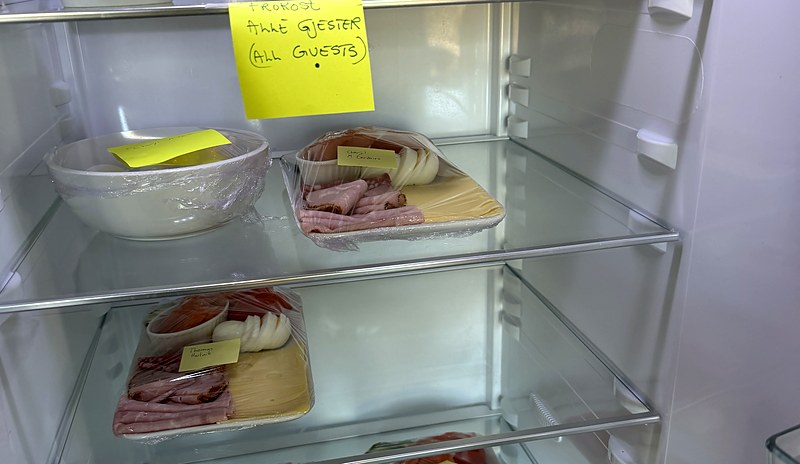
It is a tiny and soft hospitality detail. It is also, on reflection, the entire logic of the place. Nobody at Svanhovd was going to be standing at a breakfast buffet at seven in the morning if you are not together with a tour bus. A buffet says come and help yourself. A post-it with your name on it says you were expected. Both gestures are warm, the latter speaks more to the heart.
Wildflowers, in a glass, on the sill
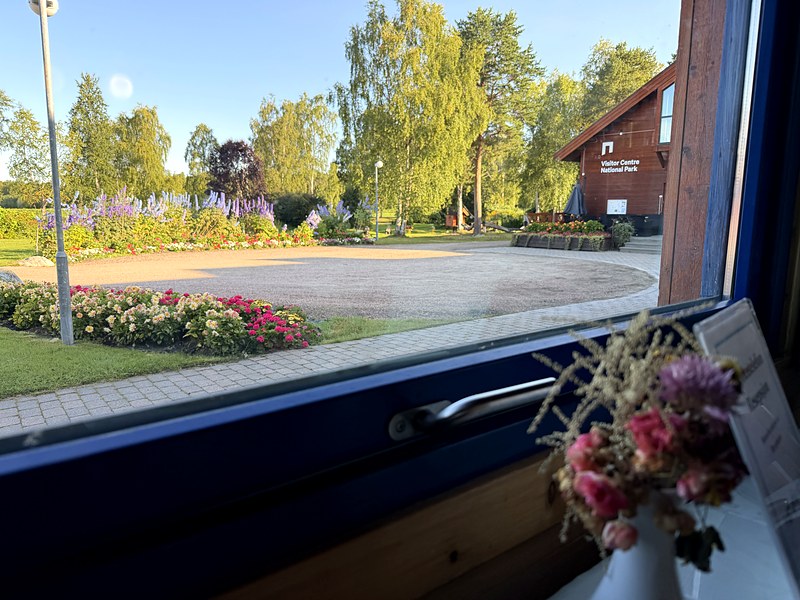
The guest rooms follow the same design instinct. Pine walls, a printed curtain, a window that opens onto the turning circle and the lupins. And on the sill, a small glass with wildflowers in it. Flowers at the table are displayed as the kind of handful you pick on the way in from the car, cut short so they stand up in whatever glass is nearest. Cozy and unperturbed.
96-Høyden, and the binoculars somebody left out
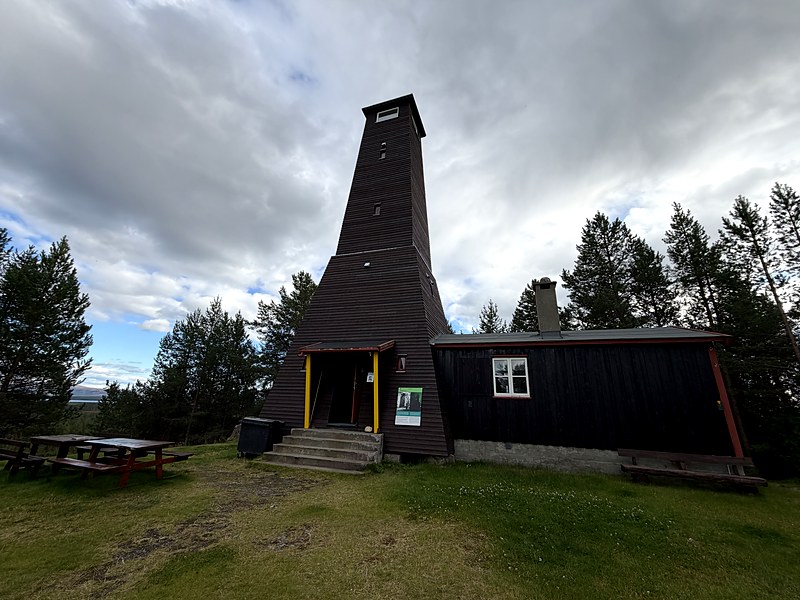
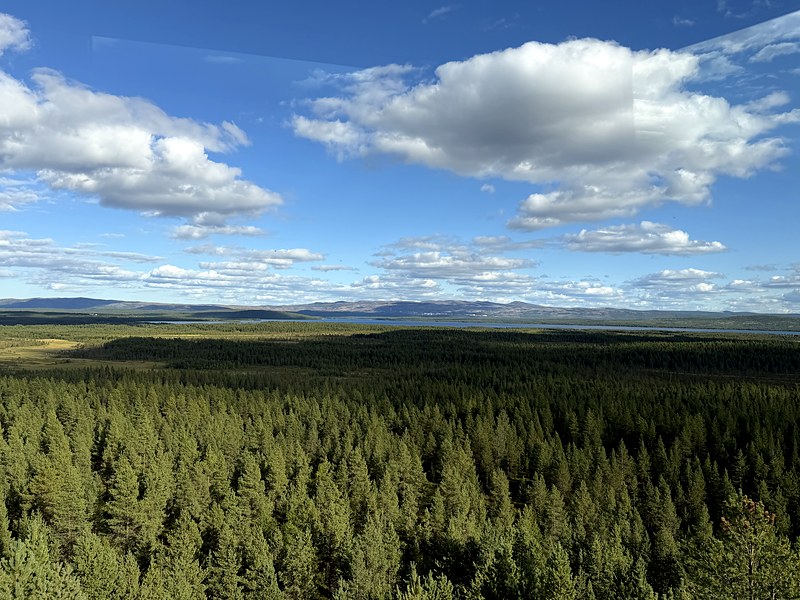
A short drive from the station, at the top of a rise in the pine forest, stands a dark wooden lookout tower called 96-Høyden. The panel at its foot tells a compressed twentieth-century history. The hill has been a viewpoint and a tourist attraction since the 1930s, when the country on the other side of the Pasvik river was Finland, not Russia. The first tower was burned in May 1944 during the German retreat. The present one was built by the Sør-Varanger Tourist Association in 1958 and 1959, was restored in 2003, and is now looked after from the research station. In its day it had a café at the top selling waffles, ice cream and coffee.
You climb, carefully, and at the top there are four windows and a bench. On the sill you’ll find a pair of binoculars, and beside them a laminated map of the valley still carrying the logo of Bioforsk, the institute that became part of NIBIO in 2015. These sit there doing their job, it seems a decade after the letterhead stopped existing. Stuck to the glass is a small warning triangle with a bear on it. It’s bearland out there.
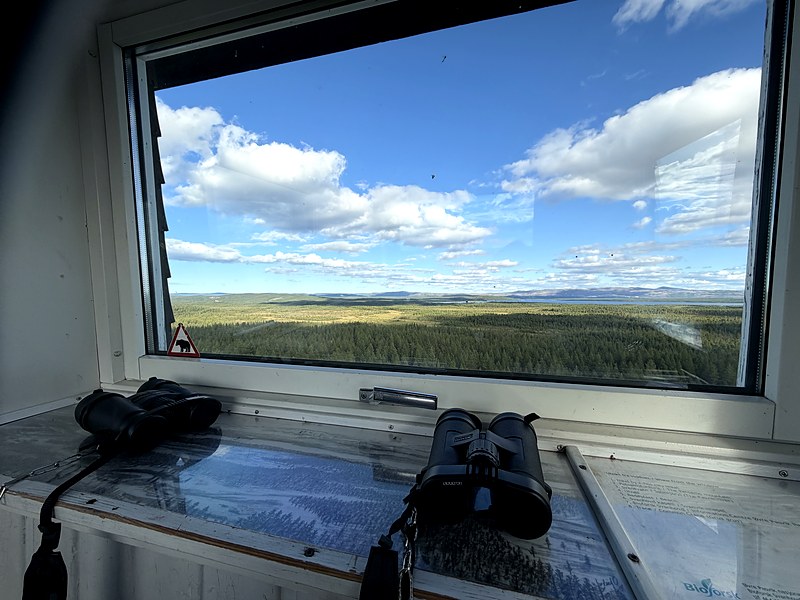
The view is likely one of the main reasons people have been coming up here for ninety years. Pine forest to the horizon, the river glinting through it, the low hills of the Russian side beyond, and to the west, Finland. Nothing about it is dramatic. It is simply very large, and very quiet, and it keeps going.
The working morning, and a memorable keyring
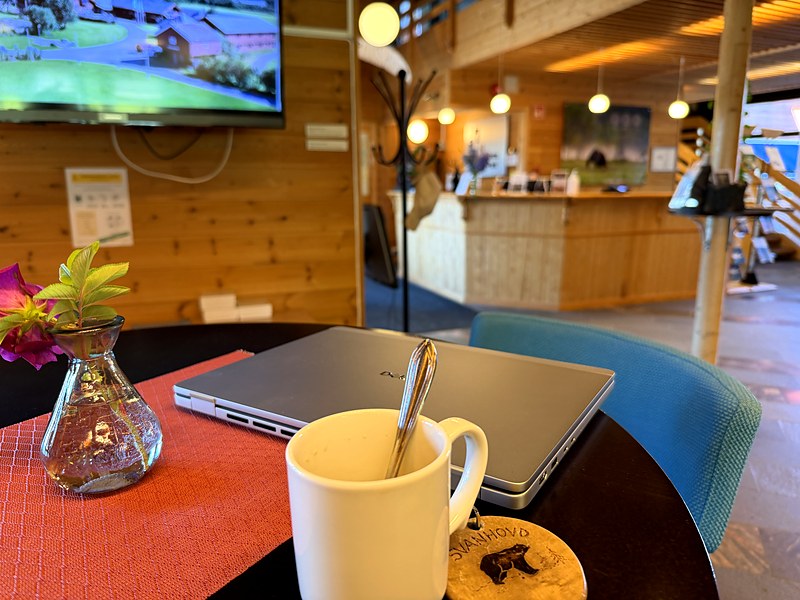
On the last morning before departing, I worked from the common room with a coffee. On the screen in the room was the Visitor Centre’s information bulletin, on the alkekonge, the little auk, and the question of where the birds come from and why that matters. On the table beside the laptop was a small wooden disc stamped with a bear and the word SVANHOVD. It’s a souvenir item that you can buy from the Gift Shop. Beautiful.
That is the thing about Svanhovd. Almost everything done and executed has a personal touch to it. Someone there designed a keyring. Someone labels the eggs. Someone picks the flowers, someone else keeps the watchtower so that the next person will find their visit fruitful, and a group of local school students had a say in how a wolf should be lit. None of this appears in a project deliverable. All of it is part of why the science gets done at all, three days at a time, by people who arrived late and are leaving early. It is a remarkable place to visit.
If you go
Fly to Kirkenes, Norway’s easternmost airport, from Oslo in about two hours. Svanhovd is at Svanvik, roughly 40 kilometres south along the Pasvik valley, and you will want a car. The visitor centre and its exhibition are open to the public, and 96-Høyden is open in the summer season. Bring binoculars if you have them, though as it turns out you may not need to. August gives you berries, long light and mosquitoes in roughly equal measure. Take repellent, and take the slow road back.