Cross-Cultural Dating in Singapore

Regardless of how westernized the Asian societies might appear today, dating someone from a different culture is dating more than just that one person, it’s an entirely different ball game.
Model: Carol Chin. Photo © by Kevin D. Cordeiro.

In this none too scientific post, my target audience is primarily western / Scandinavian males who are going to work or are working in Singapore. Since the scientific research I have been doing over the past few years has been mostly about Scandinavian top managers working in Asia, the point of view and perspective reflected will with few exceptions come from those with whom I’ve spoken. To this, I have added my own point of view as a woman and individual who has grown up in Singapore.

The dating scene in Singapore is lively
The pubs and restaurants and the social life in general encourages all kinds of human interaction in public places at all times. You are out meeting people more often than not. Most events from having breakfast at the local kopitiam (coffee-shop) to having coffee, lunch, dinner or anything in-between is a reason to meet. Technically speaking “dating” is not a problem while eventually everything around it might be.

Singapore, an easy place to blend into
A poignant surrounding factor that can cause problems when dating a girl from an Asian society is, culture. With that, comes a host of other related issues within the web of culture such as language, tradition, beliefs, religion and – food.

A spread of traditional Nonya food by the Straits Chinese. The customs and traditions of the people are as intricate and detailed as the wrappings and presentation of the food. Picture by King’s Hotel, Singapore (Khoo, 1998:130).

The culture in Singapore as well as in most of Asia is collectivistic in that sense that families are close, tightly bound, large – in some cases amounting to clans – and run by patriarchal values supported by a large, often gossipy bunch of aunties (and almost all elderly women in Singapore are called ‘aunty’) with opinions on everything and everybody.

Yet Singapore, as Asia goes, is an easier place than most other Asian societies to blend into due to its immigrant beginnings. More or less everybody came from somewhere else just a few generations ago however, well into the 20th century marriages were arranged between suitable parties, as most Asian cultures from the Indians to the Chinese, had arranged marriages as their tradition.

Today, the Singapore society at large bothers little about cross-cultural relations and interracial marriages, being currently more concerned with its falling birth-rates since 2004 (see Washington Post and the Singapore Window). Yet local to non-local relations still make interesting topics and a couple is still looked upon, observed and commented on – even by people who hardly know you.

A total stranger, when least you want to hear things
Anyone can step-up to you and start asking very personal questions, such as the woman who serves you coffee at the local kopitiam (coffee shop). One Swede observed that he from morning to morning got lower prices on his coffee obviously to soften him up for some reason. The price on his morning kopi-o (coffee, black) ran from the ang-moh (Hokkien word to mean ‘Caucasian’) price of more than $1 SGD, down to the local friends’ price of 40 cents. Flattered by the close fren price he was still unprepared for the attack. The conversation went like:

Coffee Lady: Sir, where you from?
Swede: Sweden (*one raised eyebrow*)
Coffee Lady: You how old?
Swede: Eh? Around fifty …
Coffee Lady: You got chirrun?
Swede: Eeeh?? Yes
Coffee Lady: How many?
Swede: Eeeeeh?? .. well, two …
Coffee Lady: You here for business or wat
Swede: Yes
Coffee Lady: You got your own business
Swede: Yes, in fact I do …
Coffee Lady: You earn how much?
Swede: Ehm, well yes …
Coffee Lady: You here for gerfren (girlfriend) ah?

After the questions had been satisfactorily answered and the coffee lady had figured out whether the Swede would be in the market for a meeting with any one granddaughter, niece, daughters of friends, third cousin’s neighbor’s friend’s daughter or some other eligible young woman that was felt was lagging behind in her family career of getting married and having children and needed a push in the right direction, the coffee price eventually went right back up again to the normal solid $ 0.80 SGD.

To the utter embarrassment of the younger generation, aunties can also have no qualms about inquiring about family relations and trying to set up meetings even in the very presence of the persons in question. They will happily talk right over your head as if you were not there. If you think of this as a most well meaning tradition based on the collective nature of the Singapore society you might get used to it and react on it in the proper way, which is to give evasive answers and a friendly smile. I think of it as having its roots in a kampong (village) tradition where everybody knew and cared about everything and everybody. So eventually you will be dating the whole family whether you like – or know – it, or not.

Sarong Party Girls (SPGs)
The collectivism leads to another aspect of cross-cultural dating, its social implications. Even if social gossip may not affect a foreigner with a possible time limit to his stay, there will be a social pressure from family, friends and perhaps even total strangers that might cause problems for the local woman.

The different Singaporean sub-cultures are different in this respect about social pressure and each will have varying degrees of open-mindedness towards foreigners in the family.

Some Swedes I have interviewed for my research were well aware of the concept of SPGs. This is a loose expression for a local woman who would consider dating a foreigner in much the same way as a western girl would i.e. with no immediate plans of getting married to him as soon as possible and not even asking to be paid to do so. In Singapore the SPG label implicates questionable moral or worse, as in bad business sense on the part of the woman, in a society where arranged marriages were the norm not more than a generation ago.

First, meet her parents. Then …
Picture by Lily Khoo, from The Straits Chinese (Khoo, 1998:94):

… meet her family, whom you will also be dating whether you know it or not. As an example, this old picture shows 4 generations of a family, gathered to celebrate the 80th birthday of the family patriarch. The scenes are surprisingly similar around for example Chinese New Year up until today. (Picture: Khoo 1998:39).

So while dating a local woman is not impossible, the foreign male should remember that he is out on uncharted territory. In Asia, you are not approaching only a person but whole a culture and a mindset that is as with all values are so set as to be invisible for those who share it while to the outsider will appear suddenly and out of nowhere as a glass wall at night.

Rather than to be discouraged, there is in fact plenty to gain in dating cross-culturally. There are new ideas and perspectives to discover and share. A key to smoother relations is to begin with understanding that it isn’t just a pretty face you are meeting.

References

  • Khoo, Joo Ee, 1998. The Straits Chinese. The Pepin Press: Amsterdam, Kuala Lumpur.
  • Midsummer’s Day 2008, in the Western Swedish archipelago

    Brrrrr! My first toe-dip of the season, and possibly my last.
    Missing the warm beaches at Singapore’s Sentosa Island. It would take quite a lottery win for me to go swimming in the sea this summer if the weather doesn’t let up! Outfit: A white crochet halter neck dress by BCBG Max Azria.

    This island in the western Swedish archipelago has its own tradition on Midsummer’s, where it was here that the Society of Arbores literally brought back forests and green life.

    For a number of decades every century, as long as anyone can remember, huge shoals of herring used to suddenly appear along the western Swedish coast. It is said that the sea was so full of herring that they could hardly find space to swim amongst themselves. During winter the fishermen could cut a hole in the ice and the herring would pour up onto the ice by themselves. While this might be of a slight exaggeration, the thing was that year after year the herring did indeed come back, by the millions. The most important periods were between 1747-1809, and then in 1877-1904. Continue reading “Midsummer’s Day 2008, in the Western Swedish archipelago”

    Dinner onboard the Swedish East Indiaman Götheborg III

    “You’ll be dinin’ with the captain.” – Pintel to Elizabeth in Pirates of the Caribbean: The Curse of the Black Pearl (2003) But unlike that scenario, I wasn’t disinclined to acquiesce to the Captain’s request.

    Just noticed in DN that Gotheborg III was now visiting Stockholm. The reconstructed 18th century Swedish sailing Ship Götheborg III has made its trip to Canton in China, and back. It was time now to hold a final Board of Directors meeting to close the books on the entire adventure of building the replica ship and its sail to China and back. On the agenda was also the ship’s future adventures. Her upcoming Baltic Sea Tour 2008 looks to be enough of a challenge to keep even the most hard core sailing enthusiasts happy, but even so, it sounds a breeze and a walk in the park compared to the high sea sailing to China.

    After the meeting, it was dinner onboard the East Indiaman Götheborg III. Continue reading “Dinner onboard the Swedish East Indiaman Götheborg III”

    Culinary couples: Singapore and Sweden

    dscf0682smallpomelo.jpg

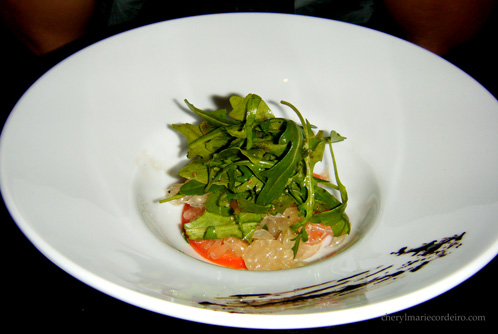
    Appetizer at Buko Nero, a blend of rucola and pomelo

    Buko Nero, Singapore

    Type in the words Buko Nero in a google search and you’ll find a long list of reviews, mostly enthusiastic and positive, on this small and personalized restaurant in Singapore, located along Tanjong Pagar Road.

    The restaurant with a seating capacity of not more than approximately 25 persons or 6 tables, looks literally as its name suggests, a ‘hole in the wall’. It’s an easy location to miss, being situated amongst the larger bridal boutiques and pubs that line the stretch of shophouses along Tanjong Pagar.

    What makes this place special is the fusion of Italian and Asian flavours that lace most dishes they serve. The fusion of flavours perhaps being a reflection of the background of the Italian husband and Singaporean wife team, Tracy and Oscar Pasinato. Continue reading “Culinary couples: Singapore and Sweden”
    Swedish Christmas Julbord Buffét 2007

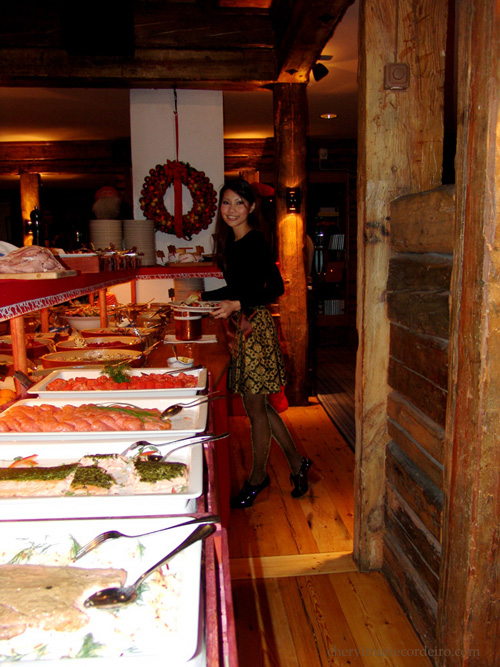
    dsc01711_cherylbuffetline.jpg

    The Christmas Julbord buffét at the Sjömagasinet restaurant, Göteborg, Sweden

    As the Christmas season rolls in, most restaurants in Sweden begin to offer a smörgåsbord of delights, known as the Julbord or the Christmas table. This line of buffet consists of traditional Swedish Christmas foods such as herring preserved in a variety of marinades, the marinades of which are as inventive as the chefs are themselves. Last year, we tried herring marinated in Coca-cola, by a chef called Mikael Sande, as one of the more unusual / eccentric dishes to the Christmas buffet.
    Continue reading “Swedish Christmas Julbord Buffét 2007”

    13th December: the festival of St. Lucia with Lussekatter

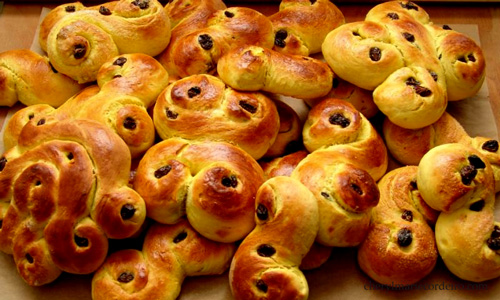
    lussekatter.jpg

    Our batch of Lussekatter or saffron bread this year, for Lucia

    I’ve asked some Swedish friends of mine, the significance of the festival of St. Lucia in Sweden. And few knew its actual significance, except that it arrived from Italy, back when Sweden was still Catholic (today it is more Lutheran), before 1700s.

    Traditionally, Lussekatter are baked without raisins in them, but as you can see from our batch above in the picture, we cheated some with adding raisins in the dough. The bread is extremely fragrant, with the smell of saffron. It does tend to dry out quickly, also because of the saffron but we hope that with the raisins in the dough, it’d stay moist just slightly longer. The saffron bread, as with most breads, tastes best fresh out of the oven. But if left for the next day, it helps with heating the bread in the oven or in the microwave oven before eating. Enjoy with a warm glass of milk!

    I found a fuller account of the festival of St. Lucia via a quick search on the internet. The information below is from the website of New Sweden

    Continue reading “13th December: the festival of St. Lucia with Lussekatter”

    Stockholm in winter and its Riddarhus

    nov2007-098.jpg

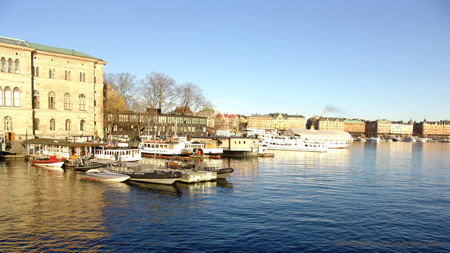
    Skyline in Stockholm on a Sunday, a grey winter’s day, November 2007

    We were in Stockholm over the weekend and there was variation in weather. A bright and clear blue Saturday and a grey wintry Sunday. Temperatures were around -1 deg C with rain and snow at the same time. Just the day before, the picture below of the same waterway was taken, with clear blue skies.

    nov2007-007.jpg

    A clear blue sky on a Saturday in Stockholm, November 2007

    Continue reading “Stockholm in winter and its Riddarhus”

    Annual Antiques Fair in Gothenburg

    dsc00897a.jpg

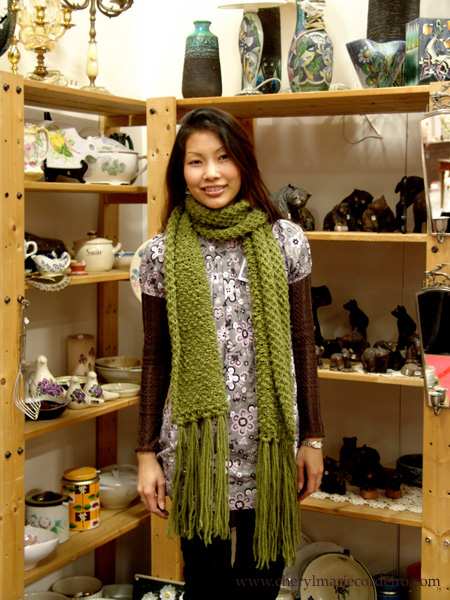
    Me in a curio stall at the Gothenburg Antiques Fair. On the shelves, the Swedish ceramic artist and studio Tilgman’s ceramics, much defining Swedish homes from the 1950s.

    Over the last week, Gothenburg held its annual antiques fair at Svenska Mässan, a large convention hall for just such events. We thought we’d spend some time there browsing the ins and outs of antiques. Continue reading “Annual Antiques Fair in Gothenburg”