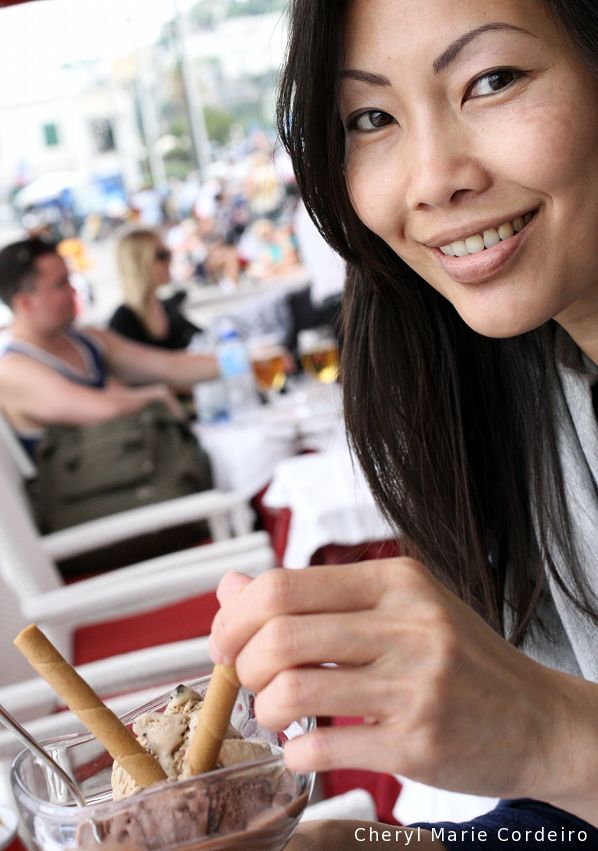
Bar Corallo, Capri, Italy 2016.
Text & Photo © JE Nilsson, CM Cordeiro, Sweden 2016
Just a few days prior to landing in southern Italy, I walked out of a little gelateria, Gelato Da Luca, in Gothenburg, Sweden. Newly located in the heart of Gothenburg’s older marketing district where cobbled streets were set out in grid format, I had in hand from this gelateria, a paper cup of two generous scoops of Italian made ice-cream. Caffè and cioccolato fondente (extra dark chocolate).
I could always do gelato, the sequence being caffè and cioccolato fondente, then cioccolato fondente and pistacchio. If there was no caffè or pistacchio, then it will be nocciola. I was only too happy to know that the owner, who had come to Sweden from Rome, had decided to open a second outlet in Gothenburg, both outlets being equidistant to the Business School at the University of Gothenburg.
Already then, I had decided that when in southern Italy, or Italy at all, I would gelato.
And that, I did. That, and cioccolata calda, a smooth, thick hot chocolate concoction that rivals Granja M. Viader xocolata calenta in Barcelona, Spain.
Swapping different types of cobbled stones from Gothenburg to southern Italy, I was beyond delighted to once again, gelato. Continue reading “Gelato, gelato, gelato”