Chanterelle forest gold

fresh

The golden Chanterelle – meaty, fragrant and perfect in a dollop of butter and cream!
Photo © J E Nilsson and C M Cordeiro-Nilsson for CMC 2010

There is in particular one mushroom in Sweden that is most popular with amateur mushroom pickers – the Chanterelle mushroom. This yellow-gold treat of a fungus is freely available in the forests during autumn for anyone who bothers to go out to find it, and for the less adventurous of us, it’s available at the wet markets and in the grocery stores for purchase.

Autumn is the season of Chanterelles, where you can find them lying hidden and camouflaged among the piles of fallen autumn leaves. Deliciously edible, this mushroom is easily recognizable by its rich yellow colour, its flat umbrella top, long ribbed stem and characteristic fragrance of something in-between flowers and forest after rain.
Continue reading “Chanterelle forest gold”
Apple Sauce – from garden to table

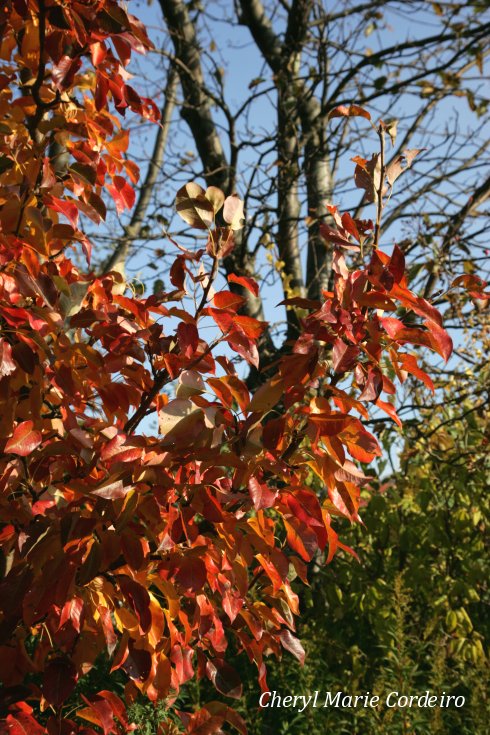
Colours of autumn, Sweden.

Colours of autumn in Sweden.
Photo © J E Nilsson and C M Cordeiro-Nilsson for CMC 2010

In a highly automated and globalized world where standards of living seem to be continuously improving, where ‘organic’, ‘eco-friendly’ and ‘sustainable’ are key words in today’s food industry, it’s surprising how far we’ve come from the basics of growing and cooking the food that we consume.

It’s much easier for example to head off to the grocery store and from there, choose from an array of produce to buy and bring home, than to harvest the very same produce from the garden or soil – lack of space, lack of time, too much city life, too many working hours etc. – there are countless valid reasons for our choices and why it is so difficult to have our food straight from the garden, sans chemical pesticides, sans chemical food preserving processes and packaging.

The Picking

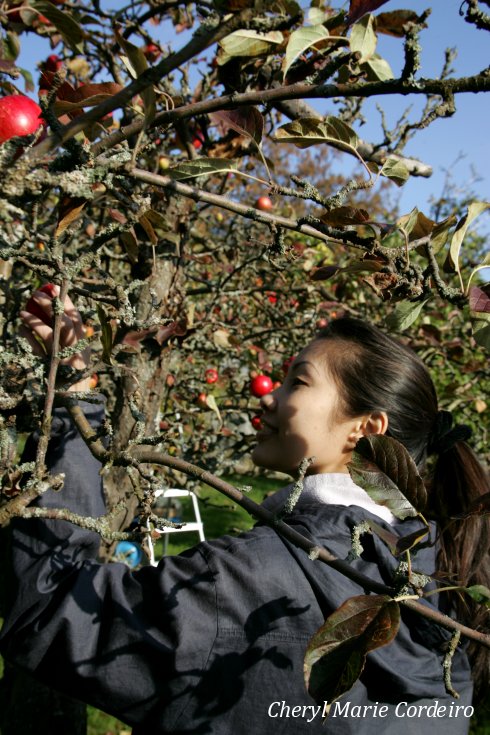
But with not so much the concept of sustainability in mind, rather as time spent on something I enjoy doing in my spare time come autumn, and what makes the little happy moments in life, I went apple picking today in a charming and rustic Swedish garden with the aim of making some homemade apple sauce!

Rustic garden, Sweden.

Swedish rustic charm.

This garden comes as part of an old house built during the 1800s along the Swedish west coast. Tucked away in a little niche corner of a narrow, winding road, it was almost surreal, driving up the path, under apple boughs to reach the center of the garden that was washed golden with low rays of the morning Nordic sun in autumn.

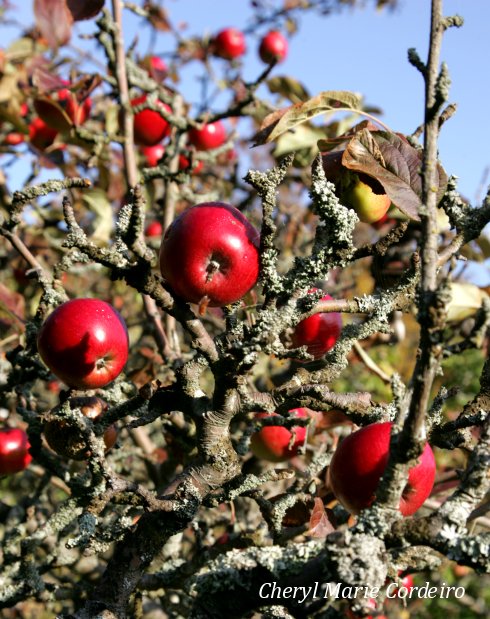
Red Ingrid Marie Swedish apples

Red Ingrid Marie Swedish apples.

Cheryl Marie Cordeiro, apple picking, autumn, Sweden 2010.

The garden had basically two varieties of Swedish apples, the small red and attractive Ingrid Marie and the green golden Signe Tillisch. These varieties are in contrast to a previous autumn picking of Gravensteins.

The Ingrid Marie is named after the daughter of the teacher, K. Madsen, who once found the tree on Westfyn island in Denmark. A small tree grew, probably from the seedlings of a Cox’s Orange, among the raspberry plants. This incident happened around 1910 and today, the Ingrid Marie is one of the most widely grown varieties in Sweden. The trees though hardy, still prefer warmer locations to grow and the apples are instantly recognizable when encountered due to its distinct size, shape and a colour of quite bright red. Some Swedes would deem this one of the best varieties of Swedish apples to be eaten as a dessert apple, baked in cakes, pies and stews. These apples keep till January.
Continue reading “Apple Sauce – from garden to table”

Mocha Cake with Kahlúa

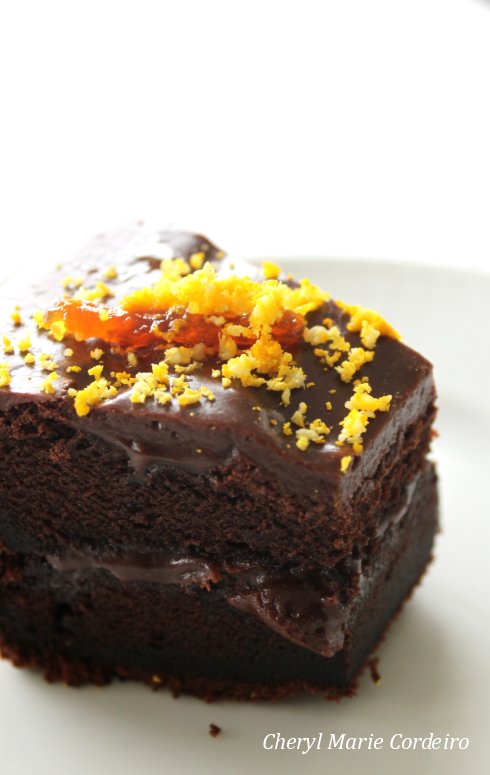
Cheryl Marie Cordeiro, mocha cake with orange zest and marmalade orange peel.

Dark chocolate frosted Mocha cake with Kahlua, served with grated orange zest and orange peel marmalade.
Photo © J E Nilsson and C M Cordeiro-Nilsson for CMC 2010

While I grew up with my family baking the traditional Eurasian Sugee Cake and the dark, rich, brandy soaked Christmas Fruit Cake, it’s chocolate cake and the myriad variations of it that I really took for granted when living in Singapore.

In Singapore, I had the opportunity and convenience to hop from café to café, whether it was Seah Street Deli and Ah Teng’s Bakery at Raffles Hotel or the corner confectionary shop under an HDB void deck, in search of the ‘mood of the moment’ chocolate cake, one that fitted my fancy.

These days, living in Sweden, there’s unfortunately no such convenience of flitting from shop to shop for that perfect chocolate cake, where I find I have to bake one that sometimes related little to the mood of the moment but was just rather decadent to have at home for the next few days.

This weekend, a rather rich Mocha Cake with a dash of Kahlúa in the recipe, frosted over with a dark chocolate butter cream frosting.

Continue reading “Mocha Cake with Kahlúa”

Sneak preview of the Gothenburg table, before the Luxembourg Culinary World Cup 2010

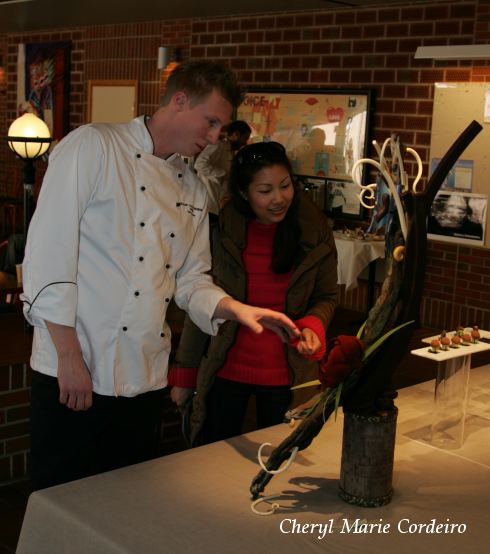
Team leader and Cheryl, the finer details of Chocolate sculpture and desserts

Gothenburg Culinary Team Leader, Johan, pointing out the finer details of the chocolate sculpture and desserts.
Photo © J E Nilsson and C M Cordeiro-Nilsson for CMC 2010

In preparation of the upcoming Culinary World Cup held in Luxembourg in November 2010, the Gothenburg Culinary Team was doing a ‘dry run’ of the competition dishes. As luck would have it I was invited to take a sneak preview of their efforts if I could make it to Uddevalla, just north of Gothenburg, Sweden and of course I’d love to.

Meeting with the whole team.

Meeting with the whole team.

At this point in time, the team is already in the later stages in their preparation for the international competition and had set up a complete display table that resembled the one to be judged in Luxembourg. This entire exhibition was a team exercise that acted as a show-case plus brainstorm session for the team members, showing in detail how things right now would look like when put together.

Even if their food display already looked thoroughly breathtaking and appetizing, the fact was that all dishes would still be improved upon before the final design that would go into the competition was set.

This event was rather nondescript for their efforts, a showing mainly for themselves, friends and colleagues. It was hysterical to observe that all visitors to the display table were frustrated that entire set meals, plus breads and desserts were strictly for display only. There would be no touching, no tasting, no licking, no eating of any crumb on the table as the crumbs would most likely be part of the dish display and most carefully placed where they should be.
Continue reading “Sneak preview of the Gothenburg table, before the Luxembourg Culinary World Cup 2010”

Fika and the Swedish Management style

Cinnamon roll served with milk; kaanelbullar med mjölk

The Cinnamon Roll – a Swedish fika staple.
Photo © J E Nilsson and C M Cordeiro-Nilsson for CMC 2010

Before Sweden, I only ever heard of the British inherited concept of afternoon Tea in Singapore from my grandparents, more specifically, my paternal grandmother. She often served Royal Danish butter cookies, of which I favoured the ones with raisins and those that came coated with granulated sugar on top. Light sponge cakes were sometimes served at these sessions, and accompanying these cookies and cakes was tea, with lots of milk.

Melting butter for cinnamon rolls or kanelbullar.

Melting the butter – the first step in making Cinnamon Rolls.

The Swedish fika, which translates to ‘coffee break’ was an activity whose local ritualistic implications dawned on me only gradually, beginning actually with my attendance at late evening seminars at the university whilst pursuing my doctorate degree.
Continue reading “Fika and the Swedish Management style”

An evening with the Gothenburg Culinary Team West of Sweden

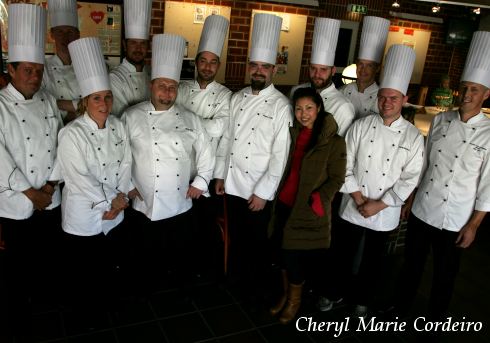
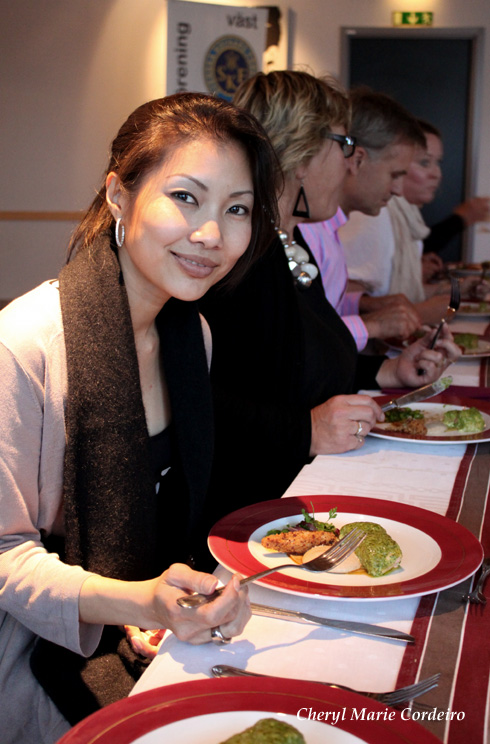
Cheryl Marie Cordeiro at Trubaduren with the Gothenburg Culinary Team, 2010.

At dinner, presented by the Gothenburg Culinary Team at the restaurant Trubaduren, Gothenburg, Sweden.
Photo © J E Nilsson and C M Cordeiro-Nilsson for CMC 2010

With the upcoming Culinary World Cup in November 2010, in Luxembourg in mind the Gothenburg Culinary Team invited friends and members of two culinary interest groups to a three course dinner event during this last weekend.

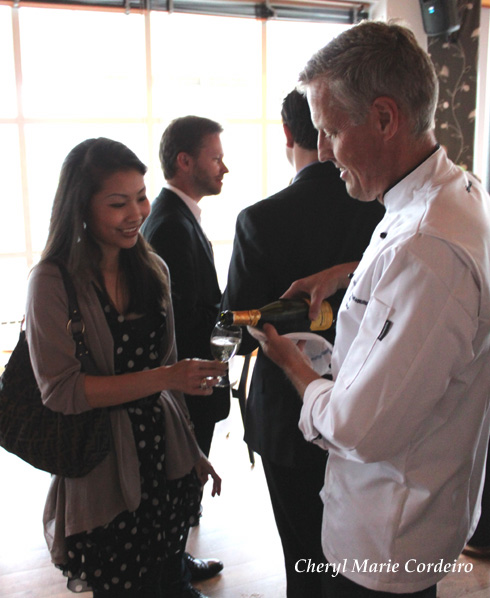
Mingle session, Cheryl Marie Cordeiro and Manager of the Gothenburg Culinary Team, Ronny Spetz.

Ronny Spetz, Team Manager, welcoming guests to the mingle session.

The atmosphere at the mingle session was as usual relaxed and friendly. The autumn air outside with its light drizzle coupled with a chilled white Champagne prior to dinner heightened our expectations of an upcoming display of culinary artistry.

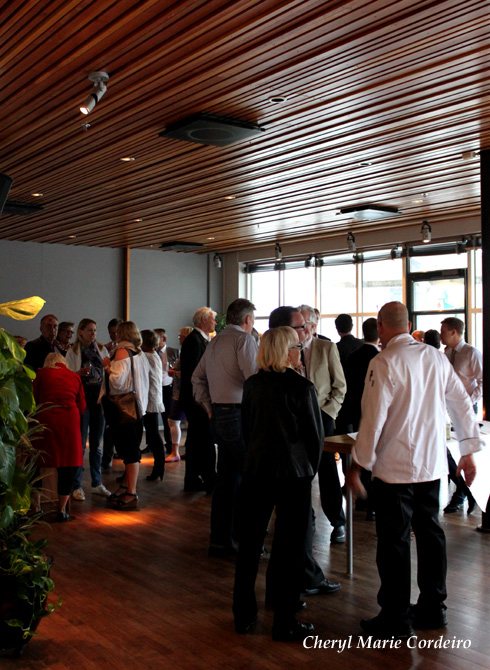
Members of the Swedish Chefs Association, and members of the Western Swedish Academy of Gastronomy, Trubaduren, Gothenburg.

Mingle session before dinner

It was during the mingle session prior to dinner that guests got to meet two managers of the Gothenburg Culinary Team, various board members of their own mother organization that is the Western Swedish Chefs Association (SKF), and members and friends of the Western Swedish Academy of Gastronomy (VGAK). The discussions bounced lightheartedly and passionately between topics about what’s current and coming in the culinary world, and not the least what was to be served for dinner that evening.
Continue reading “An evening with the Gothenburg Culinary Team West of Sweden”

A caseinic tour of Europe

hard_italian

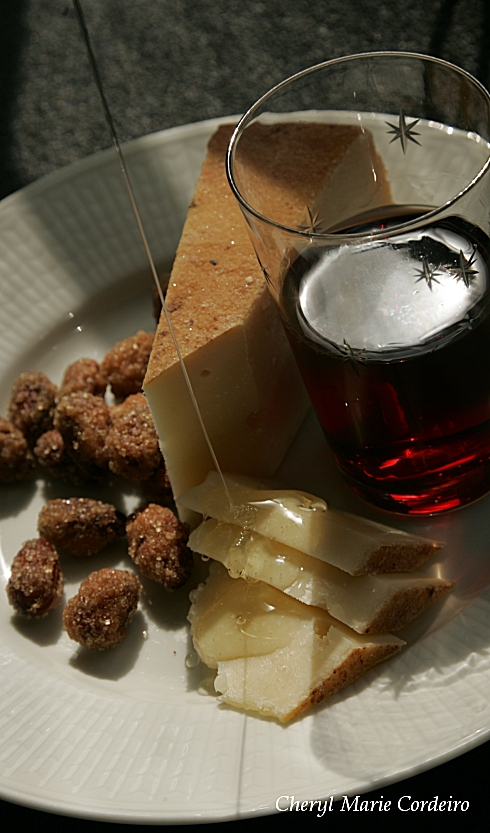
An Italian hard cheese that is washed in Recioto, perfect with Acacia honey or caramelized almonds. Tried just for fun with a drop of Port.
Photo © J E Nilsson and C M Cordeiro-Nilsson for CMC 2010

It was only in Sweden that I came to realize that cheese and coffee were more synonymous with dessert than a slice of chocolate cake or a scoop of ice-cream.

On the plate above is an Italian hard cheese whose rind was washed in a sweet Italian red wine Recioto della Valpolicella that is a variation to the rich dry red wine of Amarone della Valpolicella.

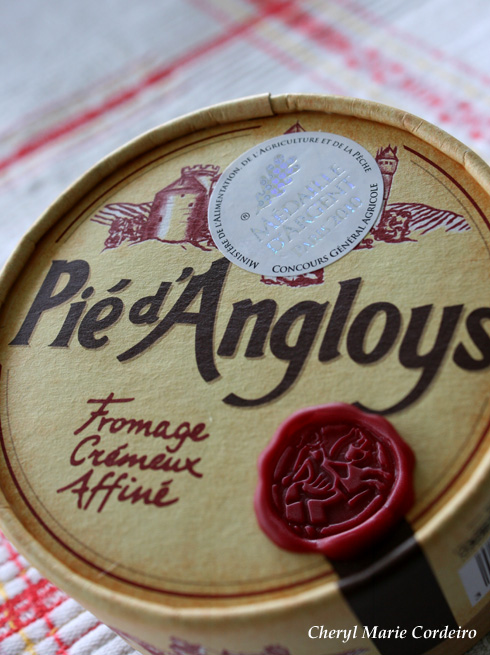
Pié d' Angloys French rind washed soft cheese.

Pié d’ Angloys, an award winning French rind washed soft cheese that has a rich, creamy texture that is a variation to the taste of brie.

Rind washed cheeses are typically bathed in a wash of salted water, wine, brandy or local spirits, according to the traditions of each region. Besides adding a distinct and local flavour to the cheese the washing process helps to soften the rind and encourage this to become a part of the cheese rather than just a skin.

The washing also helps cheeses to retain its moisture. Through this process, the cheese becomes soft, thick and brilliant and sometimes showing some coloring from the wine. Washed rind cheeses typically present a paradox, in that their colorful, often pungent rinds contrast with beautifully smooth and creamy interior.
Continue reading “A caseinic tour of Europe”

Cherry Chocolate ice-cream with Cherry Heering

Cherry Chocolate ice-cream with Cherry Heering

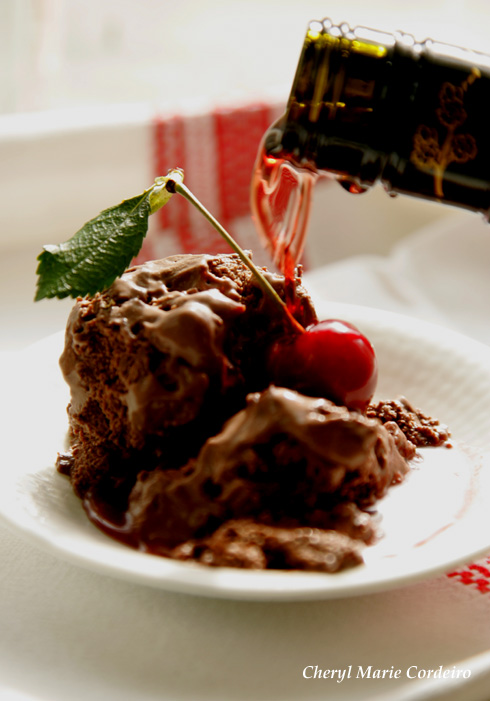
Cherry Heering flavoured Cherry Chocolate ice-cream served with a few drops of Kirsberry and one of our own dark cherries, straight form the tree.
Photo © J E Nilsson for CMC 2010

Having concentrated all my efforts on work during the week, come weekend, all I like to do is indulge in some food fantasies turned reality. This weekend’s indulgence project is homemade cherry chocolate ice-cream with skuggmoreller cherries from our garden and a touch of Cherry Heering.

Cherry Heering is a Danish cherry liqueur invented in the late 1700s or the early 1800s. What I appreciate about this liqueur is its rich flavour of black cherries that pours out in a luscious deep red colour into the glass. It isn’t overly sweet, so you can go ahead and add sugar to the ice-cream base when making this cherry chocolate ice-cream at home.

When last we visited one of the Swedish System Bolaget wine and spirits liquor stores it appeared as if Cherry Heering, which also happens to be a key ingredient in the Singapore Sling, will no longer be available in Sweden!

I believe for ice-cream purposes, most anything with a good dark cherry flavour could be used as a substitute. There is another Danish classic desert wine called Kirsberry that I’m pouring a few drops of, over the ice cream in the picture above, that might do just fine. In that case however I am more concerned about our Singapore Slings.
Continue reading “Cherry Chocolate ice-cream with Cherry Heering”

The pleasures of autumn harvest

cherry_branch

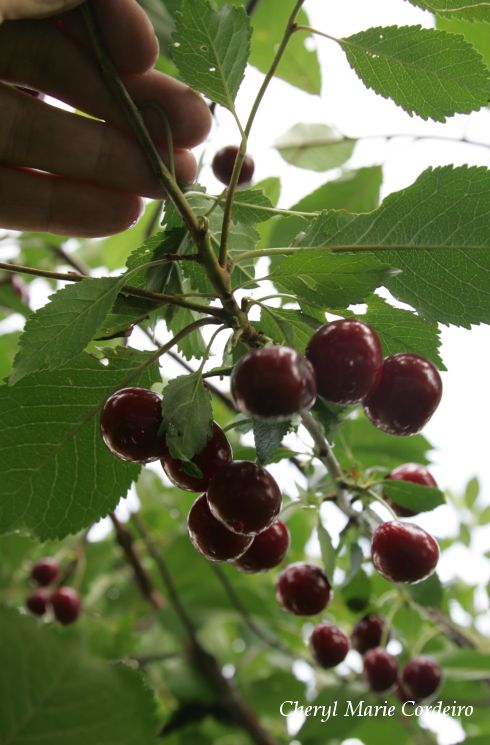
English Morello Cherries is a fantastic cherry for pie making and cooking. This dark red to nearly black fruit can be used when making liqueurs and brandies, and its tart, dark juice lends itself to be made into a most fantastic syrup!
Photo: JE Nilsson for CMC © 2010

Admittedly early August can’t really be called autumn, not even in Sweden, in northern Europe. But still, at this time of the year it is harvest time and all nice things come in such abundances it is difficult to find ways of taking care of it all.

A cherry tree in the garden offered an easy enough target for our efforts and for the first time in many years, the berries made it all the way into the kitchen without being all eaten by the pickers straight from the branches.

Making home made syrup was highest on the wishing list about these strong flavored cherries whose name is skuggmoreller in Swedish.
Continue reading “The pleasures of autumn harvest”

Variations of the Coconut Candy

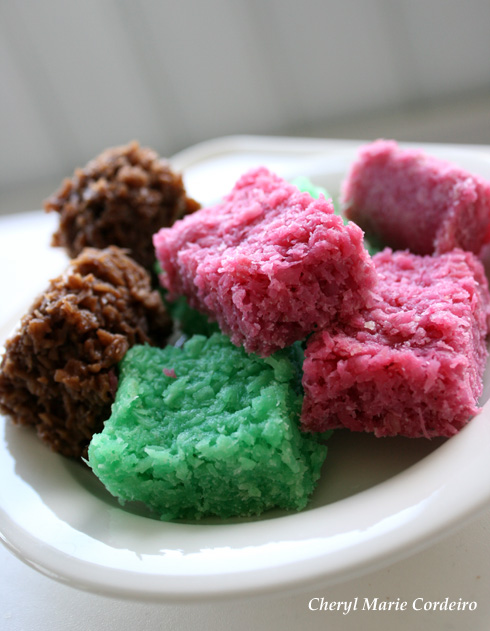
Coconut candy variation, mocha, pandan and traditional.

Variations of coconut candy – mocha, pandan and a traditional version in pink.
Photo © J E Nilsson and C M Cordeiro-Nilsson for CMC 2010

While difficult to find in Singapore these days, homemade Coconut Candy packed and sold at small grocery shops cost about 10 Singapore cents for about 4-6 pieces during the 1970s.

This candy is popular in Asia and Southeast-Asia, and can be found in variations from India, Vietnam, Malaysia and Singapore. The ones that I tended to purchase when young and subsequently became my favourite, came mostly from Indian convenience stores.
Continue reading “Variations of the Coconut Candy”