Born in the vibrant city of Singapore with a unique Eurasian blend of Portuguese and Chinese heritage, my journey has taken me from the bustling streets of Singapore to the serene and open landscapes of Sweden. My educational pursuits in Singapore culminated at tertiary level with two separate Master degrees, after which I embarked on a new adventure in 2002, moving to Sweden. In Sweden, I pursued with deep interest, the knowledge field of applied linguistics, particularly corpus linguistics research methods, earning a doctoral degree from one of northern Europe’s largest universities, the University of Gothenburg. I currently work as Project Manager, focusing on EU and international projects, at RISE Research Institutes of Sweden, at the Division of Bioeconomy and Health, Department of Agriculture and Food. My office is located in Mölndal municipality. Mölndal, known also as the Valley of Mills, is located about ten minutes by bus ride from the city center of Gothenburg to the south. If you’re ever traveling south from Gothenburg to Malmö, whether by train or car, you will likely come by Mölndal municipality. In these pages at cmariec.com, you’ll find my lifestyle musings on culinary and travel adventures from Singapore to Sweden, and from when I lived and worked the Arctic City of Tromsø (2018 to mid-2022). SINGAPORE | SWEDEN | NORTHERN NORWAY Life in Singapore Pursued all academic interests in Singapore, of which the post-graduate years were founded in two separate disciplines. In 2000, graduated with two separate Masters Degrees: (i) Master of Science in Information Studies at the Nanyang Technological University (NTU) in Singapore (ii) Master of Arts in the English Language at the National University of Singapore (NUS). In 1999, represented the Republic of Singapore at the Miss Universe Pageant in Trinidad and Tobago. With this came a variety of film, educational TV, media, and ambassadorial work for the Singapore Tourism Board. Life in Sweden In 2002, moved from Singapore to Sweden in order to pursue a PhD in Gothenburg, where a number of international corporate head offices were located that all had a substantial business presence in Singapore and also Asia in general. In 2009, graduated with a PhD in applied critical linguistics from the faculty of humanities at the University of Gothenburg, with a cross-disciplinary thesis entitled, Swedish management in Singapore: a discourse analysis study, looking particularly into the concepts of assimilation, integration and hierarchy, at top management levels of Swedish-Asian corporations in Singapore. 2013, as research fellow at the Centre for International Business Studies (CIBS), School of Business, Economics and Law at the University of Gothenburg, Sweden, researching the future implications of increasing Asian-Swedish cooperation within the field of international business. The project is entitled Gothenburg in Asia, Asia in Gothenburg, funded by the Anna Ahrenberg Foundation. The project is aligned with the 400 years anniversary of the city of Gothenburg in 2021, and falls under the broad category of Kunskap Göteborg 2021 initiated by city representatives of Gothenburg, Göteborg & Co, University of Gothenburg and Chalmers University of Technology. 2015, was granted the Flexit post-doctoral scholarship by Bank of Sweden Tercentennary Foundation (Riksbankens Jubileumsfond, RJ) for a three year project together with the Swedish-Swiss multinational enterprise ABB. From 2015-17, the research will take place at ABB Corporate Research Sweden HQ in Västerås, and at CIBS during 2017-18. The research focus of the project is how new technologies are perceived and accepted by users and customers, using linguistic methods of data analysis. More information can be found at RJ’s website, at Riksbankens Jubileumsfond (RJ) Felxit 2015. Life in Northern Norway (2018-2022) 2018, late summer. I acquired new work as Market Scientist at Nofima. Having moved to the county of Troms in August, I’m currently enjoying myself, exploring the island city of Tromsø. From the 1900s, this city became known as Paris of the North due to how the people of Tromsø were exceptionally stylish and sophisticated in contrast to the fishing village preconception that many might have of a city located in the Arctic Circle. In my years in Sweden, I have known Sweden to be called the land of the midnight sun. During the long summer mights, it was beautiful to sit and watch the sun’s languid pendulation between east and west, touching the horizon out at sea before going up again. Northern Norway takes this languid pendulation of the sun to the extreme. It is not only known as the land of the midnight sun, but it is also the land of polar nights and the northern lights. This is my new adventure. And in these lifestyle blog pages, you’ll find my personal thoughts, insights and musings. Cheryl Marie Cordeiro | PhD MSc MA ACADEMIC REFLECTIONS | CV LIFESTYLE BLOG

My new cooking buddy, the Grill Pan

Fillet of beef on an iron grill pan. At Cheryl Marie Cordeiro

To fry a few pieces of Couer de Filet of Beef to perfection,
sprinkle with sea salt, let the beef rest in room temperature for about 40 minutes. Fry one side until brown in a grill pan, flip once and fry until done. Let the beef rest for 5-10 minutes before serving.

Photo © J E Nilsson for CMC

There are a million good reasons to go out and buy a new pot or pan to the kitchen if you really try to come up with some. But what it eventually boils down to (excuse the pun) is that it makes cooking more fun. Sometimes, having a new utensil might even improve the results of your efforts.

On my part, I often find myself buying something that looks nice, figuring out later what to use it for. Eventually I will show you a very nice Italian milk-foamer and yes, a perfectly useless high-tech electric juicer that currently eats up half a cabinet of shelf space and we can’t throw it away because it was too expensive to buy in the first place. And is there anyone who actually even knows what a raquelette is?

However, our latest toy was not improvised but something that we decided to make do with, after we decided that a separate grill section to the stove would not be practical after all. After some shopping around we simply chose the heaviest cast iron grill pan we could find, which turned out to be an 11″ AGA with black enamel coating inside and out. The very look of the pan sitting snug in the shop was enough to get us all excited about it, conjuring up dishes to cook in it!

AGA cast iron grill pan. At Cheryl Marie Cordeiro

Our new toy, 2.9 kgs worth of cast iron AGA grill pan makes frying in barbeque style a breeze. The heat source does not matter as long as it can make the grill pan sizzling hot.

Continue reading “My new cooking buddy, the Grill Pan”

Pasta and Chicken liver sauté, just XO good …

Pasta with chicken liver and a dash of XO

Tagliatelle pasta served with chicken liver sauté, bacon, shallots and fresh parsley.
Photo © J E Nilsson for CMC

In my view chicken liver is a true delicatess. Its mild flavour and fine texture is likely to appeal even to those who normally are not that enthusiastic about liver. It is inexpensive and the health aspect is overwhelmingly positive.

It is also tender and usually quite fail-proof to cook, since it is done in about 3-5 minutes in a dollop of butter.

However, liver can’t be combined with everything and if you want to go beyond butter things can get ugly pretty fast.

Some additional ingredients might not go well with liver, others might be too dominating and kill off the liver flavour, making the dish pointless. Too much onion or meat cubes for example, are mortal enemies to the sophisticated aroma of tender chicken liver.

In general, safe combinations are cream and herbal spices, but here we have tried to be a bit more adventurous than that.

This dish is one of my favourites since besides containing a few surprises that makes it interesting, it shows off chicken liver from its very best side.

To serve four persons, we will need about 500 grams of pasta to this dish.

Ingredients
400 grams of chicken liver
3-4 medium sized shallots
150 grams of bacon
1 tbs dried marjory
1 handful of fresh parsley
1 cup of cream
White pepper
Salt

Preparations
Tidy up and cut each chicken liver in three parts.
Slice and dice the bacon into small pieces.
Chop the shallots
Grind the dried marjory finely in a mortar
Continue reading “Pasta and Chicken liver sauté, just XO good …”

Maggie of London dress with those Roberto Cavalli heels!

Roberto Cavalli patent leather stiletto heels

Roberto Cavalli black patent leather stilettos.
Photo © J E Nilsson for CMC

At 11 cm high, these skinny stilettos are not the most comfortable to move about in, calling for quite some stamina and that masochist in you to wear them. But some things can’t be rationalized in life and I love them just because they are so impractical, so elegant and sleek in lines – like a drawing on paper that was once fantasy, now turned into reality.

These shoes have a personality all of their own, their tiger striped insoles echoing the sharp look it carries on the outside.

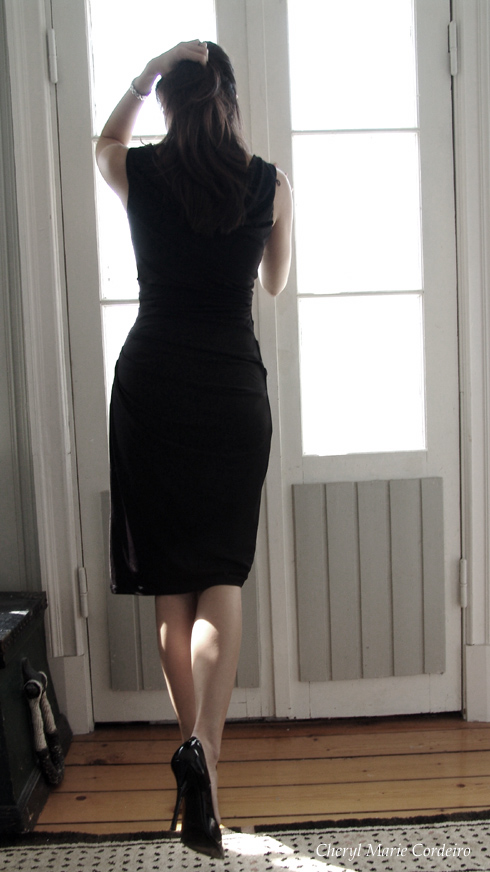
Black dress from Maggie of London, at Cheryl Marie Cordeiro

Draped black dress from Maggie of London. Vintage silvertone jewellery from Lisner and Trifari. Thick banded white gold ring from Cartier.

Depending on your imagination and what you pair with the shoes, it can take you from classy to trashy in an instant!

Cheryl Marie Cordeiro in Roberto Cavalli stiletto heels, shoes

I’m not over my fever on draped clothing, so I thought I’d pair the shoes with this black Maggie of London jersey dress that is draped around the collar and ruched down the sides.

Roberto Cavalli black patent stilettos, shoes. At Cheryl Marie Cordeiro

But then again, you could also forget about walking in these. Some shoes are made to look just gorgeous, strewn carelessly on the bedroom floor, and this pair of Roberto Cavalli stilettos is one of them.

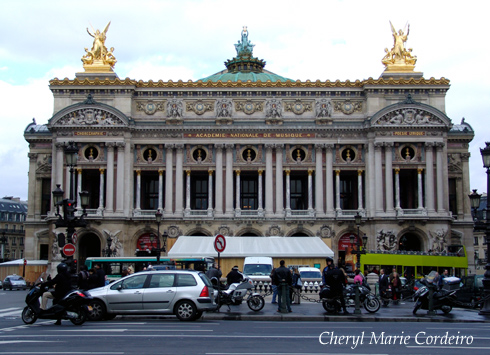
The Opéra Garnier in Paris, France

Opera Garnier in Paris, France

The Paris Opera house, also known as Opéra de Paris or Opéra Garnier.
Photo © JE Nilsson, CM Cordeiro-Nilsson 2009

If there is something that makes the French French, I think that is a certain spirit – they just don’t do boring. It’s in the fashion, women in skyscraper skinny stilettos in the Metro in the morning, their passion for life and, in their architecture. Take this Opera Garnier for example. It’s an orgy in marble and gilt, exudes a love of life and is a grand example of how to do things with panache!

Just consider that they started to plan this building with its surrealistic grandiosity less than half a century after the French Revolution in 1793, when Louis XVI and Marie Antoinette had been publicly beheaded because of their opulent life style.

The realization that there actually is an indoor lake under the basement make you half and half believe that there probably is a phantom somewhere in there too. All sets the stage in our minds for a great theatre play. You just need to step inside and the grand entrance staircase will within the blink of an eyelid place you in the spotlight, on stage in the theatre of life, cast as the star.

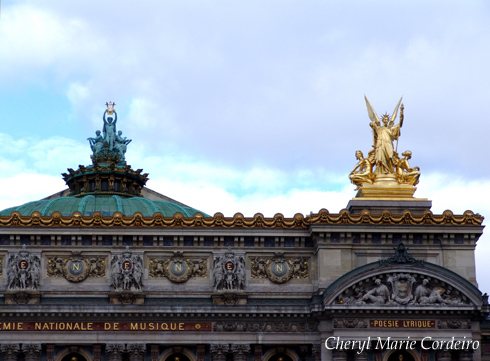
Top of the Opera Garnier or Palais Garnier in Paris, France

On the roof are sculptures of Apollo, Poetry and Music by Aimé Millet and Liberty by Charles Gumery.

The grandeur strikes you already when you set your eyes on it from across Place de l’Opéra. Above the golden frilly edge of the roof are statues of Apollo, ‘Poetry’ and ‘Music’. This is the ideal setting and one can think that Gaston Leroux’s Le Fantôme de l’Opéra (1909) must have basically written itself. This was also the story that was later adapted by Andrew Lloyd Webber to the musical, The Phantom of the Opera in 1986 and became one of Broadway’s longest running musicals of all time. I can’t even write the title without hearing the theme in my mind. Continue reading “The Opéra Garnier in Paris, France”

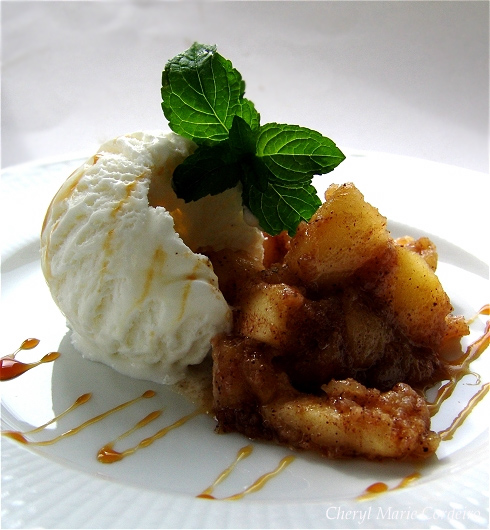
Vanilla ice-cream served with apple cinnamon sauté

Vanilla gelato, ice-cream served with apple cinnamon marmalade

A summery dessert.
Photo © J E Nilsson for CMC, 2009

One scoop of vanilla ice-cream. On the side, one small apple sliced, diced and fried in butter, sugar, cinnamon and some breadcrumbs. Decorate with a quick drizzle of dark syrup and top off with a small leaf of mint.

By the end of last autumn, we received a large number of apples from a neighbour who had a spacious garden filled with old apple trees. Apple will store and keep over the winter if kept reasonably cold and dry. Now however, we were down to our last batch and looking at our very last three apples and we decided to celebrate them by transforming them into this wonderfully sweet and temperature cooling dessert. And besides, if looking for something Italian inspired, what could be more Italian than gelato?

A buffé with a French-Italian theme

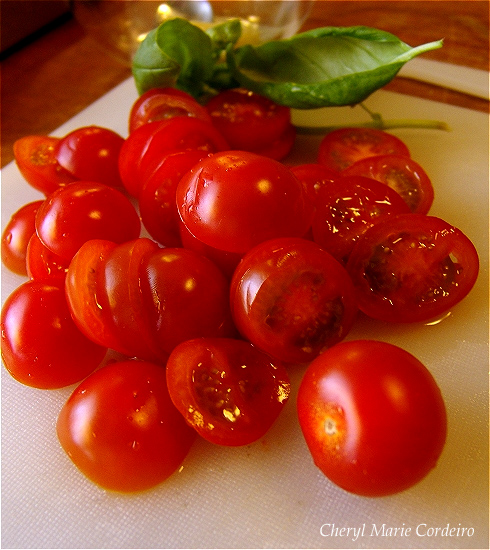
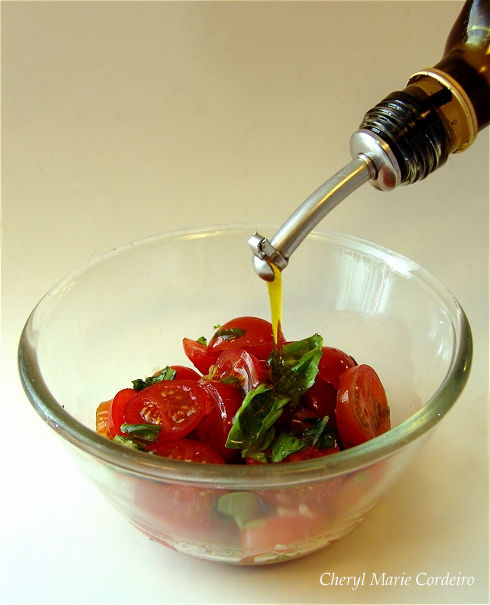
Caprice salad with buffalo milk mozzarella, olive oil and fresh basil

Caprice salad: sun ripened tomatoes with buffalo milk mozzarella cheese
with olive oil, basil, black pepper and salt.

Photo © J E Nilsson for CMC, 2009

Planning is a big part of the fun to holding events. It’s a phase that allows you to be creative and fantasize the possibilities!

In a few weeks, we’ll be holding a dinner for friends with a French-Italian theme and thought that a lunch buffé the same day should set the stage for the evening event.

So far, we have thought that the following should be in there somehow:
Continue reading “A buffé with a French-Italian theme”

Rösti – turning raw potatoes into culinarian delight

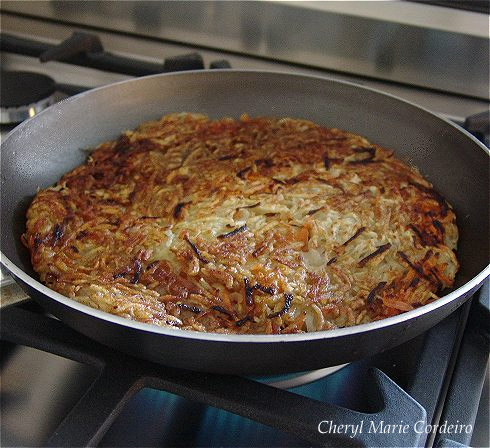
Rösti, made with potatoes and carrots

Grate fresh potatoes, flavour with garlic and some Italian hard cheese. Fry until golden brown in a generous dollop of butter. Done.
Photo © J E Nilsson for CMC, 2009

There are many aspects to cooking, from nutrition to economy, to pure lucullian joy. Ideally I try to combine all these aspects into all that we cook.

One of my favourite things to do is to take something simple and then add a twist and a half to it and see it turn into something both delicious and fun, that might even render you a couple of surprised looks at the table.

Today we needed something to go with a mouthwatering piece of beef, and we didn’t want to spend all day preparing the side dishes, so we settled for the Swiss staple, rösti. In a world of rice, pasta and french fries, rösti is not always ranked amongst our first choices.

Rösti was originally a breakfast dish, slightly related to the fried carrot cake or chai tao kway we find in Singapore, but one that will fit splendidly together with anything that benefits from the company of potatoes.

If you haven’t got around to actually cook this before, the basic recipe is pretty uncomplicated: grate fresh potatoes. Add salt and pepper. Fry. Done.

Depending on what kind of dinner you are planning rösti lends itself to many variations. Adding different ingredients such as garlic, onions, carrots, bacon or apple can turn this dish into something different, interesting and one that is to your liking.

Chef’s secret; How to flip it so that the nicely browned side is upwards when served? Use two pans. When the rösti is half done, put a similar sized pan on top of the first one as a lid, flip the whole thing, and fry until done in the second pan. Or just fry one side and do the flipp onto the serving dish.

Smaklig måltid!

Nautical stripes, a Swedish summer staple

Black and white striped top, black Warehouse shorts, Marc Jacobs shoes

By the road, in nautical, flower picking.
Photo © J E Nilsson for CMC, 2009

It took me years to get over my loathe of horizontally striped clothes, to see them as chic or flattering after a girl friend of mine once commented that a red and white striped t-shirt I had on was the ugliest thing she had ever seen.

It also didn’t help that one of the first fashion basics that we learnt in school was that horizontally striped clothes tended to make the body look broader whilst vertically striped clothes tended to lengthen the body.

But growing up, you often learn to unlearn what others have taught you or have impressed upon you through the years and these days, I don’t think much about wearing horizontal stripes. In fact, I think these nautically themed tops such as this black and white striped jumper from H&M can look effortlessly chic, depending on what you choose to pair it with.

While nautical is all the season’s rage on the runways, from Armani in Italy to Ralph Lauren in the USA in both menswear and womenswear, Gothenburg is a harbour city where come summer, you’ll find more nautically inspired clothing out on the streets as staples than perhaps any other city in Sweden. People often throw over a sailing jacket in white and navy or red and navy, that is both wind and waterproof when out shopping, paired with leather docksides. Here, nautically themed clothes are an indication of the city’s history and heritage as a trading port and home to the Swedish East Indiaman company and its ships some 300 years ago.

While April doesn’t usually allow for bare legs and shorts, Sweden seems to be experiencing a warm spell these weeks, with summer weather already here in the middle of spring. The clear blue skies are encouraging people to take to their hobby in sailing, and a view of several sailing boats at sea is exactly what you’ll find in the archipelago region along the Swedish west coast.

In this post, I’ll be sharing a few different looks with a single striped top.

For something casual (shown in the first picture above), I’ve paired the striped top with a pair of black woollen shorts from Warehouse and a pair of patent leather ballerina shoes from Marc Jacobs, as an alternative to docksides.

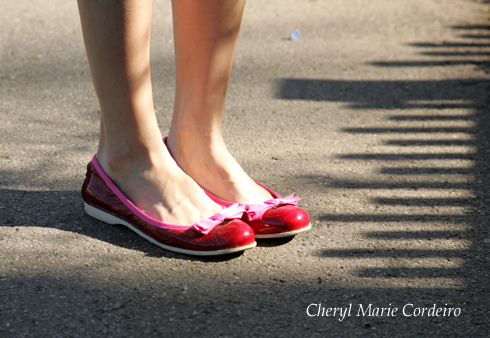
Marc Jacobs red patent leather shoes with pink bow

By the shadow of a picket fence: Marc Jacobs ballerinas in red patent leather with contrasting pink bows.

Keeping the red patent, pink bowed shoes, the top also works when worn with white shorts for another casual look (pictured below). These white cotton shorts are from Bay Trading from the UK, a company that sell quality items at affordable prices. I like how these shorts tend to look like a mini-skirt from the way it has been cut and sewn.

For something more dressed up, shorts are good to pair with heels, the trend being seen on the runways since 2006 with Luella and Gucci both having their own renditions of shorts with heels.

L\'Autre Chose brogue mules with tie front detail

L’Autre Chose brogue mules with tie front detail.

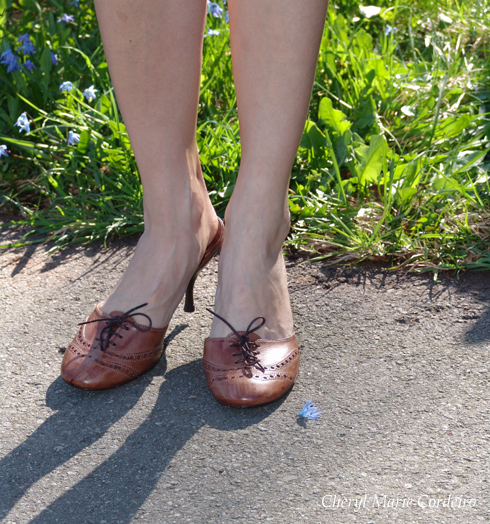
In my own ensemble, I’ve paired the black and white top with white shorts and a pair of L’Autre Chose brogue detailed mules. I find mules, even stilettoed ones, less dressy than courts and quite common a shoe form in more tropical climates, which make them perfect for a smart casual do with shorts. Espadrilles are another favourite of mine to pair with shorts.

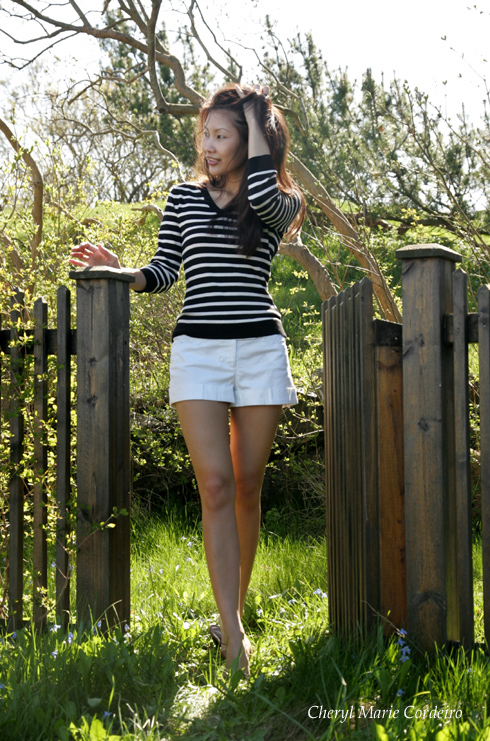
Nautical black and white top with white shorts

Nautical black and white top with white shorts, paired with the L’Autre Chose shoes.

An inspirational multimedia clip from Bill Cunningham, On the Street: a show of legs in Paris (22 March 2009) shows in pictures, how wonderful it is to have legs as a fashion feature, be it in early spring or summer. And I think here, shorts have also gained in popularity as an item to be worn paired with dark leggings and heels; a look that elongates your legs without the use of vertical stripes.

In my ensemble, I’ve paired the black wool shorts with a pair of black patent leather, pointed toe stilettos from Roberto Cavalli. No leggings necessary in this weather, if it keeps up. Cavalli is one of my favourite designers because he never loses sight of what is feminine in a woman, and puts that theme consciously into his designs in women’s clothes, shoes and bags.

Black and white top with black Warehouse shorts and Roberto Cavalli heels

Black and white top with black Warehouse shorts and Roberto Cavalli heels.

Roberto Cavalli black patent leather stilettos

Roberto Cavalli black patent leather stilettos.

As an indication of the warm weather, here’s a happy bunch of Easter lilies, basking in the warmth of the summer temperatures in spring.

Spring lilies with a summer feel, Cheryl Marie Cordeiro

Yellow Easter lilies basking in the early summer warmth.

Enjoy the warm weather upcoming!

On quality of life

Aioli with some fresh basil and rosemary as decoration

A mild aïoli made entirely with natural ingredients,
topped with fresh rosemary and some basil

Photo © J E Nilsson for CMC, 2009

I grew up in Singapore with the assumption that good cooking based on fresh and natural ingredients was something that would never change. I assumed that there would always be someone there who took fresh fruits and newly harvested vegetables, flipping fishes, and fresh meat into their pots and pans to serve well cooked dishes at affordable prices.

The hawker centre concept in Singapore to me was equivalent to well-made home cooked food at very modest prices. For perhaps $1-2 USD you could sit down at a table and have a dish that would have taken hours of preparation to make yourself. Granted, the table was not your own and sometimes a bit wobbly and more often than not you would be seated outdoors, but that was a small price to pay compared to the returns of a local delicacy from the hands of someone who loved doing what they knew best.

Even simple things such as your daily coffee and tea from a coffee shop in Singapore rivals the choices of the mega coffee chain Starbucks, coming in a variety of servings such as kopi, kopi-O, kopi-si etc and teh, teh-O, teh-si, teh tarik etc. This philosophy and lifestyle towards affordable food made with fresh raw ingredients and a passion for a select dish, reflects what I think is quality of life in a modest setting.

Today however, Singapore is seeing the commercialisation and franchising of the hawker centre concept, Food Republic is one such concept where recipes are standardized and foods pre-processed before serving. It’s a concept that is a far cry from the traditional food hawkers I grew up with, even though they equip the interior of these franchise outlets with old style kopitiam (breakfast coffee house) furniture and tea cups. These days, the real food hawkers’ fare can be found in for example, Bangkok, Thailand where food hawkers cook along the streets right next to the wet markets.
Continue reading “On quality of life”

Academic traditions: the Nailing of the Thesis, April 17, 2009

Nailing the thesis at University of Gothenburg, Sweden

Nailing the thesis at University of Gothenburg, Sweden
Photo for CMC © Jan-Erik Nilsson 2009.

When I was told that I was supposed to “nail” my thesis to the University wall, it initially didn’t occur to me that I was supposed to do so literally and in person, with a hammer.

But so it went.

A University tradition since Medieval times
In the West, universities developed as centres for research and higher learning as we know them today around the 11th to 13th century when it became obvious that the old cathedral schools were no longer adequate.

A fully developed medieval university had four faculties of which the theological was the most important. Then came law and medicine, while philosophy was a preparation in the ‘seven liberal arts’ such as math and rhetoric etc. that you needed to clear before entering the higher levels.

In 1517 Martin Luther nailed his ’95 Theses’
Looking back at the traditions of the European universities, there is surprisingly little written on academic traditions. As for “nailings”, what comes to mind if something is the famous occasion when in 1517, Martin Luther nailed his 95 theses to the door of the All Saints’ Castle Church in Wittenberg.

In most stories about this event, it has appeared as if the nailing in itself was a unique act of rebellion, to draw attention to his protests, but personally, I think what he did was to follow an academic tradition of publicly announcing his “theses”, which in Greek means “position”, and more or less invited others to discuss this at the Wittenberg University where he was a Professor in Theology.

That the nailing of the theses by Martin Luther was in academic spirit and inclination appears all the more likely since in 1502, the All Saints’ church served as an annexe and a chapel to the University of Wittenberg. The church was the place where university students were awarded their doctorates and it would have been a place where the general public would weekly (or even daily) frequent in those times.
Continue reading “Academic traditions: the Nailing of the Thesis, April 17, 2009”