Dinner party at Matsmak: the PhD disputationsfest

Cheryl Marie Cordeiro-Nilsson, PhD disputationsfest, Gothenburg

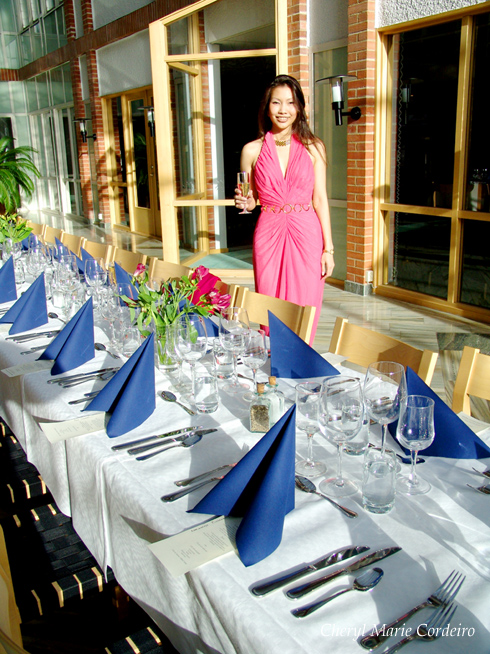
Standing at the set tables to the dinner party at Matsmak; I wore a pink pleated Tadashi gown with vintage gold tone jewellery.
Photo © J E Nilsson, David Neikter Nilsson for CMC 2009

The public defense of my doctoral thesis was followed by a dinner celebration held at Matsmak with Mikael Sande as Chef de Cuisine.

The evening event was surreal in the sense that Mikael’s restaurant had just moved to its new location at Drakegatan 1 in Gothenburg, and we were able to book the entire restaurant on a Saturday evening for ourselves. The restaurant, being located in a building with mainly offices, also meant that our guests had the entire building to themselves to enjoy that evening.

We had our seating outside of the restaurant, in the inner courtyard of the building that had white marble floors and a skylight roof that allowed the evening Scandinavian summer sun to stream through to the tables, where the light reflected pretty prisms off the rims of the wine glasses. Tall potted palm trees turned the inner courtyard into a cozy garden, so that you felt as if you were dining outdoors on a languid summer’s evening.

Jan-Erik Nilsson, disputationsfest, Göteborg

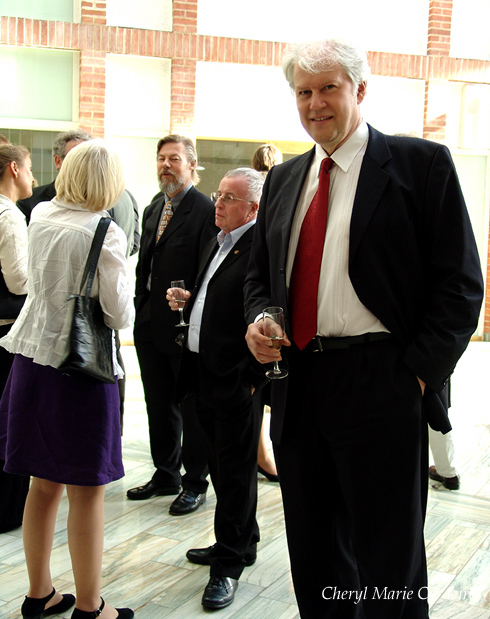
My husband, Jan-Erik Nilsson, during the cocktail session before dinner.

We had a cocktail mingle session with sparkling white wine before the actual dinner. This gave our guests time to acquaint themselves with each other if they had not already done so earlier on during the day. I was most happy to see a few friends and colleagues who had already graduated from the university, present at this dinner. It was like a reunion of sorts where you could catch up with what was going on in their lives.

Getting seated and making new acquaintances. Disputationsfest.

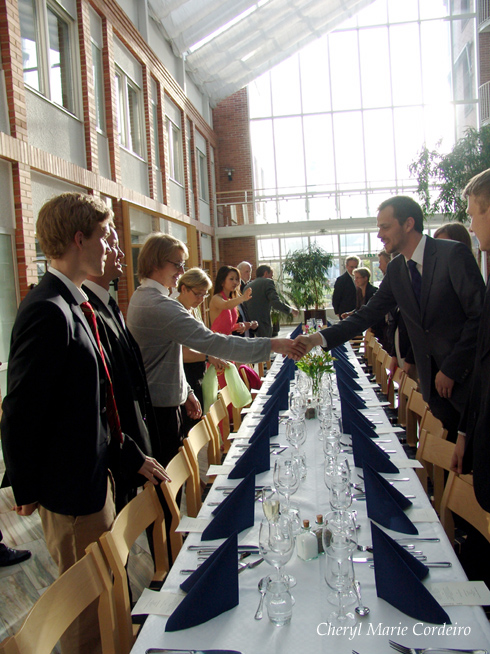
Getting seated and making new acquaintances.

The theme of the dinner continued in its French-Italian theme from the lunch buffé, though in this event, it was Mikael Sande who was in charge. Menus were printed for each guest with their names, according to their mother tongue and placed at their respective seating places.
Continue reading “Dinner party at Matsmak: the PhD disputationsfest”

Doctoral Thesis, public defense May 9th, 2009

Disputation Göteborgs Universitet. Cheryl Marie Cordeiro, Kirsten Jaeger, Aalborg

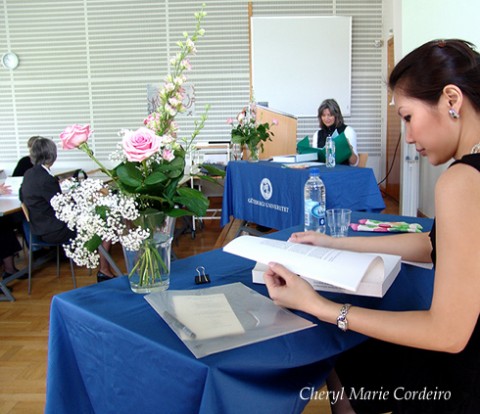
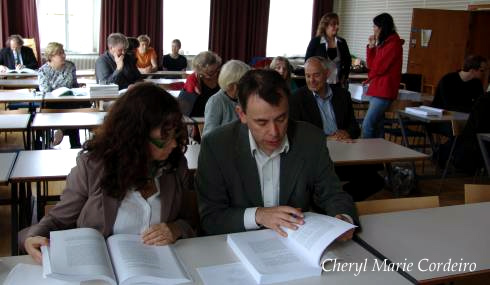
Waiting for the public defence session to begin. The Opponent and main examiner was Associate Professor Kirsten Jaeger from Aalborg Univeristy, Denmark.
Photo for CMC: JE Nilsson and David Neikter Nilsson © 2009

One of the things that have dawned on me during the years I have spent working on my thesis is that writing a doctoral thesis and having it approved are done for various reasons, and thus approached in many different ways around the world.

One reason for people to pursue a PhD is to obtain a final, formal confirmation of their status as an expert in their own lifelong field of work. In northern Europe, you can research and write a PhD thesis alongside your full-time occupation, and there is no real rush to it. If it takes ten years or more, it does not really matter. That the time taken to write a PhD thesis is secondary to the quality of the thesis is very much emphasized here in Sweden, and these values are reflected in the average time to complete a PhD in Scandinavia, which is 10 to 14 years, without anyone batting an eyelid.

A more common reason for pursuing a PhD is in preparation to your academic career in your particular field of interest. This is mostly done at the university where you’ve received your basic training, by adding a research education on top of what you have already done in your undergraduate days. This is a quicker way and you follow the methods of the professor you have already been studying under.

Personally, I have a passion for research and pursued a PhD because I wanted to become a research specialist in a field of my own choice and one that I have pioneered myself out of pure interest, which is to study Scandinavian management / leadership in Asia, in particular in Singapore. I also wanted to use the two qualitative methods of grounded theory and systemics linguistics as analysis tools on business administration matters, while most other studies on management have thus far favoured quantitative methods.

Having come from a mostly Anglo-Saxon education background, I have also sped through, the best I could, the Nordic education system with 6 years doing my PhD, that included a year as a ‘visiting student’, the time spent learning Swedish as a third language, the sporadically offered compulsory PhD courses for all doctoral students and the writing of the thesis.

I actually saw this entire process as something quite enjoyable. To be able to dig into tens and thousands of words and numbers, get them into order and eventually start seeing them form into patterns of meaning and information, is actually fun. I realize this might finally position me as a true blue ‘nerd’, but so be it.

PhD Public Defence session

Protocols for PhD public defence sessions in Scandinavia vary according to which traditions the institution follows. Some universities in Finland are amusingly conservative, so much so that one can almost see how doctoral public defences were conducted during the Medieval times, while universities in Denmark can be quite modern and informal. Swedish traditions are somewhere in-between.

Disputation, Arkeologen, G&teborgs Universitet.

All in all, around thirty persons made it to the event last Saturday. Considering this was during a spring weekend, I was impressed and happy to see so many attending the disputation instead of setting up barbecue in their gardens or pretty much doing anything else at all.

The procedure during my defence session in Sweden began with the Chairman opening the session by introducing the participants, which were the Candidate (myself) and the Opponent, in this case, Associate Professor Kirsten Jaeger from Aalborg University, Denmark, who was also the main examiner in the examination committee.

Next step was for the Chairman to ask the Candidate if there were any additions or corrections to the text. Most candidates will have an “errata” list that would now be added to the thesis. This is important if there are any significant mistakes in the paper, for example, if the word ”not” was left out in the main conclusion.

Continue reading “Doctoral Thesis, public defense May 9th, 2009”

Spaghetti al Salsa di Pomodoro Crudo

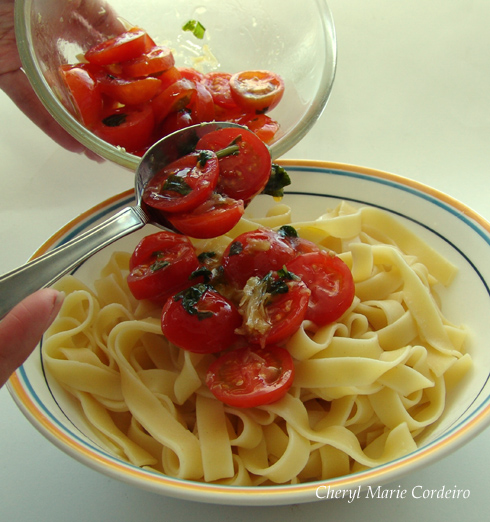
Mixing the cherry tomaroes with the tagliatelle. At Cheryl Marie Cordeiro

Cherry tomatoes marinated in olive oil and garlic, going on top of some tagliatelle.
Photo © J E Nilsson for CMC 2009

It was during our trip to Italy late last year when we stepped into a genuine Tuscan house where the old housewife continued to uphold the family cooking traditions that stemmed from generations back. We sat down and settled for Aqua and a pasta dish that seemed nice, and walked straight into a new world of flavours as unexpected as unforgettable.

Cheryl Marie Cordeiro, Florence, Italy 2008

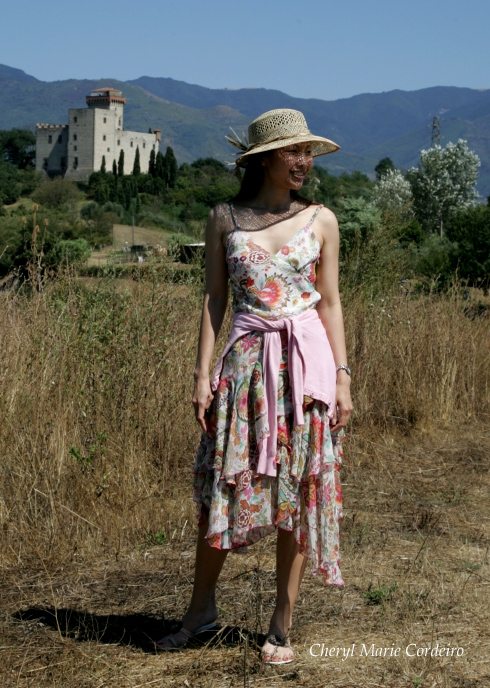
Standing outside a fantastic eating place with a beautiful view, about one hours drive from Florence.

This restaurant is located about one hour’s drive from Florence, a small monastery that serves food. I don’t even remember the name of it but it’s somewhere along the A1 when heading from the Gucci factory outlet, towards the vineyard cooperatives around San Gimignano. This is where I got introduced to this dish.

It’s very simple to prepare, as are many Tuscan dishes. The only things you need to be very careful with are the ingredients or the whole thing is hopelessly lost before you start and you will just be disappointed.

To make Spaghetti al Salsa di Pomodoro Crudo, you just cut, crush and mix into a bowl and let it sit in a warm room from morning to about lunch.

For about four persons, I took about 20 small sweet, flavour filled and sun ripened tomatoes, a generous handful of fresh basil and one fair sized clove of garlic.

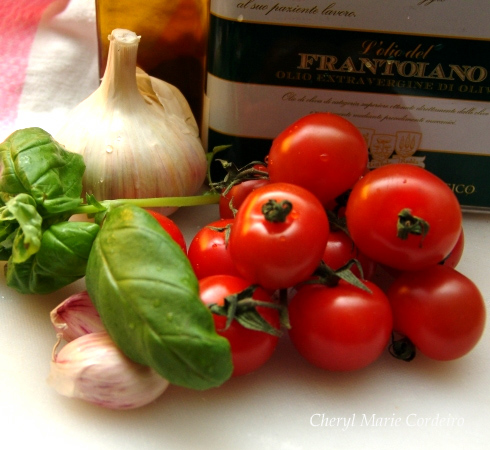
Cherry tomatoes, garlic, olive oil and basicl. At Cheryl Marie Cordeiro

Ingredients to this tagliatelle dish.

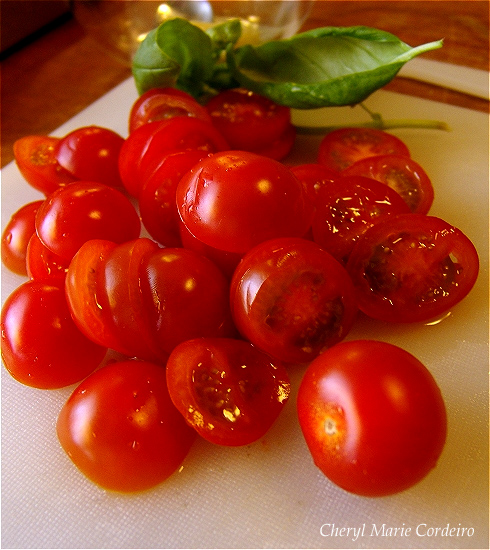
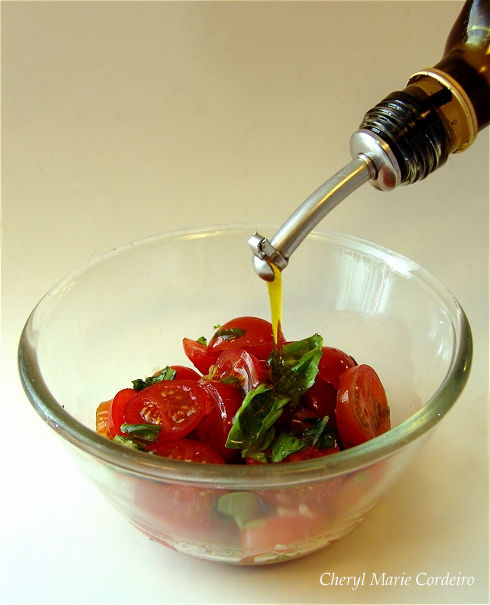
Crush the garlic clove, slice the tomatoes directly into the bowl so that the juices are not lost along the way; shred the basil leafs into the bowl using fingers and top up the bowl with fresh, green and fruity first class olive oil.

Ripened cherry tomatoes sliced and ready for marinating. At Cheryl Marie Cordeiro

Sliced cherry tomatoes.

Olive oil Pouring olive oil into the cherry tomatoes and garlic mixture.

When it comes to olive oil, there are different qualities beyond “virgin” and “cold pressed” oils. What you want is something better than extra virgin olive oil in flavour. The oil to look for is from those that hand pick their olives and have them pressed on a daily basis. Although this kind of quality olive oil is difficult to source, the daily pressed olive oils will render oils that are ultra low in acid content. In the end, this decides the fruitiness and the aroma and ultimately the entire experience of the dish.

When it is time to serve, remove the garlic cloves and pour the tomatoes with the wonderfully flavored olive oil into a bowl of steaming hot and freshly cooked pasta. For four persons you will need about 400 grams (1 lb) of pasta. Top off the dish with freshly ground black pepper and a pinch of sea salt.

My new cooking buddy, the Grill Pan

Fillet of beef on an iron grill pan. At Cheryl Marie Cordeiro

To fry a few pieces of Couer de Filet of Beef to perfection,
sprinkle with sea salt, let the beef rest in room temperature for about 40 minutes. Fry one side until brown in a grill pan, flip once and fry until done. Let the beef rest for 5-10 minutes before serving.

Photo © J E Nilsson for CMC

There are a million good reasons to go out and buy a new pot or pan to the kitchen if you really try to come up with some. But what it eventually boils down to (excuse the pun) is that it makes cooking more fun. Sometimes, having a new utensil might even improve the results of your efforts.

On my part, I often find myself buying something that looks nice, figuring out later what to use it for. Eventually I will show you a very nice Italian milk-foamer and yes, a perfectly useless high-tech electric juicer that currently eats up half a cabinet of shelf space and we can’t throw it away because it was too expensive to buy in the first place. And is there anyone who actually even knows what a raquelette is?

However, our latest toy was not improvised but something that we decided to make do with, after we decided that a separate grill section to the stove would not be practical after all. After some shopping around we simply chose the heaviest cast iron grill pan we could find, which turned out to be an 11″ AGA with black enamel coating inside and out. The very look of the pan sitting snug in the shop was enough to get us all excited about it, conjuring up dishes to cook in it!

AGA cast iron grill pan. At Cheryl Marie Cordeiro

Our new toy, 2.9 kgs worth of cast iron AGA grill pan makes frying in barbeque style a breeze. The heat source does not matter as long as it can make the grill pan sizzling hot.

Continue reading “My new cooking buddy, the Grill Pan”

Pasta and Chicken liver sauté, just XO good …

Pasta with chicken liver and a dash of XO

Tagliatelle pasta served with chicken liver sauté, bacon, shallots and fresh parsley.
Photo © J E Nilsson for CMC

In my view chicken liver is a true delicatess. Its mild flavour and fine texture is likely to appeal even to those who normally are not that enthusiastic about liver. It is inexpensive and the health aspect is overwhelmingly positive.

It is also tender and usually quite fail-proof to cook, since it is done in about 3-5 minutes in a dollop of butter.

However, liver can’t be combined with everything and if you want to go beyond butter things can get ugly pretty fast.

Some additional ingredients might not go well with liver, others might be too dominating and kill off the liver flavour, making the dish pointless. Too much onion or meat cubes for example, are mortal enemies to the sophisticated aroma of tender chicken liver.

In general, safe combinations are cream and herbal spices, but here we have tried to be a bit more adventurous than that.

This dish is one of my favourites since besides containing a few surprises that makes it interesting, it shows off chicken liver from its very best side.

To serve four persons, we will need about 500 grams of pasta to this dish.

Ingredients
400 grams of chicken liver
3-4 medium sized shallots
150 grams of bacon
1 tbs dried marjory
1 handful of fresh parsley
1 cup of cream
White pepper
Salt

Preparations
Tidy up and cut each chicken liver in three parts.
Slice and dice the bacon into small pieces.
Chop the shallots
Grind the dried marjory finely in a mortar
Continue reading “Pasta and Chicken liver sauté, just XO good …”

Maggie of London dress with those Roberto Cavalli heels!

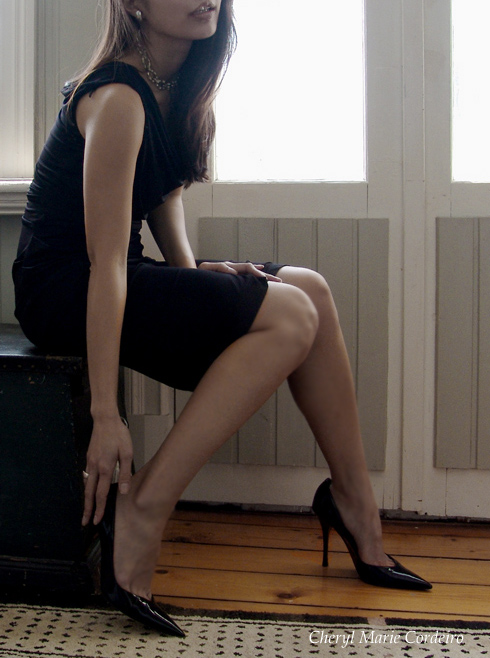
Roberto Cavalli patent leather stiletto heels

Roberto Cavalli black patent leather stilettos.
Photo © J E Nilsson for CMC

At 11 cm high, these skinny stilettos are not the most comfortable to move about in, calling for quite some stamina and that masochist in you to wear them. But some things can’t be rationalized in life and I love them just because they are so impractical, so elegant and sleek in lines – like a drawing on paper that was once fantasy, now turned into reality.

These shoes have a personality all of their own, their tiger striped insoles echoing the sharp look it carries on the outside.

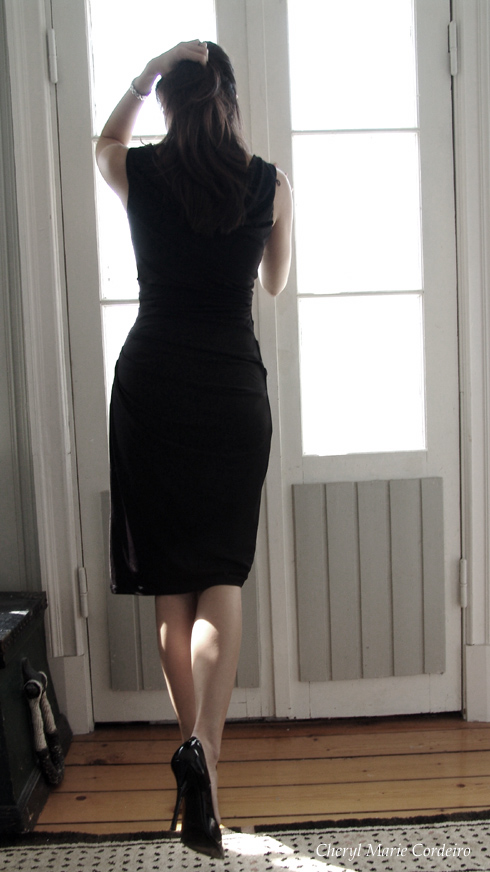
Black dress from Maggie of London, at Cheryl Marie Cordeiro

Draped black dress from Maggie of London. Vintage silvertone jewellery from Lisner and Trifari. Thick banded white gold ring from Cartier.

Depending on your imagination and what you pair with the shoes, it can take you from classy to trashy in an instant!

Cheryl Marie Cordeiro in Roberto Cavalli stiletto heels, shoes

I’m not over my fever on draped clothing, so I thought I’d pair the shoes with this black Maggie of London jersey dress that is draped around the collar and ruched down the sides.

Roberto Cavalli black patent stilettos, shoes. At Cheryl Marie Cordeiro

But then again, you could also forget about walking in these. Some shoes are made to look just gorgeous, strewn carelessly on the bedroom floor, and this pair of Roberto Cavalli stilettos is one of them.

The Opéra Garnier in Paris, France

Opera Garnier in Paris, France

The Paris Opera house, also known as Opéra de Paris or Opéra Garnier.
Photo © JE Nilsson, CM Cordeiro-Nilsson 2009

If there is something that makes the French French, I think that is a certain spirit – they just don’t do boring. It’s in the fashion, women in skyscraper skinny stilettos in the Metro in the morning, their passion for life and, in their architecture. Take this Opera Garnier for example. It’s an orgy in marble and gilt, exudes a love of life and is a grand example of how to do things with panache!

Just consider that they started to plan this building with its surrealistic grandiosity less than half a century after the French Revolution in 1793, when Louis XVI and Marie Antoinette had been publicly beheaded because of their opulent life style.

The realization that there actually is an indoor lake under the basement make you half and half believe that there probably is a phantom somewhere in there too. All sets the stage in our minds for a great theatre play. You just need to step inside and the grand entrance staircase will within the blink of an eyelid place you in the spotlight, on stage in the theatre of life, cast as the star.

Top of the Opera Garnier or Palais Garnier in Paris, France

On the roof are sculptures of Apollo, Poetry and Music by Aimé Millet and Liberty by Charles Gumery.

The grandeur strikes you already when you set your eyes on it from across Place de l’Opéra. Above the golden frilly edge of the roof are statues of Apollo, ‘Poetry’ and ‘Music’. This is the ideal setting and one can think that Gaston Leroux’s Le Fantôme de l’Opéra (1909) must have basically written itself. This was also the story that was later adapted by Andrew Lloyd Webber to the musical, The Phantom of the Opera in 1986 and became one of Broadway’s longest running musicals of all time. I can’t even write the title without hearing the theme in my mind. Continue reading “The Opéra Garnier in Paris, France”

Vanilla ice-cream served with apple cinnamon sauté

Vanilla gelato, ice-cream served with apple cinnamon marmalade

A summery dessert.
Photo © J E Nilsson for CMC, 2009

One scoop of vanilla ice-cream. On the side, one small apple sliced, diced and fried in butter, sugar, cinnamon and some breadcrumbs. Decorate with a quick drizzle of dark syrup and top off with a small leaf of mint.

By the end of last autumn, we received a large number of apples from a neighbour who had a spacious garden filled with old apple trees. Apple will store and keep over the winter if kept reasonably cold and dry. Now however, we were down to our last batch and looking at our very last three apples and we decided to celebrate them by transforming them into this wonderfully sweet and temperature cooling dessert. And besides, if looking for something Italian inspired, what could be more Italian than gelato?

A buffé with a French-Italian theme

Caprice salad with buffalo milk mozzarella, olive oil and fresh basil

Caprice salad: sun ripened tomatoes with buffalo milk mozzarella cheese
with olive oil, basil, black pepper and salt.

Photo © J E Nilsson for CMC, 2009

Planning is a big part of the fun to holding events. It’s a phase that allows you to be creative and fantasize the possibilities!

In a few weeks, we’ll be holding a dinner for friends with a French-Italian theme and thought that a lunch buffé the same day should set the stage for the evening event.

So far, we have thought that the following should be in there somehow:
Continue reading “A buffé with a French-Italian theme”

Rösti – turning raw potatoes into culinarian delight

Rösti, made with potatoes and carrots

Grate fresh potatoes, flavour with garlic and some Italian hard cheese. Fry until golden brown in a generous dollop of butter. Done.
Photo © J E Nilsson for CMC, 2009

There are many aspects to cooking, from nutrition to economy, to pure lucullian joy. Ideally I try to combine all these aspects into all that we cook.

One of my favourite things to do is to take something simple and then add a twist and a half to it and see it turn into something both delicious and fun, that might even render you a couple of surprised looks at the table.

Today we needed something to go with a mouthwatering piece of beef, and we didn’t want to spend all day preparing the side dishes, so we settled for the Swiss staple, rösti. In a world of rice, pasta and french fries, rösti is not always ranked amongst our first choices.

Rösti was originally a breakfast dish, slightly related to the fried carrot cake or chai tao kway we find in Singapore, but one that will fit splendidly together with anything that benefits from the company of potatoes.

If you haven’t got around to actually cook this before, the basic recipe is pretty uncomplicated: grate fresh potatoes. Add salt and pepper. Fry. Done.

Depending on what kind of dinner you are planning rösti lends itself to many variations. Adding different ingredients such as garlic, onions, carrots, bacon or apple can turn this dish into something different, interesting and one that is to your liking.

Chef’s secret; How to flip it so that the nicely browned side is upwards when served? Use two pans. When the rösti is half done, put a similar sized pan on top of the first one as a lid, flip the whole thing, and fry until done in the second pan. Or just fry one side and do the flipp onto the serving dish.

Smaklig måltid!