Lulling hours in Shanghai, where old meets new…

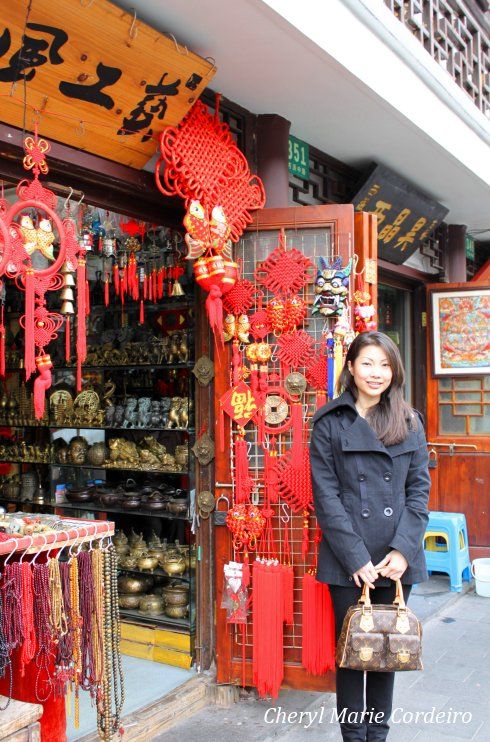
Cheryl Marie Cordeiro, Yuyuan, Shanghai 2011.

Along the streets at Yuyuan, Shanghai.
Text and Photo © CM Cordeiro 2011

Waking up in China’s largest city that is Shanghai, amongst its more than 24 million inhabitants certainly puts a perspective on how much of an impact you might make during a single day in your life when you finally step out the door and make your way around with your errands.

In just about twenty to thirty years, Shanghai as a city has grown at an amazing speed. The skyscrapers seen today along the Huangpu River, The Bund and Lujiazui were non-existent just a stone’s throw back in time, where it would’ve been difficult for most anyone to recognize the landscape and skyline of the central finance district between these decades if you were not at first shown pictures of the landscape from then till now.

The past decade alone has seen a paradigm shift in Shanghai from a city with Communist ideals to one that is cosmopolitan with a global outlook. Much of this is the fruitful result of the Chinese government’s efforts at economic reforms in China beginning in the late 1970s and early 1980s.

If any organization could trace and reflect an aspect of Shanghai’s modern history in global trade and the resulting impact of the Chinese government’s efforts at bringing China and its state-owned enterprises to the global scene, then Baosteel Group Corporation, the second largest steel producer in the world with approximate annual revenues of around USD $21.5 billion would be a good case study to examine. With 45 wholly owned subsidiaries in markets across the world, in countries with as diverse cultures such as Brazil, France, Germany, Russia and in Asian and Southeast Asian countries such as Japan, Hong Kong and Singapore , Baosteel reflects the speed and tenacity at which Chinese organizations are able to make themselves visibly global whilst simultaneously catering to their very demanding and highly competitive domestic market.

Still, amongst the city’s global ambitions supported and run by its busy inhabitants who seem to maneuver through the city via just as many noisy and exuberant vehicles that never cease their honking, you’ll find in Shanghai that some waking hours beckon a certain lull to the senses, and are in effect… quieter than others. And it is in these hours that you can sit, think and breathe the calmer soul of the city as a mist that invites you to contemplate its living as an artfully drawn landscape, one perhaps seen in Chinese watercolour on silk or paper. It is these brief lulling hours of Shanghai, at dawn or just after dusk, that paints a picture of the place both past and present, juxtaposed in front of your very eyes in material form.
Continue reading “Lulling hours in Shanghai, where old meets new…”

Yuyuan street eating and daily practicalities, Shanghai

Cheryl Marie Cordeiro 7 Dec 2011 Shanghai 03aWith the quick glances of distraction observed from tourists and a slight quickening of their pace past the local lunch scene at Yuyuan in Shanghai, where the local people seemed perfectly at east sitting along the roadside with their bowl of rice in one hand and chopsticks in the other, eating whilst waiting for their next customer to walk into the shop, I understood with clearing clarity that for most of Northern Europe, dining was a much more formal affair around a set table.

And the Northern European concept of dining was quite a contrast to this fairly common aspect of people eating on the move or simply eating outdoors in Asia in general. Whether in India or the various equatorial countries of Southeast-Asia such as Thailand, Vietnam, Singapore and Indonesia, or the more temperate regions of China, food sold along the streets in wheel carted food stalls and eating along the streets is as practical and nomadic as having all your goods for sale stacked onto a single bicycle or motorcycle and sold wherever you found a customer along the street.

Yuyuan wholesaler's street, Shanghai 2011.

Yuyuan Market, Shanghai.
Text and Photo © CM Cordeiro 2011

I grew up in the decades of Singapore where people did cart their goods around and sold them from their bicycles, and where food such as bowls of noodles, plates of fried kway teow and even cold food such as ice-shaved desserts called ice-kachang (a Singapore and Malaysian variation of ‘sorbets’ made from just rough shaven ice and sweetened with colourful syrup dripped all around the cone of ice shavings) were sold from wheel-carted trolleys. For warm dishes, burning charcoal was used for fuel in the mid-1900s for cooking and later on, small portable gas units were used.

Still, the scene in China is much more rustic and unaware – people just didn’t think if you stopped and stared at them eating, because for them, it was all part of the natural process of the day, just another practicality that you have to deal with, seamlessly interwoven into their main activity of the day, which is working. Living and working seamlessly – that is what you’ll witness at lunch hour at Yuyuan.

Continue reading “Yuyuan street eating and daily practicalities, Shanghai”

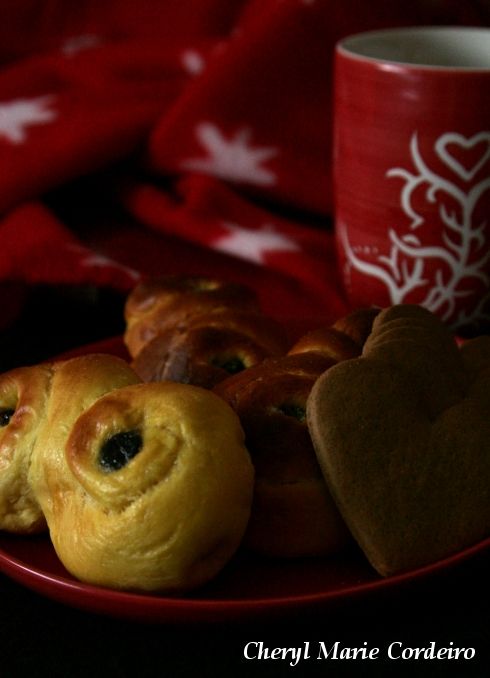
Second Sunday in Advent

coffee

Lussekatter, usually makes its appearance on St. Lucia which is 13 December.
Text and Photo © JE Nilsson & CM Cordeiro 2011

There are definitely some things more than just tradition when it comes to cooking and preparing during the Advent weeks that lead to Christmas. It’s in the air, a solemn feeling of silent expectation.

In all of this, I find it very much soothing to the busy mind, all too often kept spinning by the daily transactions, to relax and just spend the whole day baking.
Continue reading “Second Sunday in Advent”

Late evening at No Menu, Singapore

Osvaldo Forlino at No Menu, with guests.

Late evening visit at No Menu, 23 Boon Tat Street, Singapore.
Text and Photo © CM Cordeiro 2011

One of the more enjoyable part-time jobs I’ve held as a young student in Singapore some more than fifteen years ago was that of waitressing in a small restaurant. There I was on my feet, running to and from the kitchen with orders, water pitchers, new plates, napkins, most anything and everything that made a restaurant work at rush hour, and I didn’t feel the strain. It was more a constant pulse of a beating heart, that happily kept going.

In my very brief stop-over in Singapore this time around, I considered it an absolute privilege to have been invited to spend a late evening at No Menu with owner and Executive Chef Osvaldo Forlino, with his team and Head Chef Daniele Devillanova.

What struck me more than the food by itself which is the obvious thing to experience in a gourmet restaurant of this magnitude, was the atmosphere that at No Menu is spirited, generous and warm. The air was most often punctuated with bouts of heartfelt laughter and goodwill, where the food, the people and ambiance feels like an orchestrated symphony by light, set against a fabric of seductive fragrances wafting from the kitchen… making the full experience of dining here so much more than just one more dinner however excellent.
Continue reading “Late evening at No Menu, Singapore”

Trattoria Capri, Singapore 2011

Luca Iannone, Cheryl Marie Cordeiro, Michele Cuozzo

With Luca Iannone and Michele Cuozzo of Trattoria Capri.
Text and Photo © CM Cordeiro 2011

Impromptu. It seems that’s the word these days when it comes to meeting up with family and friends when back in Singapore that is always at full speed. But seeing that there was a glitch in communication on whereabouts and places to meet for various groups of persons on different days, I figured, for impromptu, this day’s lunch at Trattoria Capri at 3 Binjai Park, turned out uncomplicated.

As I’ve experienced countless times in the past both in Singapore and in Italy, the warmth and hospitality of the Italian people is a treasure to hold in this day of fast paced living and dining. A quick phonecall to Luca was all it took for them to keep the kitchen open till after their usual operating lunch hours and upon our arrival that was just a tad later than the expected late, we were greeted with broad and genuine smiles with the question, “What do you want to eat?”

Famished, we all had just a single craving – white truffles. Since we knew it was white truffle season in Europe, white truffle anything would be fun to have right here in the midst of the Singapore tropics. A smile back from Michele and a knowing nod – not a problem! And no, we didn’t so much as browse the menu, but had left the Chef instead, to surprise us with some magic!

Continue reading Trattoria Capri, Singapore 2011″

Lujiazui by night, Shanghai

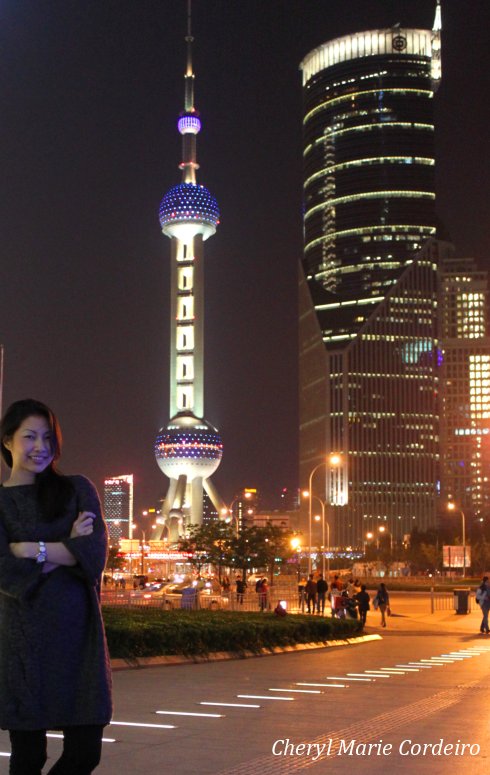
Cheryl Marie Cordeiro at Lujiazui, Shanghai 2011

Lujiazui by night. In the background, lit blue, the Oriental Pearl Tower.
Text and Photo © K Meeks and CM Cordeiro 2011

When in Shanghai, the last place I expected to find myself exploring come sundown is Lujiazui, the city’s financial district, as the more popular of nightspots would include Xintiandi or even the quieter street of Hengshanlu lined with all sorts of eateries from Turkish and Thai to Hunan cuisine.

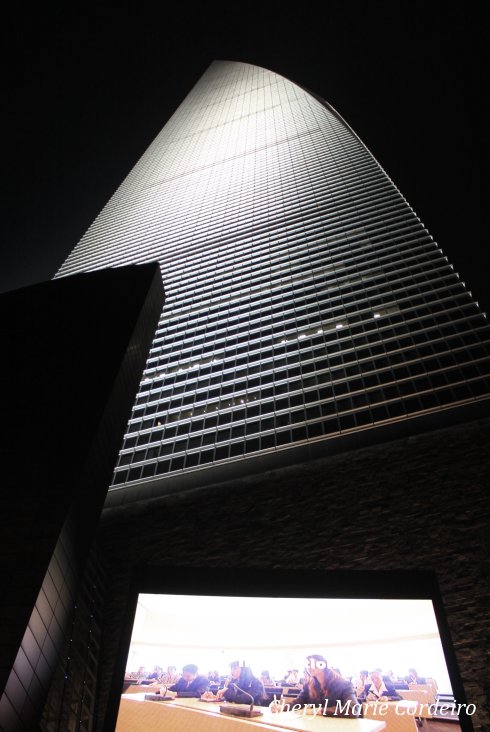
Shanghai World Financial Center

Shanghai Word Financial Center (SWFC).

Still, walking down the pristinely clean streets of Lujiazui lit blue and orange from the surrounding buildings, called to mind the quiet of Raffles Place and Singapore’s very own Central Business District by night, where all at once, despite the glittering globes of the Oriental Pearl Tower in festive blue ahead, I couldn’t help but feel at home, thinking – this is Asia! – and how much I miss its vibes when living and working in Scandinavia. Continue reading “Lujiazui by night, Shanghai”

Chicken liver Pâté and Cumberland, a precurse to Julfika

patett

Oven baked chicken liver pâté served on toasted white bread, with cornichons and a slice of orange.
Text and Photo © JE Nilsson and CM Cordeiro 2011

Part of our Christmas tradition in Sweden is to prepare and subsequently feast upon, the many dishes that go into our the traditional Swedish Julbord or Christmas Table. In reality the dishes are so numerous that it would be impossible to sit down and enjoy them all in one sitting as a grand jultide smorgasbord as intended. So, we have found it better to start well in advance and use the dark months ahead of the mid-winter celebrations for various cooking experiments.

One of those many dishes that just came to mind was various pâté to be served with a wonderfully fruity cumberland sauce. When it comes to liver pâté there are lots of recipes on line. The traditional ones ask of you to mince and mix the ingredients first and then bake the pâté in a water bath in the oven. The more modern ones if one might say so suggests that you can fry the ingredients first and then just put all of it in a blender and voilá, pâté. Both methods work and the blender method is of course faster. It also gives the benefit of better control of how much you cook the liver, since liver doesn’t benefit from over cooking. Really tasty and flavourful liver should hardly be cooked at all or at least as little as possible. Then again the slightly browned crust you would get from oven baking is also delicious so, I have done both and if I have the time, prefer to bake the pâté.
Continue reading “Chicken liver Pâté and Cumberland, a precurse to Julfika”

Autumn mushroom crepes

crepes_136

Autumn mushroom crepes.
Text and Photo © JE Nilsson and CM Cordeiro 2011

If there was a culinary disadvantage to be named whilst growing up in an almost mono-seasoned (you could optimistically consider wet and wetter to be two different seasons coming with the monsoons) equatorial climate, it would be that you hardly have the distinct seasonal food groups that come with a Nordic climate. Coconuts and bananas for example, seemed always in season when I was young. So now when the leaves on the trees in Sweden are turning from a vibrant green to shades of mellow gold and red in our garden, serving up some creamy mushroom crepes to an autumn themed meal felt just about right.
Continue reading “Autumn mushroom crepes”

With a penchant for olives

With a penchant for olives

Making your own tapenade – the French Italian classic olive paste – is quick and easy.
Photos © JE Nilsson and CM Cordeiro 2011

Weekends are the time when I read, plan for the work week ahead, and cook. Besides all other good things that could be said about preparing your own food, I find the sometimes long winded and perhaps monotonous preparation of food very calming. It lets your mind wander in any direction it might, encouraging the formulation of new ideas, where you find yourself combining familiar things in creative ways both in your mind as well as in your pots.

By what you cook, you can also revisit places you wish to see again that right now are inaccesible for such mundane reasons as that your work lets you travel, but to a different continent.

This weekend I revisited the South of France and the North of Italy by means of a black olive tapenade and a generous slab of home made ‘Ciabatta’ style bread.
Continue reading “With a penchant for olives”

A Swedish-French Onion Soup

Onion Soup

Onion Soup.
Photos © JE Nilsson, CM Cordeiro 2011

French onion soup evokes memories of those student days where you wanted to see your friends at your own place for some home cooked food, and the most of what you could offer was hospitality and friendship but not so very expensive food. And while everybody else’s task was to see to that they brought their own wines and beers, your task was to come up with the food.

During such events, catering was always an option but it gets boring in the long run, besides which, showing off some cooking skills was always fun? Well, at least if the dish worked out well and the guests in general approved of the food served.

However much you progress in your career, your history continues to remind you of your previous success and failures. And these days, what I have at work are Tuesday breakfast meetings to cater to, on a rotating roster.

So, what comes to mind is

French Onion Soup.
Continue reading “A Swedish-French Onion Soup”