When failure is success: a change of view in expatriate integration

The job of the expatriate in international job transfers is hardly an easy transition. Most Scandinavian expatriate contracts in Singapore for example average 3 years, during which time, the employees, usually at managerial level, are supposed to make adjustments along several dimensions, both in the private and public domains.

International managers not only need to adjust to a new home, perhaps a new language, and new schools for the children if the family is in tow, but they are also expected to adjust into the new role within the organization and perform on the job.

If the ballpark figure is given at about a year to adjust to a foreign environment, then 3 years for the average expatriate contract, isn’t much time given to get things working smoothly, since as soon as you begin to feel comfortable in the new environment, it’s time to go home. Going home is not also always smooth sailing since you’re perhaps faced with a host of re-acculturation issues due to that you have gained new knowledge from the new environment and now cannot help but apply that new knowledge back home.

During the 1960s and up until about ten years ago, the majority body of literature that governed relocation and expatriate managers’ experience overseas equated their transition success with how far they’ve come to be integrated with the host country’s culture (Black, 1988; Janssens, 1995)

In speaking with Scandinavian respondents about their experience in socializing with Singaporeans, many of them mentioned that they felt marginalized and not at all integrated into the Singapore society. It didn’t seem to matter whether they were there for three years or in some cases, fifteen to twenty-six years. Disheartened and feeling not quite successful in the aspect of cross-cultural socializing, many said they felt ‘outside’ of the local system, some even mentioning that they felt more ‘Swedish’ or ‘Danish’ when they were in Asia, than when they were back in Scandinavia.

When it came to cross-cultural socializing, the organizations had office functions and staff dinner and dances, which they found a perfect opportunity to mingle with the locals, but apart from such events, they found themselves rarely socializing with the locals.
Continue reading “When failure is success: a change of view in expatriate integration”
The mysterious ‘Notre Dame’ Cathedral in Chartres, France

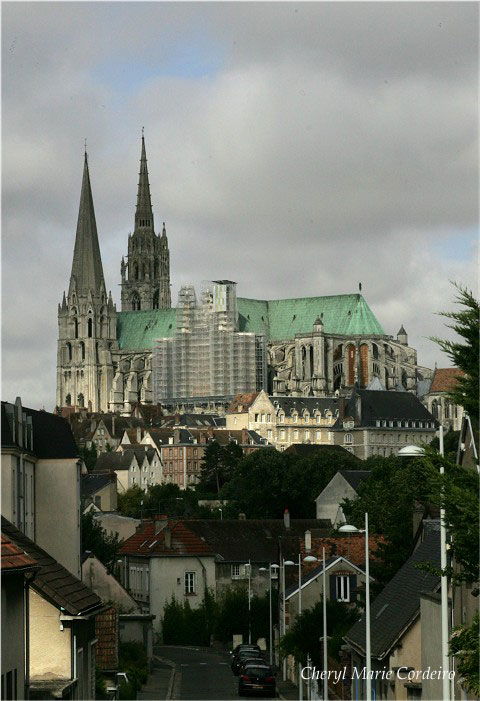
The heart of Chartres, the Notre Dame Chartres Cathedral looms impressively over the town and is visible from miles along the plains of Beauce.

The entire landscape around the city of Chartres about 45 km south of Paris, is mostly flat agrarian countryside. Mile after mile of fertile soil made the foundation of wealth that went into the building of this Cathedral. From a distance, the Cathédrale Notre-Dame de Chartres seems to float among the clouds. This impossibly large structure strikes you as unlikely as Noah’s ark, just stranded on the mountains of Ararat.

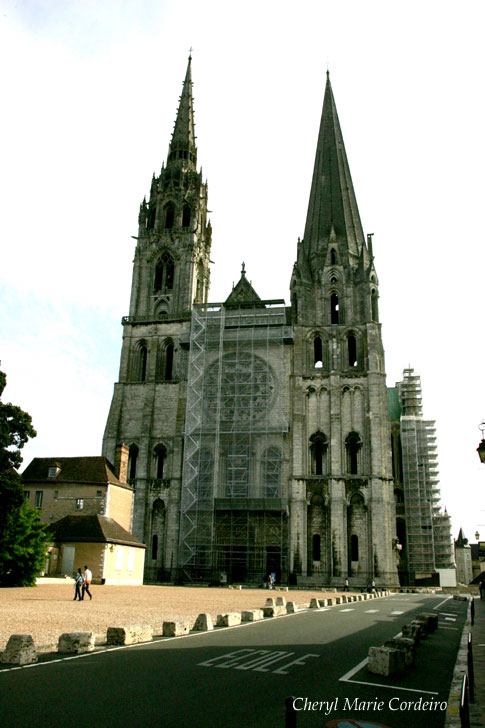
The west facade of the Notre Dame in Chartres, a magnificent piece of mid 12th century high Gothic architecture. Its famous Portail Royal, completed about 1155, is currently under restoration. In this picture, the right (south) tower is the original, older, from about 1150. The higher, left (north) tower was rebuilt in 1513 after a fire.

The medieval charm of Chartres envelopes you as a warm cloak even as you approach the small town. The river Eure that runs through the town provides it with a picturesque backdrop and one is immediately taken in by the timbered architecture of the houses that line the cobbled streets, making them look almost right out of a Brothers Grimm fairytale.

At the heart of this city is the massive and striking Notre Dame Cathedral in its Gothic glory. From afar, the looming structure seems to float on clouds. It is only upon drawing closer that you realize that it sits quite solidly, on a hilltop, previously known as The Mound. Continue reading “The mysterious ‘Notre Dame’ Cathedral in Chartres, France”

Visiting the Rothschild vineyards in Bordeaux, 2008

Visiting Baron Philippe de Rothschild’s Vineyards in Bordeaux

The region of Bordeaux was legendary to me. I had heard of it long before I ever thought I would visit it. To me, Bordeaux was superior wines, it’s romantically undulating landscapes that the grapevines so needed to grow, the warm weather and the rustic lifestyle of grape harvesting and wine making.

Even though my knowledge of wines is limited to be able to recognize a good wine when I am served one, I expected to hit every single chateau in sight for some wine tasting, inspect all barrels of wines in different stages of aging and come away with much greater knowledge than before I set foot here.

It was such a disappointment then, that the day we had set out to explore Bordeaux, was a French national holiday weekend and all chateaus were closed!

With a sunken heart, we decided to travel around some and take a look at the vineyards and chateaus anyway, targeting one of our favourites, the Rothschild’s vineyards in the Médoc area just northwest of Bordeaux. Since the history of the Rothschild family, as well as the history of the vineyard and the wines all have approached mythical proportions, we decided this was worth doing even if there would be no one on grounds to meet.

A signpost leading the way to maybe the most famous of all vineyards in Bordeaux. The vineyards and chateaus are generally easy to find, following the signs.

The roads were tiny and winding slightly up and slightly down. They were also bare of any vehicles or crowds due to the holiday.
Continue reading “Visiting the Rothschild vineyards in Bordeaux, 2008″

Stirred, not shaken, in Monte Carlo

Cheryl Marie Cordeiro, Monaco, France 01

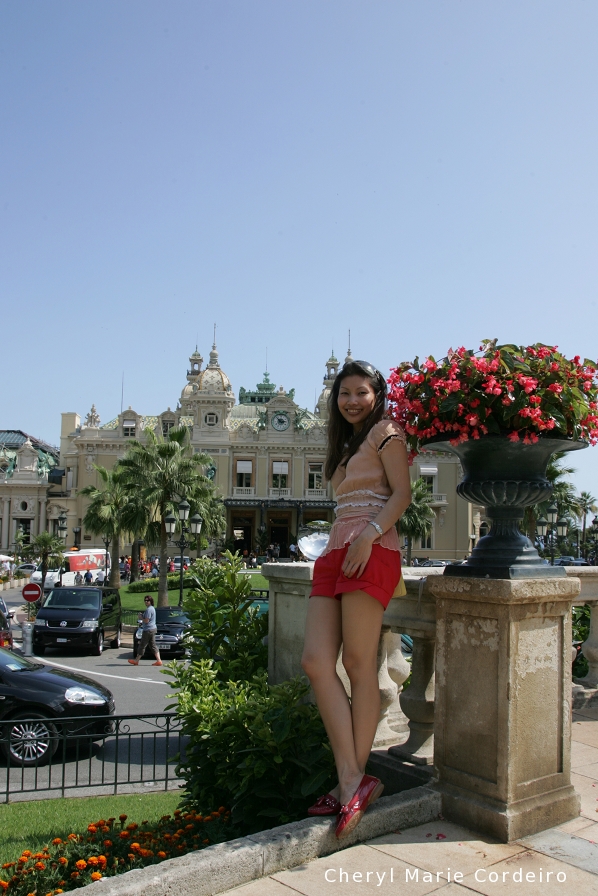
In the background, Le Grand Casino, Monte Carlo, Monaco.
Text & Photo © JE Nilsson, D Neikter-Nilsson, CM Cordeiro-Nilsson 2008

The kingdom of Monaco is stunningly famous despite its modest land area. Only 800 meters by 4.8 km (0.5 x 3 miles) it is the second smallest country in the world. The only state even smaller is the Vatican inside Rome. As such, you can walk clean through the country of Monaco almost without noticing that you’ve entered or left it. The country is however, fantastically scenic as it clings to the rocky, sometimes vertical slopes of the coast of the Mediterranean sea. One fifth of the entire city-state of Monaco is reclaimed from the sea and the main feature of this place is a very large harbour where the exceedingly rich who live here have their luxury yachts.
Continue reading “Stirred, not shaken, in Monte Carlo”

The Cannes Film Festival beach

Cheryl Marie Cordeiro, Cannes beach 1 2008

As the beach was just 100m across La Croisette from our hotel,
it was only a matter of grabbing the towels and go!

Text & Photo © JE Nilsson, CM Cordeiro-Nilsson 2008

When in Cannes, there really isn’t much to do in this city except eat, shop and watch movies, so after a hearty breakfast buffet at the Majestic Barrière, we did what most people along the La Croisette were there to do; we went swimming!
Continue reading “The Cannes Film Festival beach”

Hotel Majestic Barrière, Cannes

Cannes – City of dreams.
france-italy_16-17aug2008 391a 598

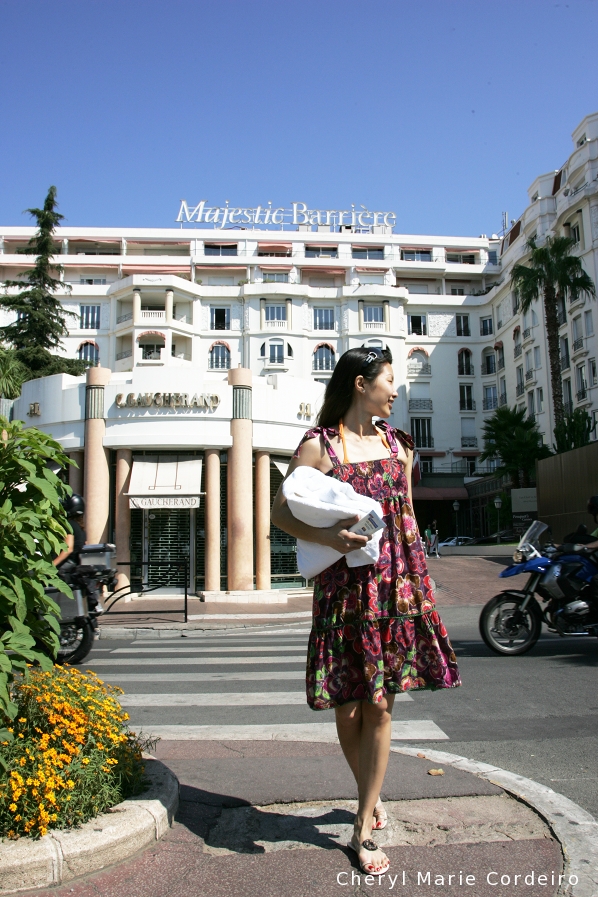
The Hotel Majestic Barrière offers a splendid view across the La Croisette towards the Cannes Film Festival’s main building with its roof designed as a spacious helipad. To the left, is the beach where a bikini clad Brigitte Bardot introduced a new beach fashion to a whole world in the early 1950s. In the middle is the private entrance for artists to the festival building, right now leading into the Palais Club discotheque. Further out is the Port de Cannes where many large and comfortable private yachts are anchored.
Text & Photo © JE Nilsson, CM Cordeiro-Nilsson 2008

Once a year the city of Cannes becomes the focal point to all who hold any hope of making it into the fame and fortunes of the international movie industry, as it hosts the most important film festival in the world, the annual Festival de Cannes.
Continue reading “Hotel Majestic Barrière, Cannes”

Discovering ‘Bistecca alla Fiorentina’, at Trattoria Quatro Leoni, Florence 2008

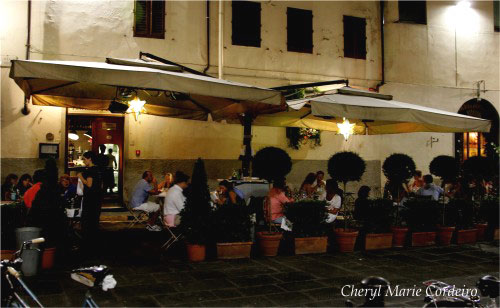
Our first decision in Florence was that we should go out to explore the city by foot. A good friend set out to book a table at her favorite place and after some time walking in and around the old streets of central Florence, we ended up at Trattoria Quatro Leoni at Via Dei Vellutini 1/R at Piazza Della Passera.


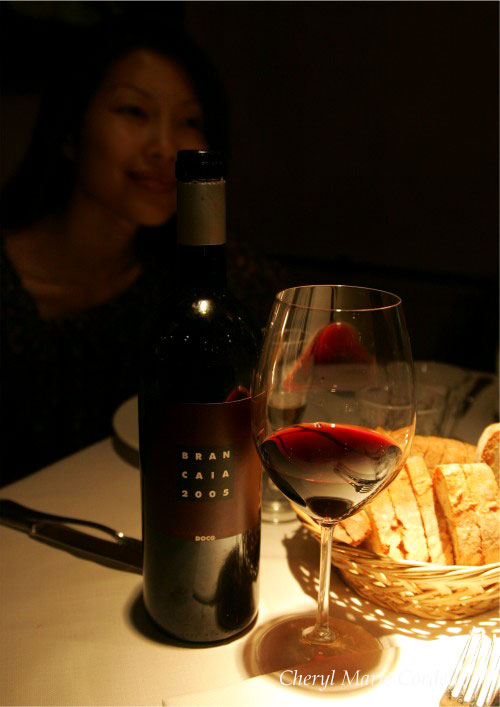
Our waiter and sommelier recommended us a Brancaia 2005 as well suited for our purpose and budget. It’s a full flavored red Tuscan wine of decent quality. In 2007 it received quite positive reviews in the Swedish newspaper, GP.

Quatro Leone or The Four Lions is a mind-bogglingly old restaurant. Having originally opened in 1550, both Dante Alighieri, members of the Medici family as well as Michelangelo himself could well have sat on these chairs before us. Well, maybe not. The chairs were probably replaced in the mid 1990s when the restaurant was renovated, restoring some of its old charm while removing centuries of kitsch.

The restaurant is central but still difficult to find, and it has a large proportion of locals in the eating crowd, both being good signs

For those unfamiliar with Florence in Tuscany, the region is famous for its true concern of the quality of the food ingredients, and traditionally alter as little as possible when cooking. Green and fruity olive oil, garlic, unsalted bread, parma ham and parmaggio cheese plus generous helpings of black pepper are expected staples of many Tuscan dishes.
Continue reading “Discovering ‘Bistecca alla Fiorentina’, at Trattoria Quatro Leoni, Florence 2008″

San Lorenzo, Florence, Italy

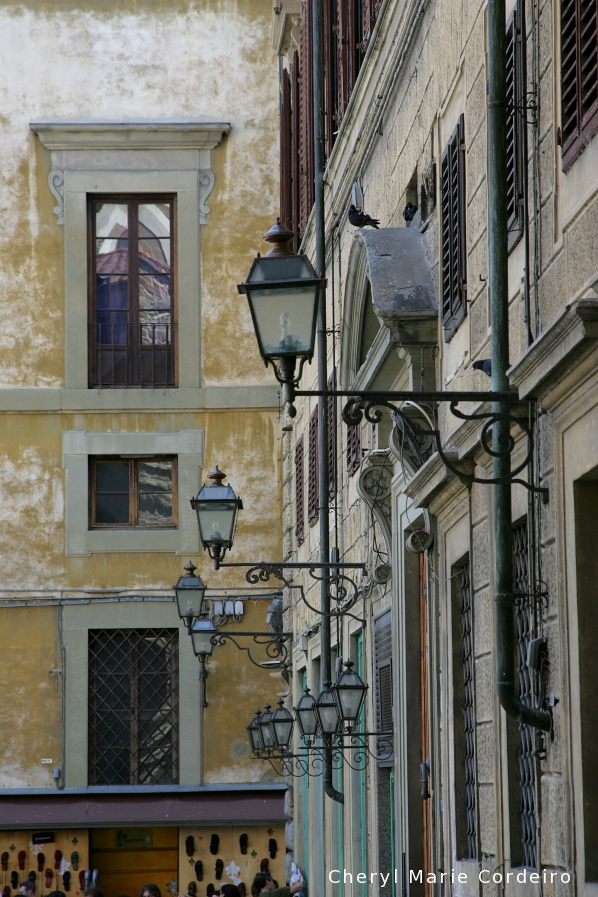
Florence, Italy. Street.

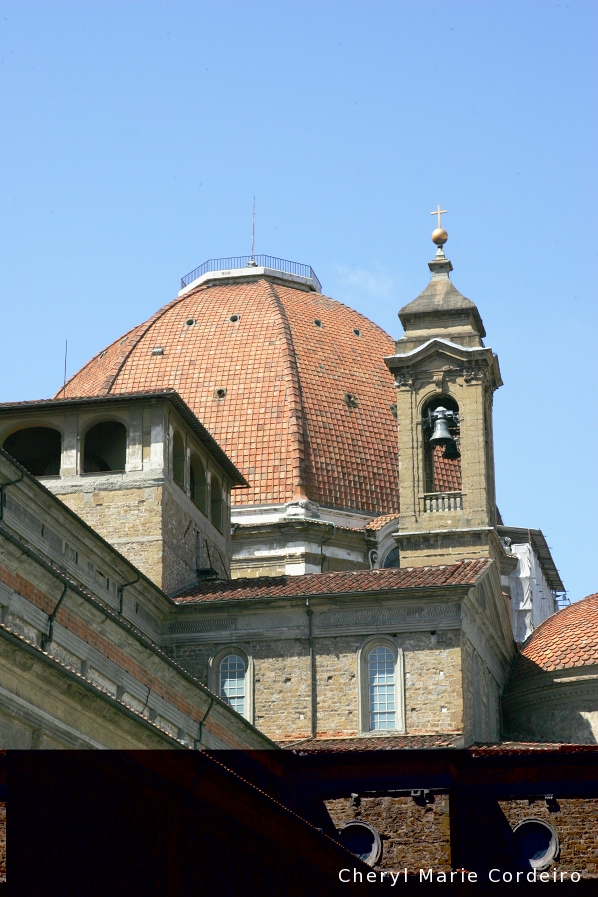
Beautiful façade.
San Lorenzo, Florence, Italy

Text & Photo © JE Nilsson, CM Cordeiro-Nilsson 2008

San Lorenzo in Florence has a charm of its own quite different from other cities of Italy that I’ve visited. A main marketing district, it’s historical buildings, its winding streets that interconnect that seem to make all things of interest within walking distance to each other really grounds your perspective as to how this place might have functioned hundreds of years ago.

San Lorenzo Florence Italy

The Church of San Lorenzo.

And, I love marketing.

It doesn’t matter which country I visit, it’s the sights, sounds and aromas of the local markets that draw me to their heart. Piazza del Mercato Centrale is no exception and I found myself walking end to end under the roof of the main market, curious at what they had to offer.
Continue reading “San Lorenzo, Florence, Italy”

The Mall at Leccio, Florence, Italy

Cheryl Marie Cordeiro, Florence, Italy 2008

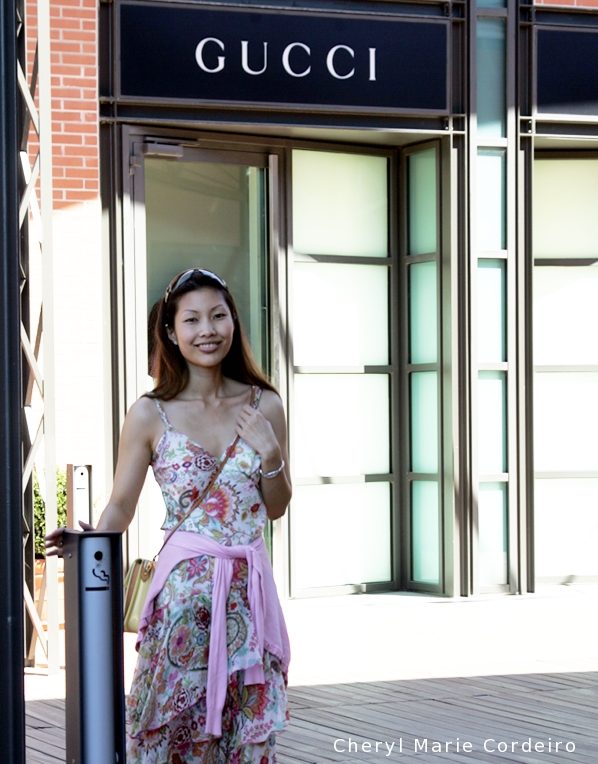
At The Mall, Leccio, Italy.
Text & Photo © JE Nilsson, CM Cordeiro-Nilsson 2008

Italy is really everything that has ever been written and described about in its designs and designers. In a world of ever increasing low priced and sloppily made consumer goods, the attention to design detail and craftsmanship in Italy is a breath of fresh air. Perhaps it is something with the stubborn and highly individualistic Italian mind-set that just can’t take orders and insists on doing things their own way – down to the local village cheese preparation – that feels just right applied to the making of clothes and accessories.

florens19aug2008

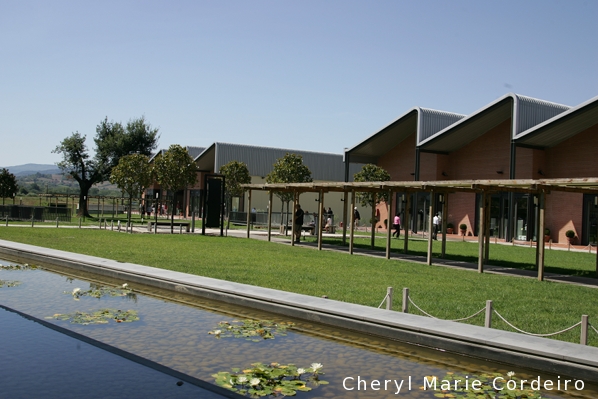
“The Mall” is located just 30 minutes along the A1 motorway from Florence. A Gucci mecca of sorts, The Mall at Leccio, hosts several luxury brands.

In combination of urban and country, with its soft rolling hills in the region and beautiful vineyards, I’ve found Florence also to be a shopping haven for things well-designed. An ill protected secret is the availability of numerous factory outlets who away from city centers, sell the real deal at discounted prices. And if you are prepared to venture outside the extreme first class locations in the city centers, such as right outside the Palazzo Veccio in Florence, your efforts will be richly rewarded with hefty discounts on luxury items. True shopping gems, if you find them.
Continue reading “The Mall at Leccio, Florence, Italy”

The romantic city port of Bremen, Germany

Cheryl Marie Cordeiro-Nilsson 2008 022 598

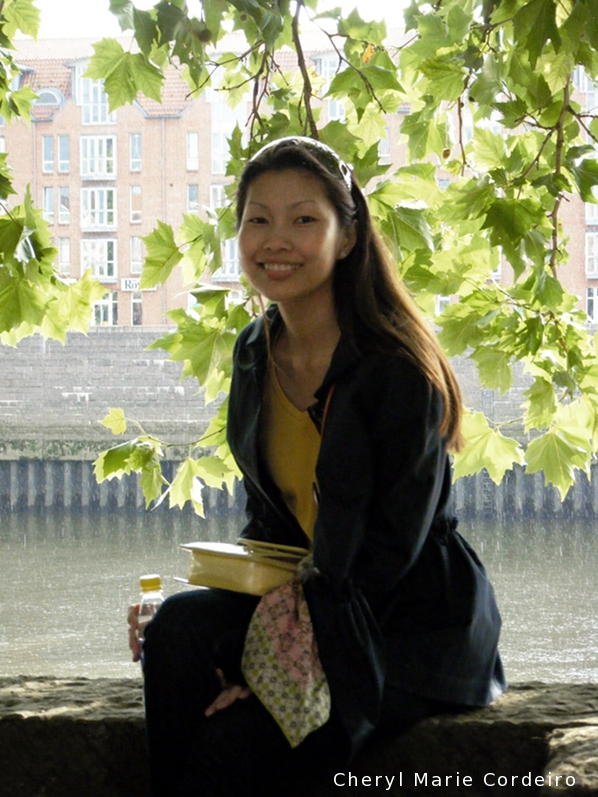
Sitting by the Weser riverfront, where you will find a long row of restaurants and pubs that serve good food. In the background is a smattering of both sunshine and drizzle.
Text & Photo © JE Nilsson, CM Cordeiro-Nilsson 2008

Bremen is Germany’s 2nd largest city with an old town city center dating back to around 150 AD. Most of the old red brick buildings still standing are medieval, giving the city center something of a fairytale look. Continue reading “The romantic city port of Bremen, Germany”