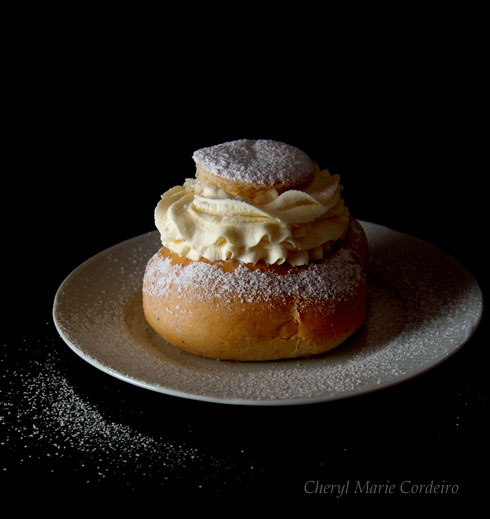
Fettisdagen or Fat Tuesday, a day for semlor in Sweden

Semla dusted with icing sugar, photo by Jan-Erik Nilsson at Cheryl Marie Cordeiro

Today the original meaning of ‘Fat Tuesday’, as the day when all fat and other perishables should be consumed before Lent, is lost on most Swedes. However, the tradition of eating typical Fat Tuesday buns is kept alive and well.
Filled with almond paste and whipped cream, the ‘semla’ dates back to the 16th century. Records suggest that they first became popular in Sweden in 1541.
On February 12, 1771, the Swedish King Adolf Fredrik reportedly passed away after consuming a luxurious banquet rounded off with 14 of these buns, served in a bowl of warm milk.
Photo for CMC by: Jan-Erik Nilsson © 2009.

One of my more favourite days in the Swedish year is Fettisdagen or Fat Tuesday, which corresponds to Shrove Tuesday in the United Kingdom, Ireland and Australia and Mardi Gras in the USA and France. Though Sweden in itself is rather secular, Fettisdagen marks the last day before the period of Lent in the Christian tradition, a period of fasting and abstinence before Easter. And while some mark this day by feasting on pancakes, the Swedes have it as a day of eating semlor (singular: semla). Continue reading “Fettisdagen or Fat Tuesday, a day for semlor in Sweden”
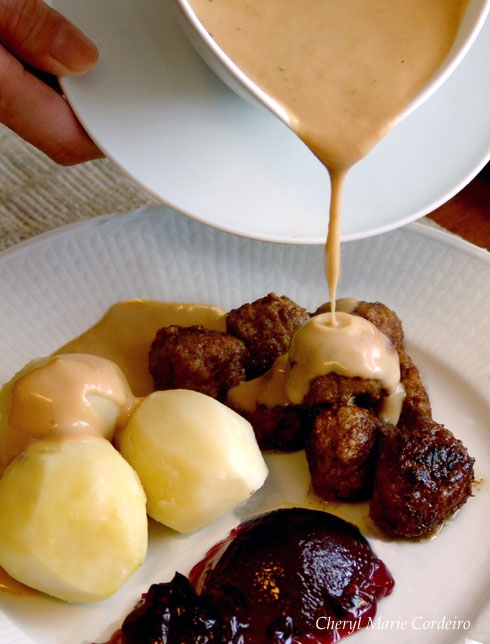
The REAL original Swedish Meatballs!

Warm from the stove, our homemade Swedish meatballs
served with brown sauce and potatoes. As traditional as it could be.

Photo for CMC by JE Nilsson © 2009

Swedes are very passionate about their meatballs.

When talking to Swedes, you will find most topics meandering their way sooner or later to food, and the most ardent topic of all – meatball recipes. Most male Swedes will be adamant that his mother is the only one who can do them right. Their recipe will be kept as a family heirloom and they will insist that their recipe is the only good one around.

As an international Swedish meatball ambassador, IKEA has achieved quite some success by promoting, selling and serving industrially mass-produced meatballs in their in-house restaurants all over the world. Most Swedes however, think that IKEA would have been much more successful if they had followed their mothers’ recipe instead, or at least Ingvar Kamprad’s mother’s recipe! Continue reading “The REAL original Swedish Meatballs!”

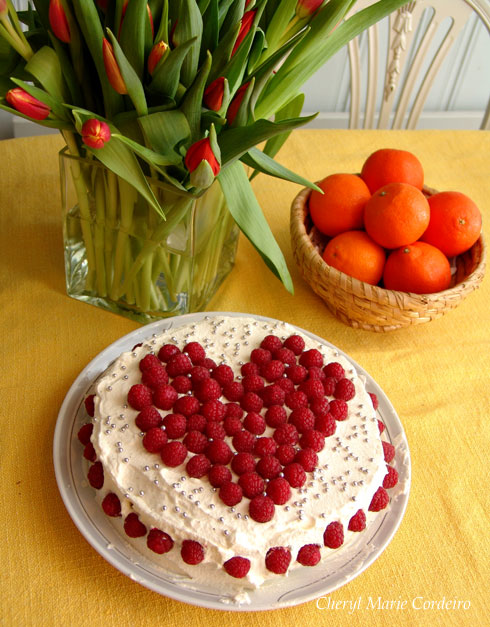
A Valentine’s Day cake!

In celebration of Love – a no fuss sponge cake filled with our favourite fruits!

We thought that one of the best ways to celebrate and enjoy an uncluttered St. Valentine’s Day without the all too commercialized menus at restaurants, was to sit back and enjoy this wonderfully soft and romantic cake that’s just bursting with all our favourite fruits.

This is one of my favourite cakes to put together that uses sponge cake layers bought off the shelf at the grocery stores in Sweden. A tried and tested version that actually won a school competition for ‘best tasting cake’ in a cake-making competition is raspberry jam and fresh mashed bananas between the sponge cake layers. The competition cake was topped with whipped cream and fresh strawberries for decoration. Continue reading “A Valentine’s Day cake!”

You tiao in Penang, Malaysia

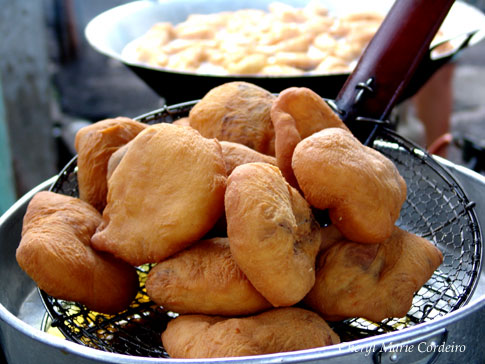
From a street-side hawker in Penang, these deep fried ham jing peng, which are deep fried buns with a sweet red bean paste as filling, are ready to go!

Deep fried bread sticks or youtiao and its variations such as the ham jimg pengs in the above picture are a simple treat in Southeast-Asia. They’re usually eaten at breakfast with a good cup of thick kopi-O (black coffee), but they can be enjoyed throughout the day as a finger food as well.

Fried bread sticks and fried buns with various fillings can most conveniently be found at hawker centers in Singapore and at street-side hawkers in Malaysia. They’re also found in other Asian countries such China, Philippines, Laos and Vietnam.

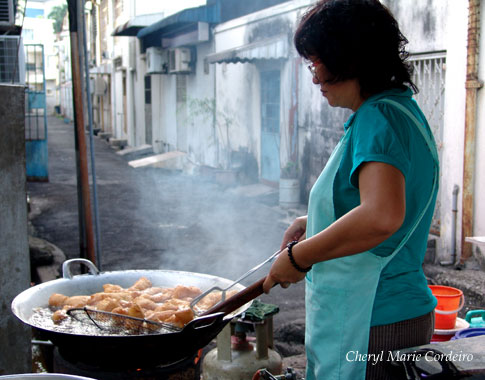
The lady with her street-side stall. Just behind her is the backstreet lane of several shophouses in Penang, Malaysia.

During my trip to Penang, Malaysia, late last year, I found some youtiao at a street-side hawker near the Pulau Tikus market. I stood and watched as the lady in a sky blue apron, expertly kneaded the dough into shape and dropped them gently one by one, into a wok filled with hot oil. She seemed to do this without effort, something of a testament perhaps, to the number of years she’s already been doing this. Continue reading “You tiao in Penang, Malaysia”

Swedish white cabbage meat wrap or Kåldolmar

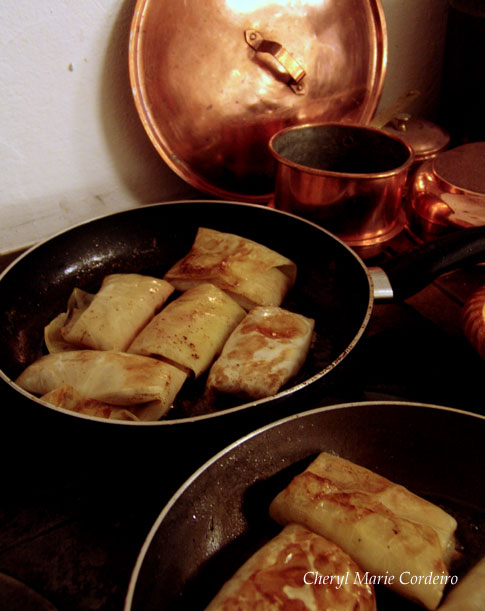
Cabbage wrapped meat packages frying on a 19th century wood stove.

This traditional Swedish dish has its origins in the Middle East where the Swedish King Charles XII and his army took shelter for a while during a war with Russia. The dolma, which is the Turkish name of a common cabbage wrapped meat dish is thought to have been imported name and all into Sweden by the early 18th century. Today kåldolmar is an old fashioned traditional staple food in Sweden that sadly, fewer and fewer can find time to cook.

Making these cabbage wrapped meat packages takes quite some time. You can expect to set aside an entire day or the best part of the afternoon to do this. A great weekend activity if your weekend allows for it. On the upside is that they deep freez well and you can make a large batch of them in one go. It is also not very expensive. What goes into them is mostly time.
The kåldolmar or cabbage “dolms” are served warm with boiled potatoes and lingonberry jam. Continue reading “Swedish white cabbage meat wrap or Kåldolmar”

Christmas dinner at Sjömagasinet, 2008

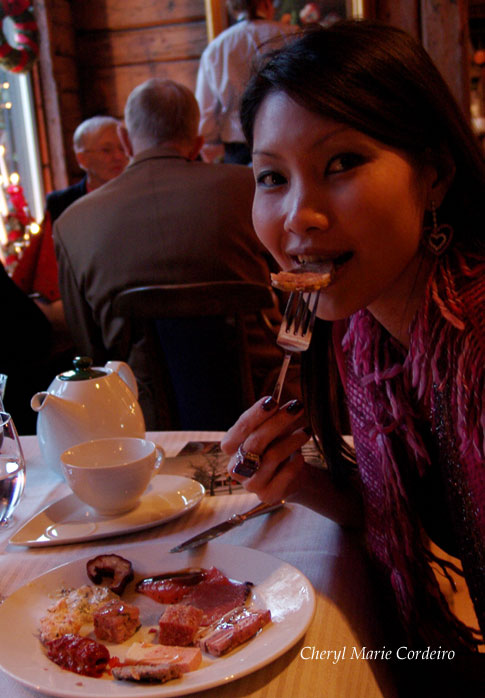
Tucking in at the ‘julbord’ or Christmas buffet at Sjömagasinet, Gothenburg. This restaurant serves a wonderful variety of Scandinavian delicacies during the Christmas season and it’s a recommended restaurant to visit at any time of the year, when in Gothenburg.

Sjömagasinet is somewhat of a tradition, and this year, we made our way back to the restaurant for our Christmas dinner. It’s all things familiar, such as the warm fireplace at its entrance and its golden candle lit interior, that makes you feel at home when you step in. A gazing sweep over the buffet spread and you begin to look forward to trying out your favourite dishes, the ones you can recall from last year.
Continue reading “Christmas dinner at Sjömagasinet, 2008”

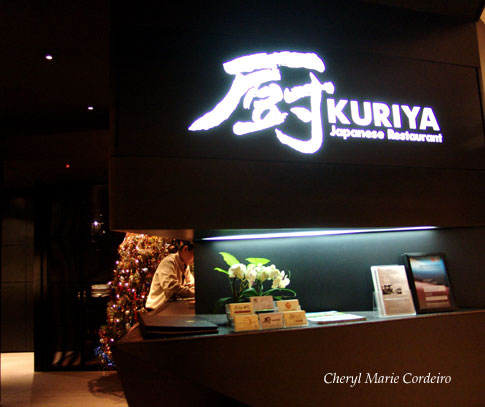
Kuriya Japanese restaurant, Singapore

The dramatic entrance to Kuriya, an established Japanese restaurant at Raffles City Shopping Centre, 252 North Bridge Road, #B1-06/07, Singapore.

It was unexpected that we ended up at Kuriya at Raffles City shopping centre (located next to Raffles Hotel in Singapore), since I had in mind something local food and a more casual setting for a Friday evening dinner with some girl friends.

As with most group meetings, a designated time and meeting place were chosen. But after having decided upon a time and place, in keeping with the Singapore tradition of meeting-up, nobody turned up on time, or at the designated meeting place. A quick call via the mobile phone, and I found the others happily shopping in the mall, as was I. We mapped ourselves terrestrially within the mall in an instant, and they found me a few minutes later, in the Aldo shoe store browsing for a festively sexy stiletto. Continue reading “Kuriya Japanese restaurant, Singapore”

PS Café along Harding Road, Singapore

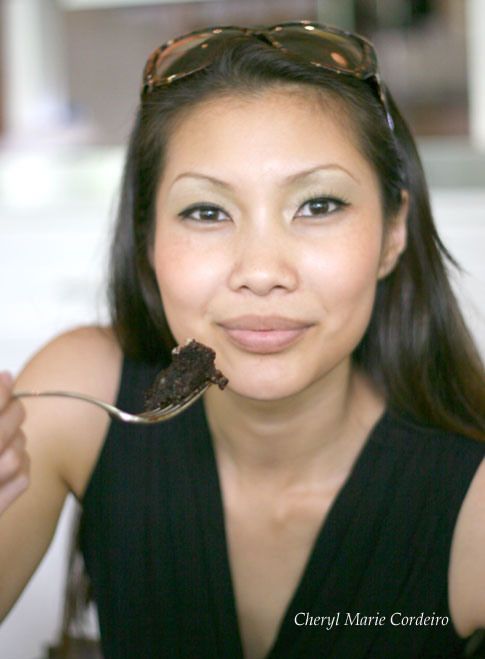
About to bite into a chocolate fudge cake at PS Café.

One of the coziest spots in Singapore to have a languid Sunday brunch is at PS Café, situated along Harding Road. The café is not difficult to find if you’re familiar with the cluster of eateries that mushroomed amidst the tropical rainforest at Dempsey Road, including Samy’s Curry.

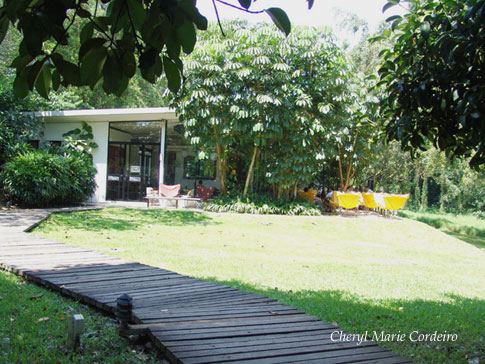
A wooden planked path leads right to the doors of the sprawling PS Café.

The grounds of PS Café is sprawling and large. A wooden planked path leads to the entrance of the café and everything about its design suggests a cozy private house with a well kept garden, where one can sit at the patio for hours, refilling that cup of tea. I felt all at once welcomed, and delighted at the thought of spending a few hours there, eating and socializing with close friends on the patio.

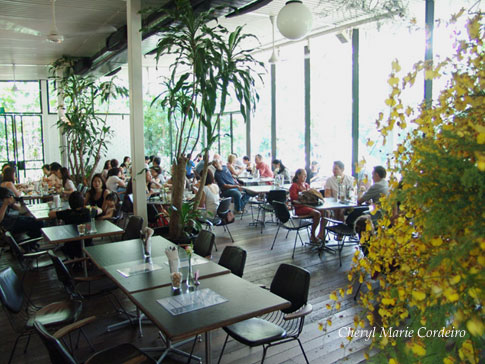
The spacious and green interior design of PS Café makes you feel like you’re dining outdoors, even when sitting in.

The café had both indoor and outdoor seating, though the high ceilings and glass walls of the café gave the impression of dining outdoors, even when seated indoors. Two large golden shower orchid plants greeted us as we entered and I couldn’t help but feel like settling into a soft sofa before perusing the menu. As I found out, the menu contained a varied selection of frosted drinks for the often warm days in equatorial Singapore. Continue reading PS Café along Harding Road, Singapore”

At home in the tropics: the banana tree

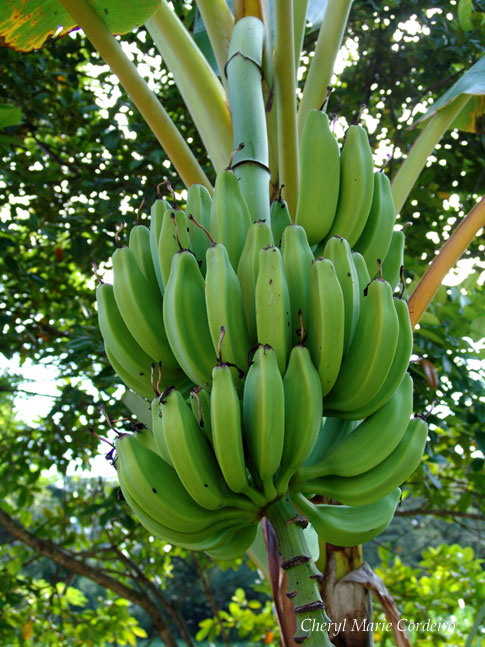
An idyllic spot in the tropics of Singapore allowed this banana tree to grow this beautiful bunch of bananas.

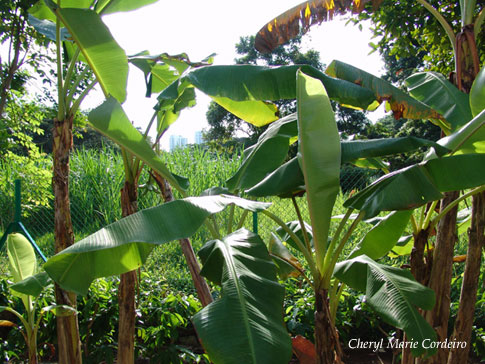
The banana tree is native to the region of Southeast-Asia, growing quite freely in the wilderness of Malaysia, Philippines and Indonesia. In the suburbs of Singapore, where concrete has replaced most of the secondary forests here, the banana tree is something of a tropical idyll to have in one’s private garden. The tree doesn’t grow too tall and its broad lush leaves provide shady relief from the mid-day sun.

Banana trees in the morning sunlight.

The ease at which the banana tree grows in this region has made it a popular choice of ingredient when cooking local food. The leaves for example, are not only used to serve food as with the Indian tradition, but it is also used in traditional Malay desserts such as Kueh Lopes and the Chinese dessert, Banana Hoon Kueh, made with green bean flour and sliced bananas. Continue reading “At home in the tropics: the banana tree”

Visiting Singapore – A banana leaf meal in the middle of the rainforest

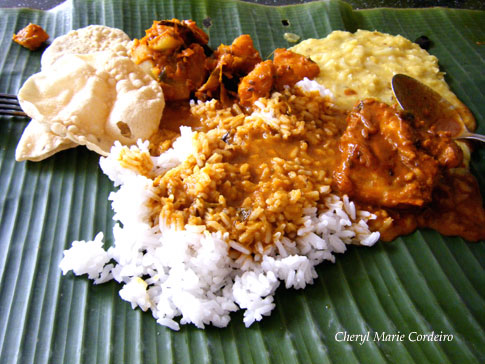
A meal served on a banana leaf at Samy’s Curry at Dempsey Road, Singapore. They serve traditional south Indian food.

The Singapore scene is one that is constantly changing. In a short span of a year, new roads and buildings have appeared, with new eating places that support the vibrant food culture of this place.

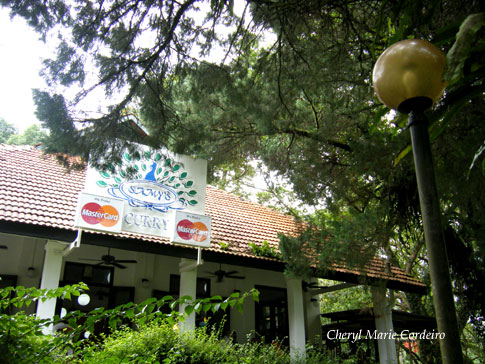
Nestled amongst lush rainforest trees along Dempsey Road is Samy’s Curry, that serves up south Indian cuisine on a banana leaf.

Samy’s Curry at Depmsey Road is comfortably nestled amongst a thicket of rainforest trees. The lush leaves cool the atmosphere, even on a hot tropical day.

Eating on a banana leaf was a more common sight in Singapore about twenty years ago. These days, only specific Indian eateries and restaurants serve their meal on a banana leaf, one of them being Samy’s Curry. Their waiters walk around carrying tins of spicy looking concoctions that smell as delicious as they looked! Their mission is to re-fill the banana leaves on tables that threaten to go almost empty of these side dishes.

Indian cuisine in Singapore is characterised by the use of spices such as cardamon, cinnamon, fennel, cloves and nutmeg. Coconut milk is often used in curries and plain yoghurt is also used in their cooking. Indian food can also be largely vegetarian, so one can find the most delectable vegetarian dishes in this restaurant, alongside barbequed chicken, squid and fish. Curried gourds, aubergine, ladies fingers and lentils are a staple in vegetarian dishes. Potatoes find their way into curries quite comfortably too, giving the curry a thicker texture.
Continue reading “Visiting Singapore – A banana leaf meal in the middle of the rainforest”