Listening to Antonio Vivaldi, The Four Seasons – Autumn.
Text & Photo © JE Nilsson, CM Cordeiro 2013

The past decade has seen an increasing call for the field of International Business studies (IB) to embrace interdiciplinarity, the interest moving from cross-disciplinary and multidisciplinary in nature to one that encouraged the blurring of boundaries and the integration of disciplines to render new insights.
In a recent roundtable session, the terms multidisciplinary (MD), interdisciplinary (ID) and trans-disciplinary (TD) were discussed in relation to the field of IB. As could be expected we all entered the debate with our own tacit knowledge of the field, to be put on the table and to disentangle our various definitions.
The task proved more interesting when one paper on the definitions of these words was placed on the table, that now set a reference point. And then more papers were presented that set a number of different reference points.
We did what we do best in such situations and that was to survey the ground from a top-down perspective, and then break for coffee.
With a single cardamom cookie on the side that came with the Swedish fika in times of brainstorming, and sipping the strong doses of black coffee from the small coffee mugs in hand we set out to consider the various viewpoints.
If I had previously thought, that the list of 164 different definitions of the concept of culture, already back in 1952, by American anthropologists, Kroeber and Kluckhohn was confounding, only because as Apte (1994:2001) wrote in the ten-volume Encyclopedia of Language and Linguistics, “Despite a century of efforts to define culture adequately, there was in the early 1990s no agreement among anthropologists regarding its nature.“, where Avruch (1998) noted that much of the difficulty of understanding the concept of culture stems from the different usages of the term ranging from high culture to popular culture and then culture as values and beliefs, that are still dominant in general discourse today, then the disentanglement of the three concepts of MD, ID and TD would certainly take more hours of critical reading.
Continue reading “Multidisciplinary, Interdisciplinary, Transdisciplinary”

The fika break is a Swedish near holy opportunity to stay tuned in on what is really going on.
Text & Photo © CM Cordeiro 2013
It was 2004.
We were sitting in the canteen of the main administrative building. The canteen was located on the higher floors, with high ceilings and large windows that overlooked three other buildings with chimneys billowing smoke.
At the table where we sat, the aroma of a hot cup of Zoéga coffee wafted through the air.
Coming back to Sweden
The story at hand was how reintegration into the Swedish organisation – coming back to Sweden to work, after having been abroad for a few years – constitutes just as much of a culture and organisation shock for many, as those who go to foreign countries to work.
Little attention paid to reintegration
While most organisations take care of practicalities, even giving their top managers / employees cultural orientation to the new culture they would soon be experiencing as part of their overseas posting to a foreign subsidiary, the aspect of re-acculturation when coming back to Sweden thereafter, is little paid attention to. Most would take for granted that employees would delight in coming back to Sweden and just being relieved doing so, reintegrating right back to where they were.
– You feel, useless? But, you have directorship, or at least, that is your job title.
– Yes that is my job title but what you do and what you feel, that is different from the title given to you in the company. The title could be because I have been here for very many years, so in a way, they are obliged to give me this position. Or course, it is also merited, I have a lot of experience. But you can say, I feel a little lost at the moment.
Continue reading “With ears to the ground”

The advantage of being in sniper position and camouflaging is the ability to produce blueberry muffins as one of three food wishes, from limited quantities of frozen blueberries.
Text & Photo © JE Nilsson, CM Cordeiro 2013
We were standing loosely, in a group, outside the main office buildings, in idle summer chatter which mostly covered what transpired during the most recent seminar that some of us had just stepped out of. It was lunch time and those present were waiting for a few more colleagues that formed the daily lunchtåg or lunch train, before proceeding to said destination for lunch. Except in Swedish group organization tradition, those present are never really sure who is going to turn up for the lunch train, and there is most often no said destination for lunch. Decisions are made in a much more mysterious manner – you just needed ‘to know’ these kinds of things. This happens too in more formal meetings, where issues other than what is on the agenda are discussed and there seems to be no general agreement on anything at any one point in time. In such meetings, it is also not unusual that the only point in time when people start to take notes would be at the end of the meeting when they are deciding when to meet next. And meetings are planned very much ahead of time, so you could decide on two future meetings already now.
Continue reading “When in doubt, begin with a custard then go left.”

Street in Hong Kong.
The moment you realize that navigating this scene will require much more
tacit knowledge skills than years of actually living in Asia affords.
Text & Photo © JE Nilsson, CM Cordeiro 2013
– Don’t worry, once you’ve learnt how to ride a bicycle, you’ll know it forever. Bicycle riding becomes you. You are the bicycle!
So I was told when I was about five or six years old at the time, riding a bicycle with small trainer wheels at each side of the back wheel, that gave me no security in feeling in balance with the mechanism because I felt I was going to tip over one side or another at any one time.
Perhaps I’m not of the adventurous sort.
Bicycle riding proved traumatic enough for me as a child that was compounded by the fact that as I grew up, I never really got to keep any of my bicycles for one reason or another. I still mourn the demise of my muffin cute pink, purple and white racer, and no, it doesn’t matter if the colours of the bike has nothing to do with its function, that bike looked good enough to eat and as a little girl, that’s all that made my day just staring at it, not wanting for it to get a slick muddy in the monsoon seasons of Asia.
So at the back of my mind, not only was I worried I would never be able to balance without trainer wheels on a bicycle, but I wouldn’t actually have the contraption to ride anyway. Why spend time mastering riding then when I could be playing with my Cabbage Patch kid?
Continue reading “Itinerizing Hong Kong”

Känsö’s ship observations tower at the island’s high point,
offers a splendid view over the neighbouring islands of Gothenburg’s southern archipelago
and is well worth the effort making it up there.
Text & Photo © JE Nilsson, CM Cordeiro 2013
Känsö synopsis
Känsö is a small island in the Southern Archipelago of Gothenburg. The name refers to its use by the people of the nearby island of Brannö, who let their cows grass on it over the summer.
In the early 19th century, science medical theories had made enough progress to suggest that becoming ill could be avoided by insulation. The island’s location immediately south of the Gothenburg port entry made it ideal to be used as a quarantine to try to protect Gothenburg and Sweden from any number of contagious deceases that at the time, plagued continental Europe and Asia.
The theories and practices developed here were advanced, though as time moved on, the progress and knowledge in hygiene standards that was made through the use of this facility eventually disseminated to the mainland hospitals. The consequence was that the island was gradually made available for other purposes and it is today, a military naval base and training camp.
The first quarantine manager, Jacob Forsell and chief surgeon of this facility had plenty of free time on his hands, some of which he devoted to developing the island’s meagre flora. Being mostly rocky and barren he created space for an apple orchard of 150 trees and planted the remaining island with more than 5,000 other trees of which quite a few appears to have been pine, considering what is still standing on this restricted access island.
Continue reading “Stora Känsö, Swedish west coast archipelago”
Text & Photo © JE Nilsson, CM Cordeiro 2013
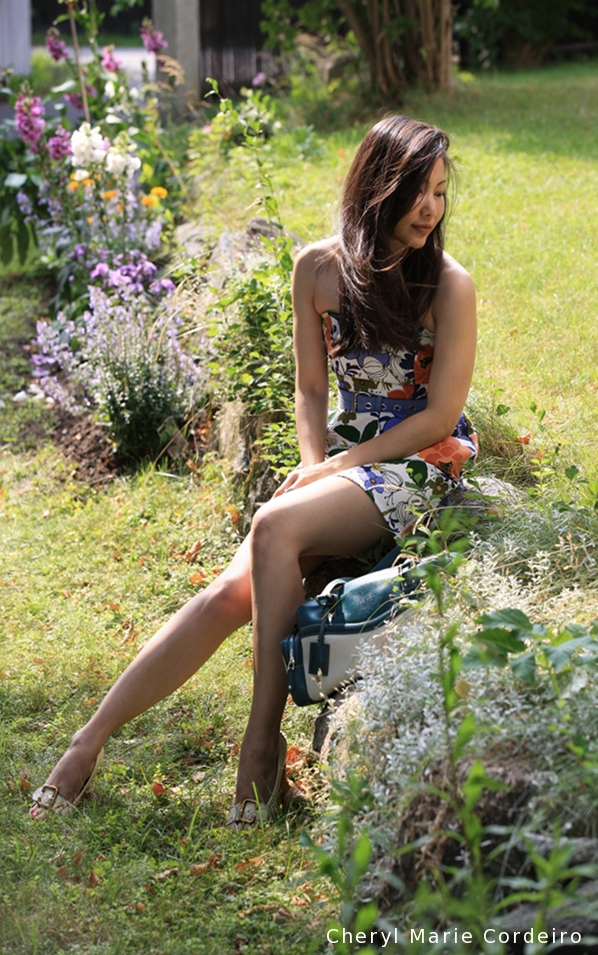
A noticeable feature of the houses found in the Swedish west coast archipelago are the picturesque gardens that look unkempt. Seemingly forgotten and left wild, it is this visual feature that I find gives the gardens their defining, core beauty.
Since settling in Sweden more than a decade ago, I have now had ample opportunity to admire these grounds whether it is via seasonal garden parties or from long evening strolls around the neighbourhood.
The garden closest to my heart, was once under the care of a professor in botany. To that extent, set in an undulating landscape, this garden has some interesting varieties of plants from Iceland Poppies (papaver nudicaule) that every year shed red petals after only a week of intense efforts of drawing attention to themselves from the local bee population, to sprawling crawlers such as the Grape Ivy (parthenocissus tricuspidata), that come autumn covers nearby branches and facades in a fiery red and green.
Continue reading “Summer perennials”
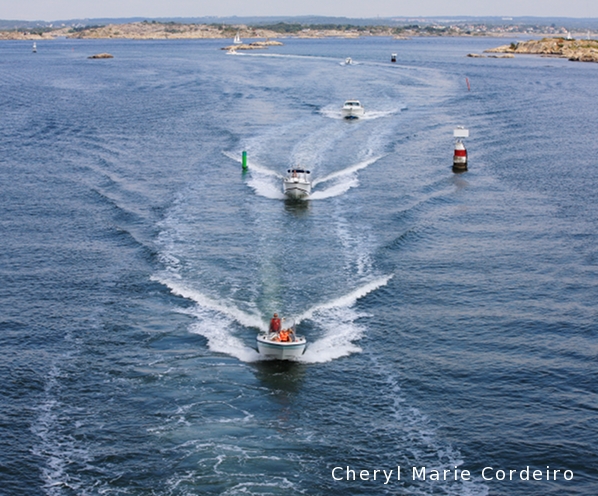
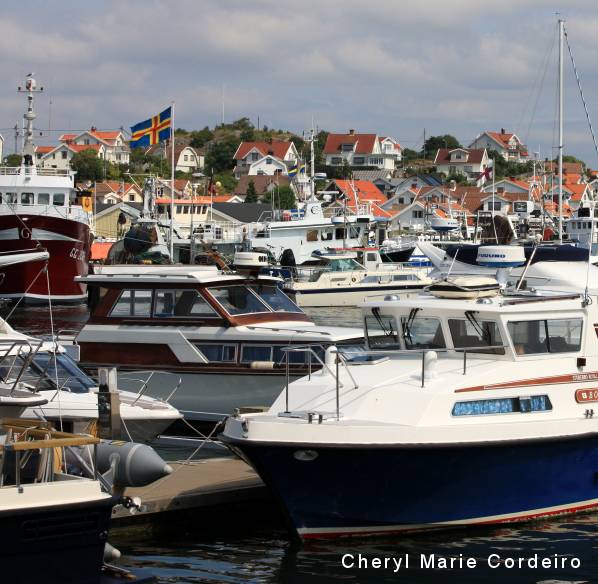
Donsö hamnfest 2013. The harbour festival draws a large crowd,
both from the local community and from farther away.
Text & Photo © JE Nilsson, CM Cordeiro 2013
Late in the summer every year, a harbour festival is held at Donsö, an island situated at the southern archipelago of Gothenburg. Events to this festival go on for two days that includes a marathon around the two islands of Styrsö and Donsö. The route is marked by deep blue and yellow tapes tied to street lamps, branches of trees and fences to help the runners find their way. Come evening of the harbour festival, the air fills with the sounds of live bands, the guests fed with fresh grilled seafood sandwiches, under tents and eaten right by the waterfront.
So it’s no surprise that the harbour festival draws a large crowd, both from the local community and from farther away. The natural means of communication is by sea, and the harbour at this event is fully packed with rows upon rows of pristinely polished boats and yachts in various sizes. Occasional product tankers and trawlers owned by the islander families are also pulled home and docked for greetings at the quay side.
All in all, the elements and atmosphere make for a glorious cocktail of fun and hanging out the next few days.

Continue reading “Swedish west coast Harbour Festival, Donsö 2013”

The Greek national dish Moussaka, for a summer dinner. A drop of Lambrinì Theodossious olive oil from Plomari on the romantic island of Lesbos, adds just that extra beam of sunshine.
Text & Photo © JE Nilsson, CM Cordeiro 2013
As much as I love Italian cuisine, pasta has not so far made it into my top favourite dishes. However, in many respects a Greek Moussaka could be seen a lighter version of a Lasagna, that will leave some room for that special cherry chocolate tiramisù dessert, that indeed is one of my favourites.
Since there are so many good Moussaka recipes to be found on the Internet by the click of a ‘mouse’ I will not go into all the details of this dish but just mention some ideas that I find useful myself.
There are four steps in putting this dish together. A little bit time consuming maybe, but well worth it in the end.
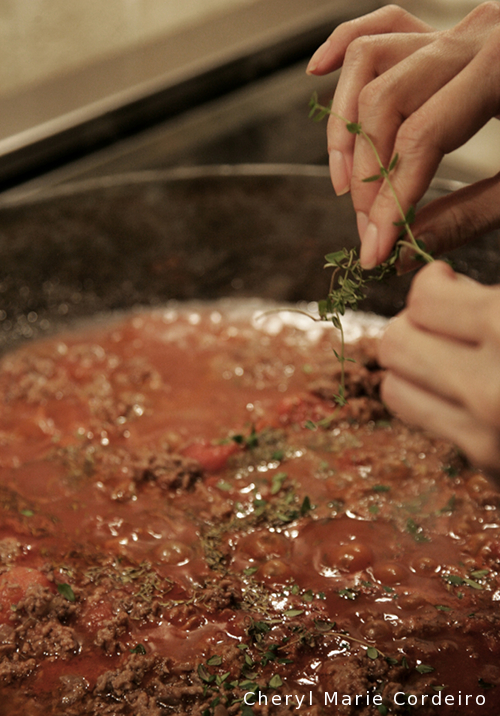
Thyme into the meat sauce.
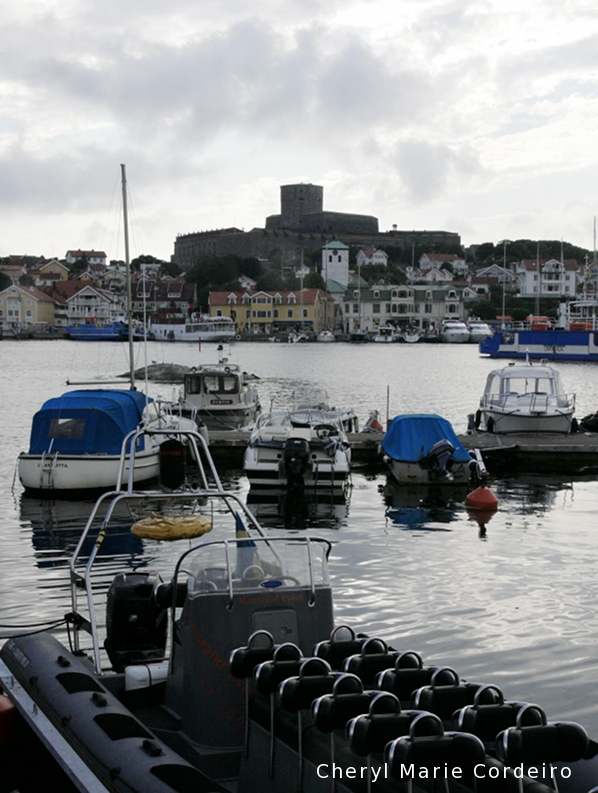
Carlstens Fortress at Marstrand as seen from Koön
Text & Photo © JE Nilsson, CM Cordeiro, 2013
About an hour’s drive north of Gothenburg lies an old stone fortress called Carlstens Fortress. Huddled around its imposing stone wall is the old town of Marstand. The town is located on two islands, the one outermost and housing the fortress is called Marstandsön while the inner one is the Koön – the Cow’s island.
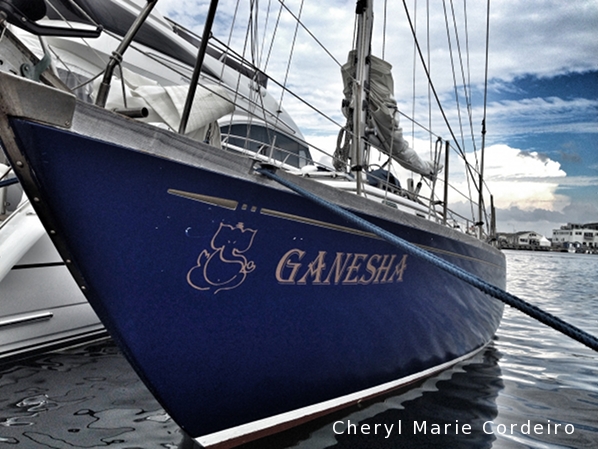
Ideally, one would arrive by boat to dock alongside other seafaring adventurers, a natural thing to do since during the summer, Marstrand hosts an endless number of sailing competitions. The winter season is somewhat of a lull while most activities try to hibernate the best they can.
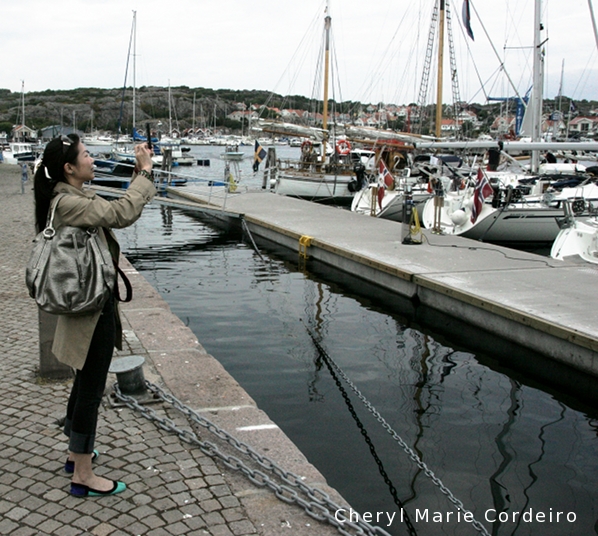
By the quayside, having spotted some über lush princess yachts flagged Norwegian (not pictured), christened “Rojoto” and “Fru Nilsen” (Mrs. Nilsen).