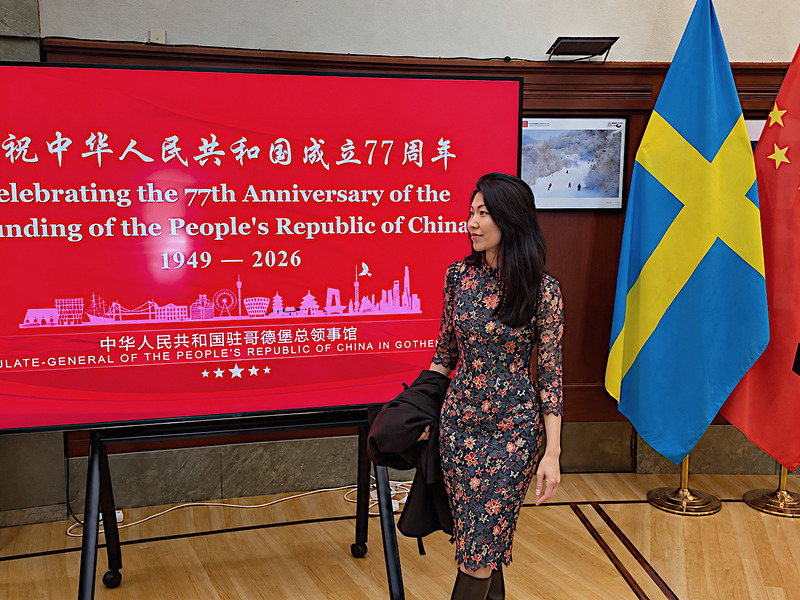
© 2026 Photos and text by JE Nilsson and CM Cordeiro
A lovely evening at the Consulate-General of the People’s Republic of China in Gothenburg, marking the 77th anniversary of the founding of the People’s Republic of China. Guests from many institutions and walks of life gathered under the glass dome of the Consulate’s reception hall.
It was a pleasure to join the celebration and an evening of warm conversations and cultural exchange.
Seventy-seven years of economic change
Seventy-seven years is a short span in China’s long history, yet it covers one of the largest economic shifts of modern times. By the economic historian Angus Maddison’s estimates, China produced roughly a third of the world’s output in 1820, before a long relative decline [1]. Measured at purchasing power parity, its share of the world economy has since grown from about 2 per cent in 1980 to close to 20 per cent in 2025, the largest of any country [2]. Over four decades, the number of people in China living on less than US$1.90 a day fell by close to 800 million, nearly three-quarters of the reduction in extreme poverty worldwide over the same period [3]. Since 2013 the Belt and Road Initiative has recast the historical Silk Road as a network of overland and maritime corridors across Asia, Europe and Africa, regions home to some 64 per cent of the world’s population. Huang [4] describes it as China’s greatest international economic ambition, joining infrastructure with policy dialogue, trade, finance and people-to-people exchange, while identifying coordination, differing political systems and the financial viability of cross-border projects as its main challenges.
Gothenburg and the China trade
Gothenburg is a fitting place for such an evening. The city’s ties to China go back to the Swedish East India Company, chartered in 1731 and based in Gothenburg, whose ships sailed to Canton (Guangzhou) for tea, porcelain and silk. Between 1731 and 1813 the company completed 132 voyages to China with 38 ships, each round trip normally taking a year and a half or more [5]. Economic historians have shown that the company’s profits rested largely on re-exporting Chinese tea to other European markets, and that for much of the century the East India trade dominated Sweden’s transport and trade sectors [6]. The best known of its ships, the East Indiaman Götheborg, struck the Hunnebådan reef on 12 September 1745, some 900 metres from the fortress of Nya Elfsborg at the entrance to Gothenburg’s harbour. It was returning from its third voyage to Canton with some 366 tonnes of tea and around 300,000 pieces of porcelain on board, and no lives were lost in the wreck [7]. In 1992 the Götheborg Ship Project, a plan to build a full-scale replica of the ship, was presented; Jan-Erik Nilsson, whose website gotheborg.com documents the company and its porcelain, was a co-founder and member of its initial management committee [8]. The Götheborg III Ship retraced the old route in 2005–2007 and was received in Guangzhou and Shanghai in the summer and autumn of 2006 [9].
Sweden and China in modern diplomacy
In modern diplomacy, Sweden became the first Western country to establish diplomatic relations with the People’s Republic of China, on 9 May 1950, although the United Kingdom, Denmark and Norway had recognised the new state a few months earlier [10]. Relations went through a difficult period between 2017 and 2021, when several Swedish municipalities scaled back their Chinese partnerships; Gothenburg chose in 2020 not to renew its sister-city agreement with Shanghai [10], [11]. The past two years have brought renewed exchange. The 75th anniversary of diplomatic relations was marked in 2025, Foreign Minister Maria Malmer Stenergard met Foreign Minister Wang Yi in Beijing in October 2025, and China introduced 30-day visa-free entry for Swedish nationals from 10 November 2025 [12], [13]. Wang Yi’s visit to Stockholm in July 2026 continued the dialogue, with trade, the green transition, science and technology among the areas discussed [14].
The evening at the Consulate-General
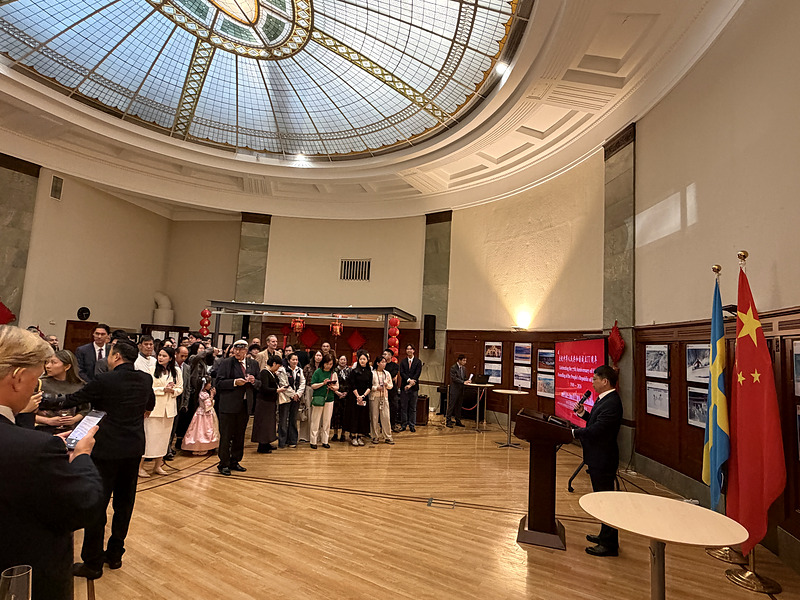
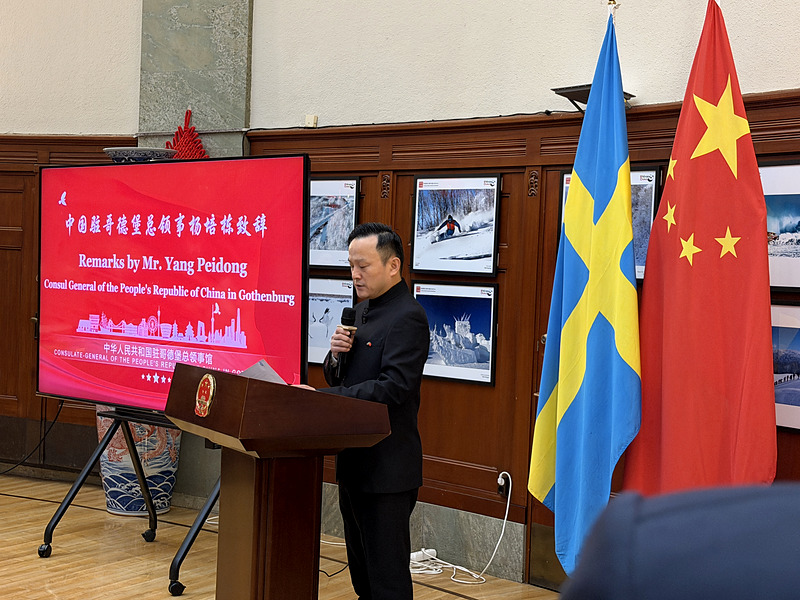
The evening opened with remarks by Mr. Yang Peidong, Consul General of the People’s Republic of China in Gothenburg, who welcomed the guests to the celebration.
Remarks followed from Mr. Mikael Appelqvist, Head of Protocol at the County Administrative Board of Västra Götaland (Länsstyrelsen i Västra Götaland), who addressed the guests on behalf of the region.
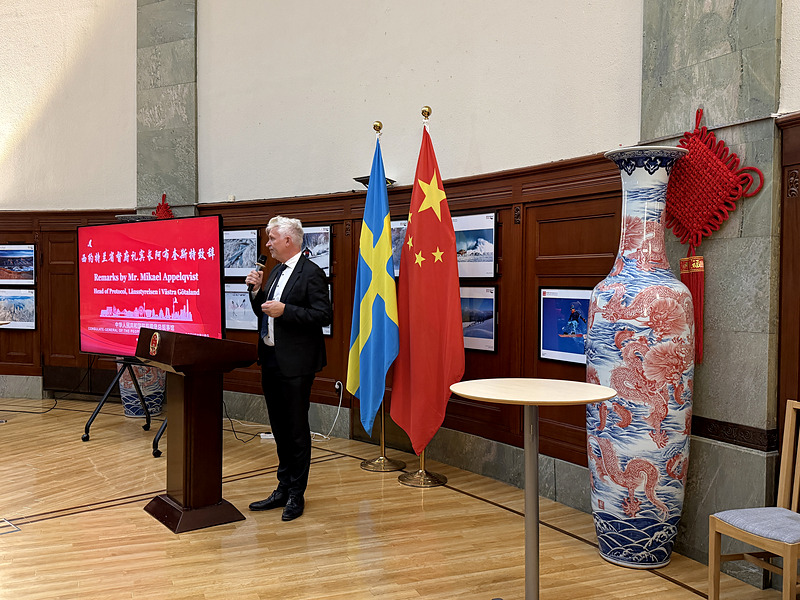
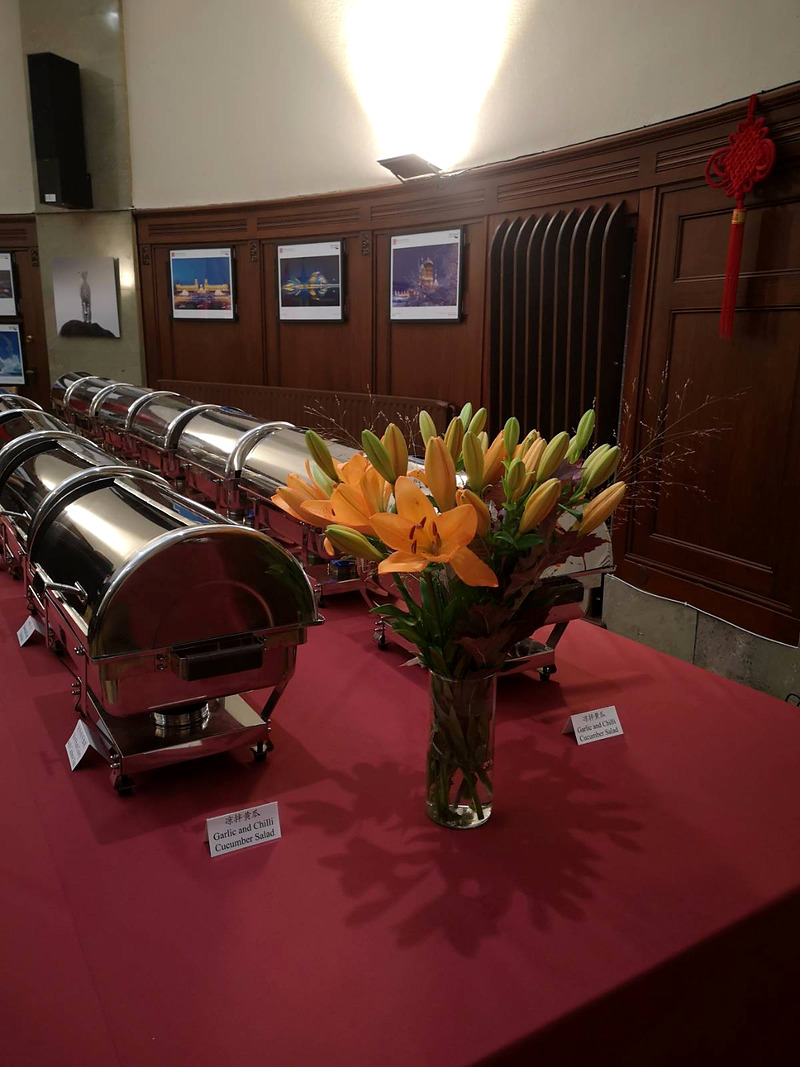
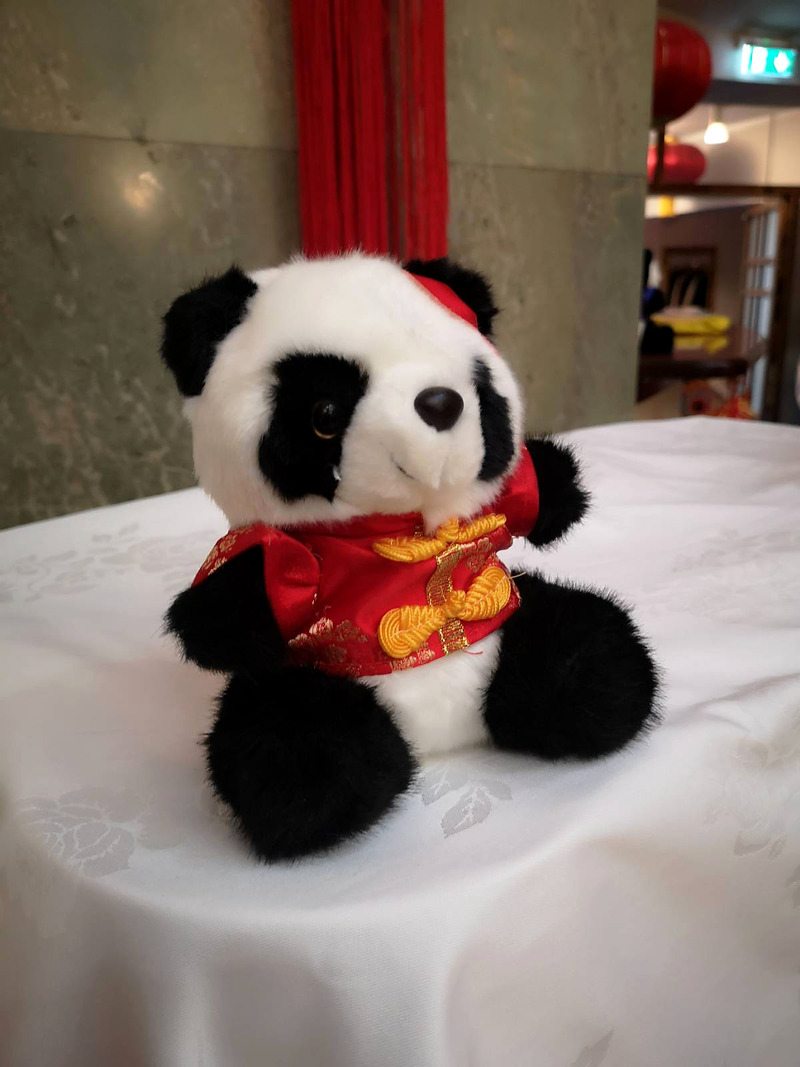
Around the hall, a photo exhibition of winter landscapes and ice and snow sports lined the wood-panelled walls, alongside red Chinese knots and a tall blue and white porcelain vase painted with dragons. The buffet was laid out beneath the photographs, with orange lilies on the table and small bilingual cards naming each dish, from garlic and chilli cucumber salad onwards. There was even a small guest of honour in a red silk jacket keeping watch over one of the tables.
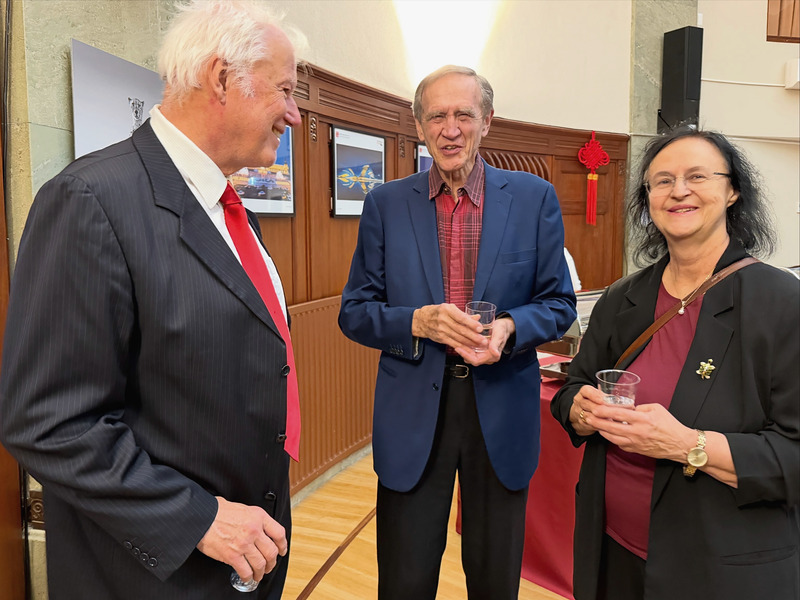
After the speeches the room settled into small circles of conversation, old acquaintances catching up and new ones being made. It was a particular pleasure to catch up with my former PhD supervisor, Professor Emeritus Jens Allwood. My thanks to the Consulate-General for the warm hospitality, and to everyone I had the pleasure of speaking with over the course of the evening.
References
[1] A. Maddison, Chinese Economic Performance in the Long Run, 960–2030 AD, 2nd ed. Paris, France: OECD Development Centre, 2007. [Online]. Available: https://www.oecd.org/en/publications/2007/09/chinese-economic-performance-in-the-long-run-960-2030-ad-second-edition-revised-and-updated_g1gh8357.html
[2] International Monetary Fund, “GDP based on PPP, share of world,” IMF DataMapper, World Economic Outlook. Accessed: Sep. 24, 2026. [Online]. Available: https://www.imf.org/external/datamapper/PPPSH@WEO/OEMDC/ADVEC/WEOWORLD
[3] World Bank and Development Research Center of the State Council, P. R. China, Four Decades of Poverty Reduction in China: Drivers, Insights for the World, and the Way Ahead. Washington, DC, USA: World Bank, 2022. [Online]. Available: http://hdl.handle.net/10986/37727
[4] Y. Huang, “Understanding China’s Belt & Road Initiative: Motivation, framework and assessment,” China Econ. Rev., vol. 40, pp. 314–321, 2016, doi: 10.1016/j.chieco.2016.07.007.
[5] Gotheborg.com, “The Swedish East India Company, trading to China 1731–1813.” Accessed: Sep. 24, 2026. [Online]. Available: https://www.gotheborg.com/project/company.shtml
[6] K. Rönnbäck and L. Müller, “Swedish East India trade in a value-added analysis, c. 1730–1800,” Scand. Econ. Hist. Rev., vol. 70, no. 1, pp. 1–18, 2022, doi: 10.1080/03585522.2020.1809511.
[7] Gotheborg.com, “Last voyage of the Götheborg 1743–1745.” Accessed: Sep. 24, 2026. [Online]. Available: https://www.gotheborg.com/project/lastvoyage.shtml
[8] Gotheborg.com, “The East Indiaman Gotheborg III ship friendship project.” Accessed: Sep. 24, 2026. [Online]. Available: https://www.gotheborg.com/exhibition/je_nilsson.shtml
[9] Götheborg of Sweden, “Previous expeditions.” Accessed: Sep. 24, 2026. [Online]. Available: https://www.gotheborg.se/en/about-gotheborg/previous-expeditions/
[10] A. Börjesson, “Sweden and China: The use of history and mismatched expectations,” Inst. Secur. Dev. Policy, Stockholm, Sweden, Asia Paper, Mar. 2025. [Online]. Available: https://www.isdp.eu/wp-content/uploads/2025/03/Asia-Paper-Agust-March-2025.pdf
[11] G. Sundqvist and B. Jerdén, “Paradiplomacy and international conflict: Disengagement from China by Swedish local governments,” Asia Eur. J., vol. 22, pp. 313–332, 2024, doi: 10.1007/s10308-024-00703-2.
[12] Ministry of Foreign Affairs of the People’s Republic of China, “Wang Yi meets with Swedish Foreign Minister Maria Malmer Stenergard,” Oct. 17, 2025. [Online]. Available: https://www.fmprc.gov.cn/eng/wjbzhd/202510/t20251017_11735375.html
[13] Swedish Chamber of Commerce in China, “China visa-free travel policy for Swedish nationals effective November 10,” 2025. [Online]. Available: https://www.swedcham.cn/chamber-news/china-visa-free-travel-policy-swedish-nationals-effective-november-10
[14] Ministry of Foreign Affairs of the People’s Republic of China, “Wang Yi holds talks with Swedish Foreign Minister Maria Malmer Stenergard,” Jul. 6, 2026. [Online]. Available: https://www.mfa.gov.cn/mfa_eng/wjbzhd/202607/t20260706_11976067.html