Text and Photo © 2026 JE Nilsson, CM Cordeiro
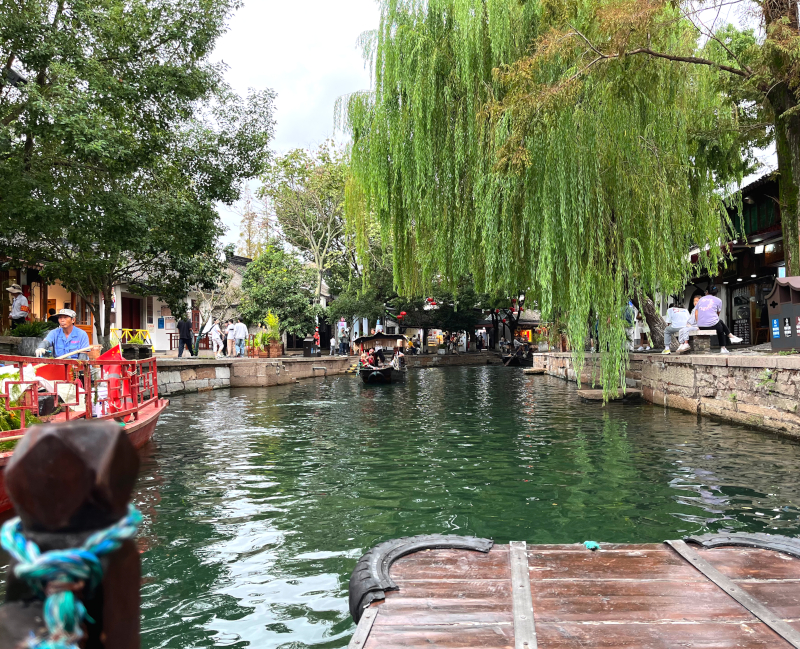
They say the best way to see Shanghai is to leave it, if only for an afternoon. Not for another skyline, but for a place where time is measured by the quiet push of a boat pole and the patient repetition of hands at work. In October 2025, I took the easy one-hour trip out to Zhujiajiao and found it wasn’t a postcard version of the past. It was a living town, layered, textured, and gently awake beneath willows that moved with the breeze.
A watercolour sky
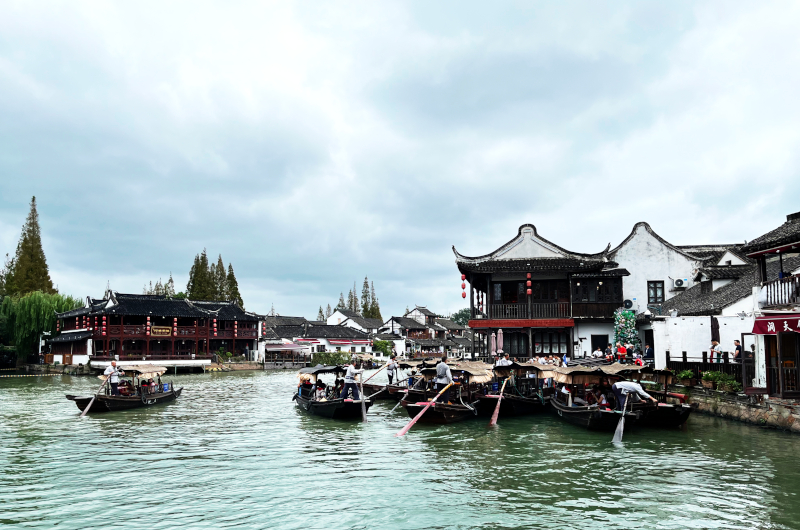
Zhujiajiao in autumn doesn’t need dramatic sunshine to feel beautiful. That day, the sky was more like a thin wash of watercolour, soft and overcast, with swirls of cloud-white. The humidity of summer had lifted, replaced by air that felt clean and light on the skin. The canals held a calm green, the willows stayed green too, and the whole town seemed to lean into a quieter palette.
Overcast weather does something useful: it removes the spotlight and makes you look closer. You start noticing textures instead of highlights, the dampened grain of old wood, the worn edges of stone steps, and the way lantern red doesn’t pop so much as glow steadily against muted surroundings.
At Fangsheng Bridge, which sits at the east end of Great North Street and spans the Caogang River, the town’s most famous crossing still had its choreography, people pausing, framing, waiting for a gap in the crowd. Without harsh sunlight, it felt less like a photo stop and more like a meeting point, with stone underfoot, water below, and voices passing through.
How the town is shaped: one main waterway, many quiet tributaries
Zhujiajiao is easy to read once you understand its layout. There’s a main current of people and shops running along Great North Street (北大街), the place most first-time visitors end up because it’s lively, food-scented, and continuous.
But the real pleasure comes from treating that busy street as a reference line, not a destination. Step off it, just once, just a turn or two, and the tempo changes. The sound drops. The air feels less handled. You begin to move by curiosity instead of crowd-flow.
The rhythm of the back alleys
North Street and its aromas, braised pork trotter included, were hard to ignore. Somewhere between the shop signs and snack stalls, I slipped into a narrower lane and found my favorite moment of the day.
In the doorway of an unassuming shop, a woman worked with calm, hypnotic skill. Her hands moved with the economy that only years can teach: a scoop of glutinous rice, a jewel-bright salted duck egg yolk, a swift fold and twirl of bamboo leaves, secured with a single strand of red string. She was making xian dan huang zongzi, salted egg yolk dumplings.
I grew up with the Straits Chinese version of zongzi, sweetened pork, shiitake mushrooms, winter melon strips, flavors that feel like family. The Zhujiajiao ones were different, savory, rich, unapologetically salted. That egg yolk looked almost decadently inviting, the kind of center you plan your bite around.
I stood there longer than I meant to, because I’d only ever watched my own mother make dumplings with that same expert certainty. And that was the point, it wasn’t a performance for tourists. It felt like routine, like a season made visible through craft. Watching her, I understood why Zhujiajiao feels different the moment you step away from the loudest lanes, the town isn’t only something to be visited, it’s something still being done.
A global gathering, stitched into the local
What surprised me most wasn’t what I saw. It was what I heard.
The melodic Shanghainese of shopkeepers was punctuated by a dozen other languages, Australian accents debating which tea house to try, lively French voices over silk scarves, and the careful murmurs of a German couple studying wooden latticework on an old window.
And then, unexpectedly, coffee.
I ducked into a small local café with young owners, fresh out of university and serious about artisan beans. With a cappuccino in hand on a canal-side café table, I felt that small, steady sense of belonging that comes when a place doesn’t demand anything from you except attention.
Zhujiajiao’s “slowness” doesn’t only feed nostalgia. It’s structural: bridges that force you to climb and pause, water that refuses straight lines, and lanes that reward wandering instead of efficiency. Within that structure, the local and the global don’t clash, they sit side by side. We weren’t all there searching for the same “authenticity” in a slogan-like way. We were simply responding to the same human impulse, to linger, to touch something older than our schedules, and to feel time widen a little.
Leaving with more than souvenirs
Zhujiajiao in autumn isn’t frozen in time. It’s quietly alive, without trying to impress. It’s old stone, slow water, and the soft pull of familiar wonder.
I left under that soft, overcast sky, with the town settling into itself. I carried something better than a souvenir: the warmth of a leaf-wrapped dumpling, the echo of my mother’s hands in someone else’s craft, and the calm proof that Shanghai has another register entirely, one you can step into simply by following the water.