The Ruins of St. Paul’s Cathedral, Macau

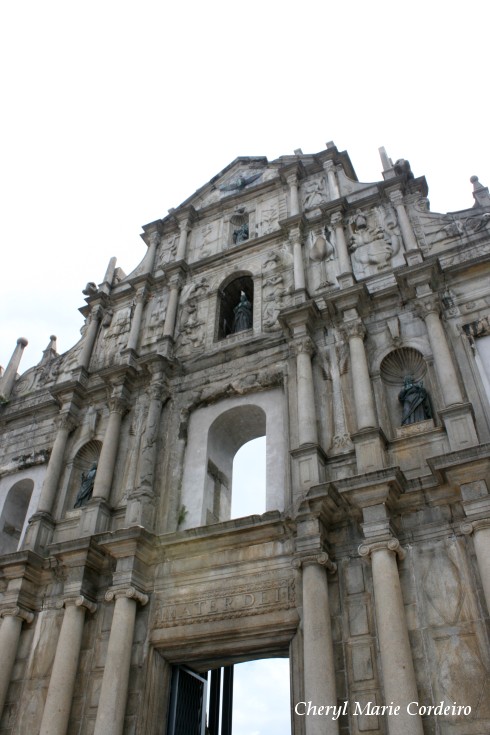
Facade to St. Paul's ruins, Macau.

The facade of Ruínas de São Paulo or the Ruins of St. Paul’s, Macau’s historic landmark that attests their Portuguese heritage.
Photo © C M Cordeiro-Nilsson for CMC 2010

In today’s modern Macau, it is difficult to find any trace that Macau had set out its life as a western outpost in Asia, as a matter of fact together with Malacca as one of the oldest. Macau is also one of the most visible reminders of the fact that it was actually the Portuguese explorer Bartholomew Diaz who in 1488 discovered a sea route to China and that Great Britain, still so present in today’s Singapore, arrived centuries later in the Far East.

Today Macau has been given back to Chinese administration, however the remnants of Portuguese culture is deeply instilled in the food, culture and architecture of Macau. During my recent visit, one of my ‘most important places of interest’ was the Ruins of St. Paul’s Cathedral. To find my way there was a mixed experience.

The Ruins of St. Paul is constantly filled with people, so walking from Senate Square in the direction of the Macao Museum would be one of the most convenient means of getting there. Even when driving, we parked some 400m away and walked.
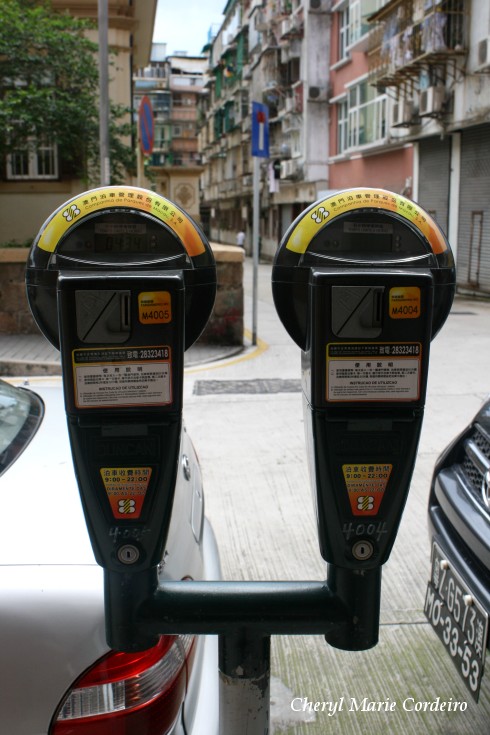
Parking meters, Macau.

Parking meters is the system in Macau when parking along the streets.
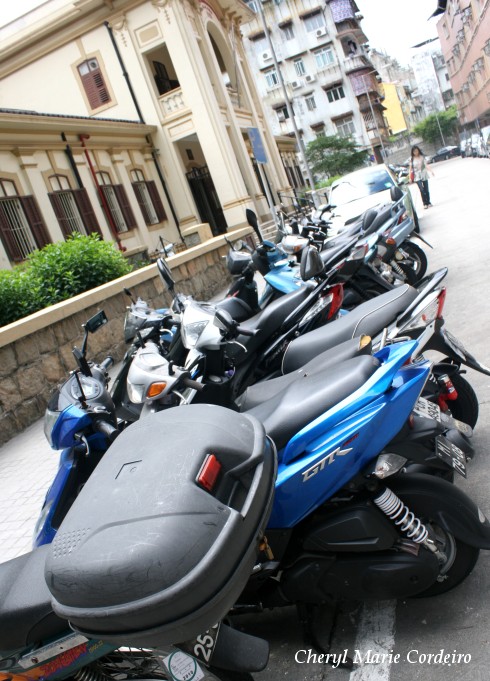
Scooters and motorcycles, common mode of transport, Macau.

Scooters, a common sight and mode of transport.
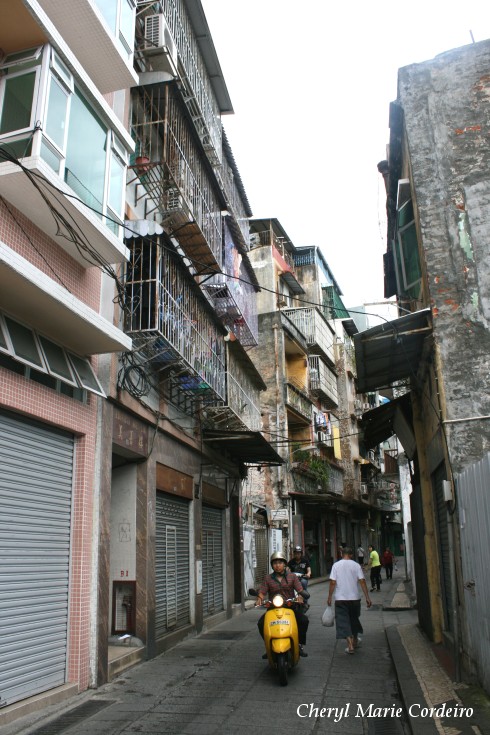
Narrow street, Macau.

All the better to navigate these older, narrow streets.

Parking meters are the system in Macau, if you’re driving and you’ll also notice a fair bit of scooters and small motorcycles on the roads, which are excellent vehicles to navigate the narrower streets of the region.

The Ruins of St. Paul is today what is left of a Portuguese Jesuit cathedral that was accidentally destroyed by fire in the early 1800s. Dedicated to Saint Paul the Apostle, it was in the 1600s, a collegiate church that the Jesuits used to house those of their society who were on their way to Japan, via Macau. These ruins are one of the region’s most historic landmarks and enlisted as part of UNESCO’s World Heritage Site in 2005.
Continue reading “The Ruins of St. Paul’s Cathedral, Macau”
360 Café at Largo da Torre de Macau

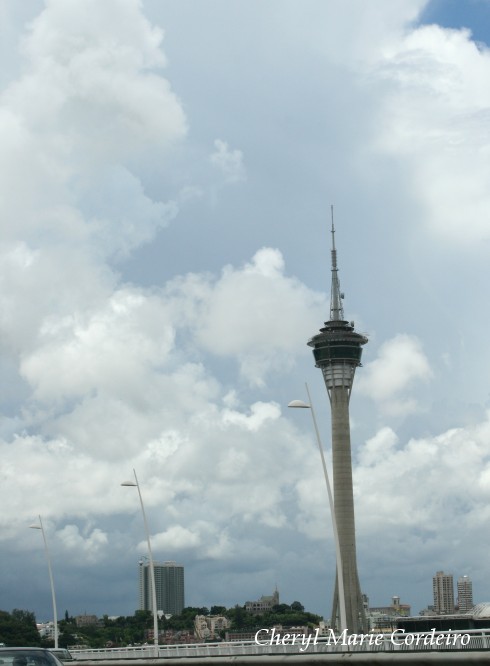
Torre Panorâmica, Macau Sky Tower from the highway, Macau.

Torre Panorâmica or Macau Sky Tower, one of the region’s landmarks with the world’s highest bungee jump point from its outer rim at 233 m. A thrill to all Evel Knievels out there, and certainly not for the faint hearted!
Photo © C M Cordeiro-Nilsson for CMC 2010

Driving along the highway, Macau’s Sky Tower looked akin to Seattle’s Space Needle, though at 338 meters, it stands considerably higher than Seattle’s landmark. Both structures halfway across the globe, have a revolving restaurant at the top and it was there, at 360 Café that we were headed to have lunch.

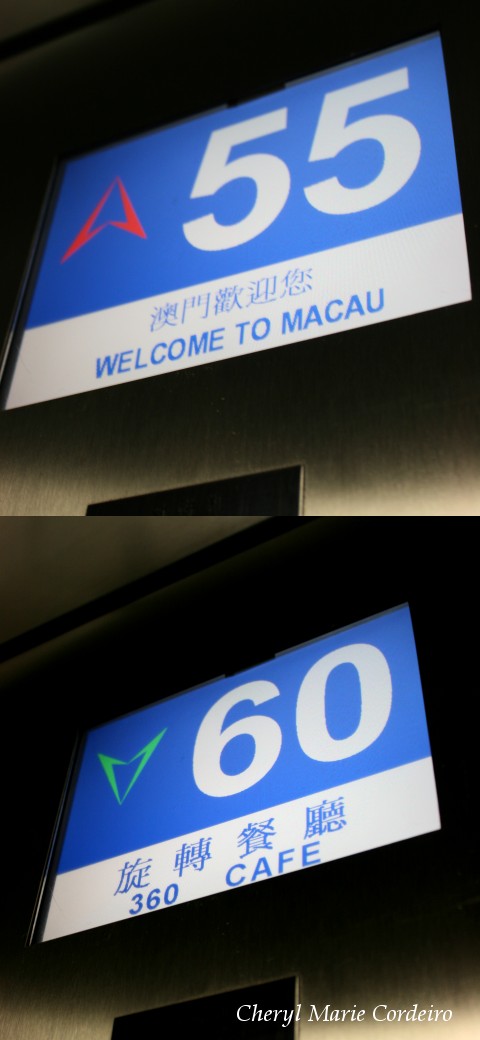
Torre Panorâmica, Macau Sky Tower, elevator to the 60th floor, 360 Café.

360 at 60.

Having never been to Macau or dined at such an altitude, I hardly knew what to expect. The enthusiastic discussions between well-meaning and highly adventurous relatives on bungee jumping after lunch made me think twice about having lunch at all, wondering which was worse, never having bungee jumped at all or contemplating bungee jumping after downing lunch.

My quiet reservations about eating at 360 Café lifted however, when on the 60th floor, I stepped out of the elevator and was greeted by the most delectable spread of cookies, cakes, jellies and fruits – the dessert table laid just where the elevator entrances were.

Continue reading “360 Café at Largo da Torre de Macau”

Through the backstreets of Macau to Margaret’s Café e Nata

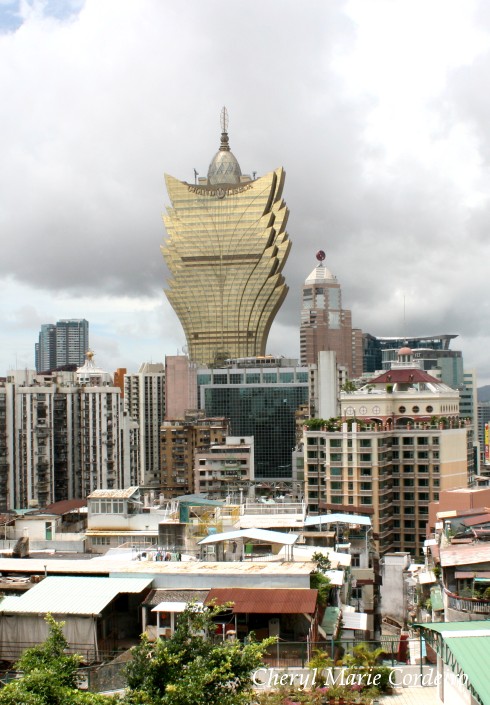
The Grand Lisboa as seen from the fortress, Macau.

A view of Macau today with the towering Grand Lisboa as seen from Monte Forte.
Photo © C M Cordeiro-Nilsson for CMC 2010

When in Macau, what hits you first are the ostentatious buildings, mostly casinos to attract all sorts of tourists. And some people frequent Macau with what I find in slight irony for masochistic reasons, the gamblers for a purpose and the non-gamblers for the sheer delight to revel in what they are not.

But Macau, rich in its history and currently known for its distinctive blend of Portuguese-Chinese culture ingrained into the administrative and education system of the region, is also known for its food.

Café e Nata, Macau for Portuguese egg tarts.

Highly reviewed and written about, though more difficult to locate for first timers in Macau.

In this post is a discovery of some of the most sumptuous Portuguese egg tarts in Macau, tucked away in a highly unlikely corner of the region in Gum Loi Building – Margaret’s Café e Nata.

I thought the café unlikely because of the manner in which I found it. Bundled in a car by relatives and driven to a nearby parking area that wasn’t exactly nearby after all, we walked through busy main streets, crossed several large junctions where the golden glint of the Grand Lisboa loomed large before us, not to be missed by anyone and as if out of nowhere, shuffled into a back alley that though sunny, looked the complete opposite of all that glittered in Macau.
Continue reading “Through the backstreets of Macau to Margaret’s Café e Nata”

Ben and Larry’s in Singapore, thinking outside the ice-cream box

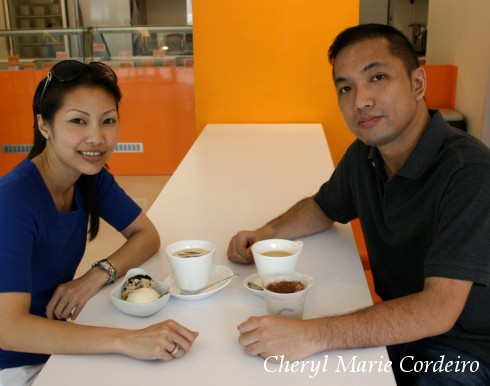
Cheryl Marie Cordeiro and Ben Chung, owner of Blic's homemade ice-cream parlour in Tampines, Singapore

With Ben Chung, part owner of Blic (Ben and Larry’s Ice-Cream) ice-cream parlour at Tampines, Singapore
Photo © Cheryl Marie Cordeiro-Nilsson for CMC 2010

Tucked away in the cozy heartland of Tampines in Singapore, not too far from Tampines SAFRA, I was surprised to find an ice-cream parlour with a sleek orange and cream interior called Blic. Following my instincts in finding good ice-cream, I went in. The place served up authentic homemade ice-cream and sorbets without preservatives, artificial flavours or fillers – a pure food philosophy that was right after my heart!

Ben Chung of Blic (Ben and Larry’s Ice Cream) is the creative force behind Blic and has created more than 40 ice-cream flavours of which some 20 flavours are rotatingly available at the counter at any one time.

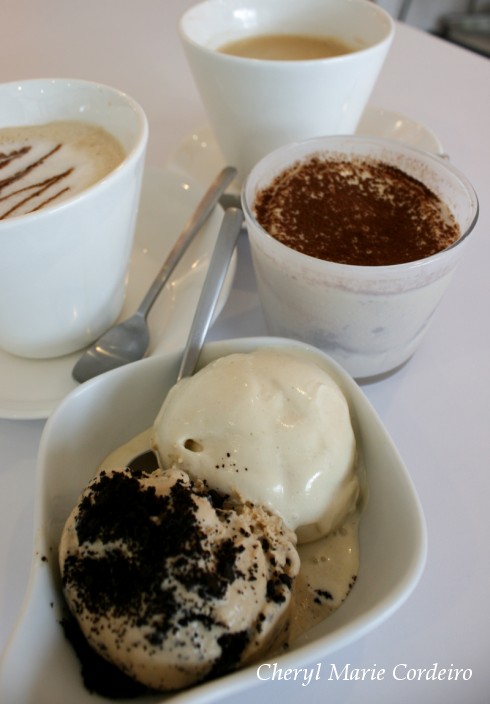
Sea Salt Malt, Kahlua Cookies Caramel and Tiramisu from Blic, Singapore.

That gorgeous melt! Seasalt Malt, Kahlua Cookies Caramel and Tiramisù.

Ben’s first original creation was Seasalt Malt, inspired by Japanese ice-cream parlours and a variation of a popular Japanese Seasalt Caramel he once tried.

Personally, I have to admit I’m not too adventurous when it comes to ice-cream flavours, preferring all my life to stick with dark chocolate, rum and raisin and coffee flavours. Then several years ago when sushi bars were becoming popular and established in Singapore, I tried Matcha or green tea ice-cream which I thought was radical! I’ve personally never tasted an ice-cream flavour that was sweet-salty as in this Seasalt Malt flavour, so this was a first! Another first was Kahlua Cookies and Caramel, where I’ve only ever tried the conservative Cookies and Cream flavour prior to my visit to Blic.
Continue reading “Ben and Larry’s in Singapore, thinking outside the ice-cream box”

Swedish westcoast archipelago

Cheryl Marie Cordeiro, Swedish westcoast 1

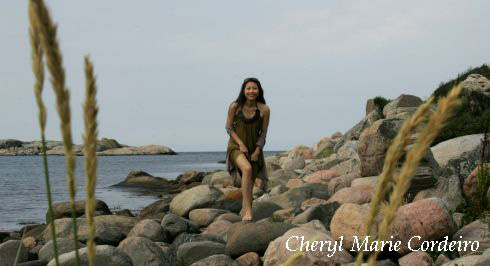
In a moss green maxi halter dress along the Swedish westcoast archipelago.
Photo © JE Nilsson and CM Cordeiro-Nilsson for CMC 2010

I was greeted by a tepid tropical rainstorm when I landed, the weather being unusually warm and playful even as Swedish summers go. It felt surreal that I didn’t need to put on any cardigan on my way home.

Cheryl Marie Cordeiro, Swedish westcoast 2

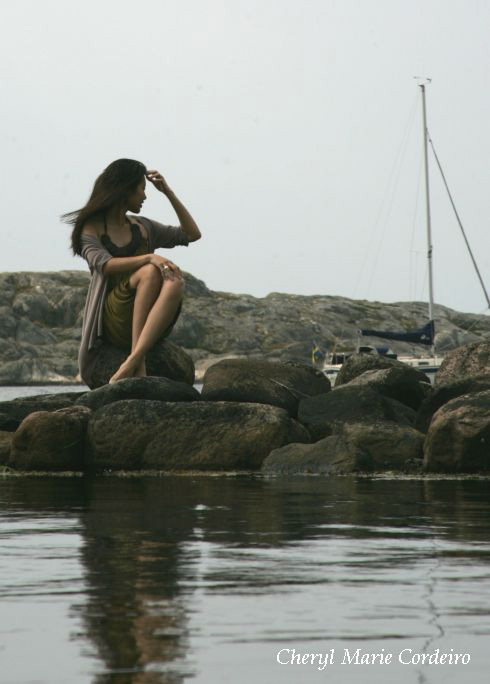
After the hectic weeks spent in Singapore at the heart of Asia, where everything seemed to move at double speed, being back in Sweden offered an instant breather. For one thing, you can sit and watch the sail boats go by without having a need to know where they’re off to or when they’ll return.
Continue reading “Swedish westcoast archipelago”

Dim Sum that touches your heart, in Hong Kong

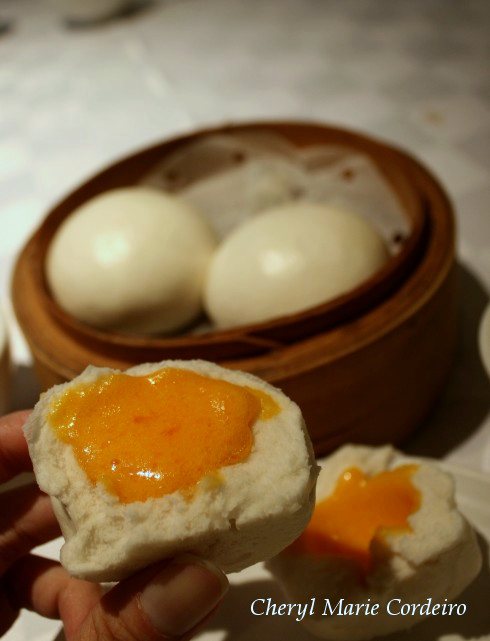
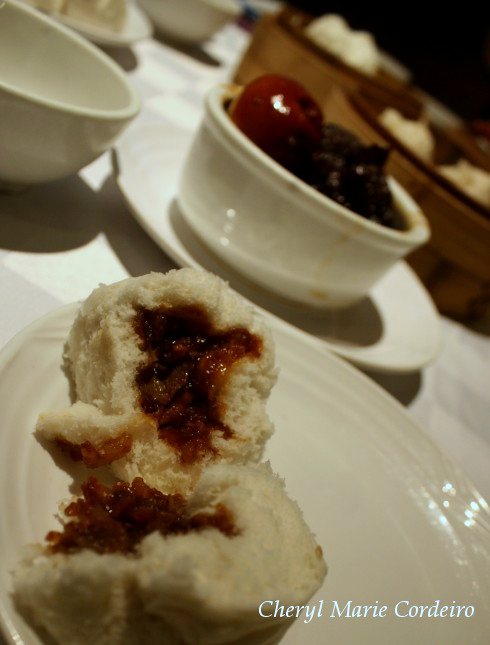
Steamed eggyolk buns, dim sum or yam cha in Hong Kong.

Steamed egg yolk buns, New Star Restaurant, Hong Kong.
Photo © Cheryl Marie Cordeiro-Nilsson for CMC 2010

I’ve far too often heard that Hong Kong has the best dim sum, so I was naturally excited about being in Hong Kong if only for the food.

But when in Hong Kong, like its so many shopping establishments, you’re confronted with so many eateries and interesting food choices that finding the recommended dim sum spots doesn’t even occur to you. You’ll find yourself pulled by interesting sights and smells to various foods on display, not the least amusing is watching people enjoy their meals standing at street corners, oblivious to heavy traffic not two feet from them. People stand and eat with the current rain on their shoulders, playfully dampening their fresh clothes and all of this plus the noise of the traffic and the rush of footsteps from others, makes you as a visitor want to get in on the act too – go completely local and tuck into some interesting food, standing in mud puddles and all.

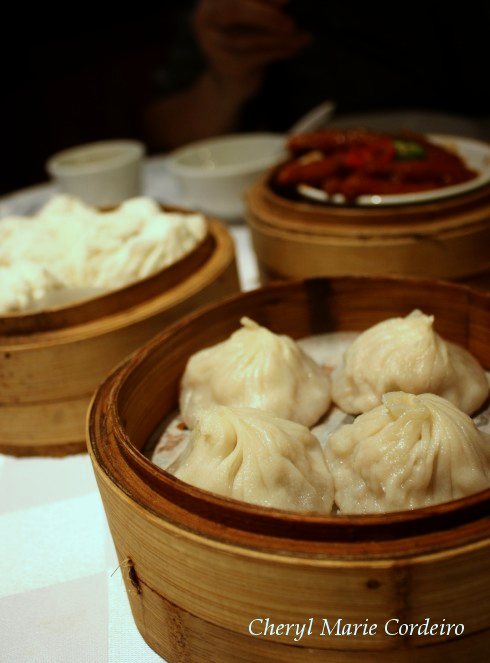
Steamed meat dumplings, dim sum, Hong Kong.

Steamed meat dumplings.

Charsiew pau, dim sum, Hong Kong.

Char siew bao.

After the first rush of excitement and confusion with authentic Hong Kong cuisine, I set about to find the Guide Michelin star dim sum restaurant, Tim Ho Wan (添好運點心專門店) which means “Add Good Luck” at Tsui Yuen Mansion, Kwong Wa St, Mong Kok. The place is notoriously tiny in seating capacity and has been described as literally, a hole-in-wall place to eat. Well, suffice to say, without much planning this time around for Hong Kong and worse, without a map, I didn’t manage to find that place but ended up at New Star Seafood Restaurant along Stewart Road that, to my serendipitous discovery, had some truly awesome dim sum!
Continue reading “Dim Sum that touches your heart, in Hong Kong”

Victoria Harbour, Hong Kong.

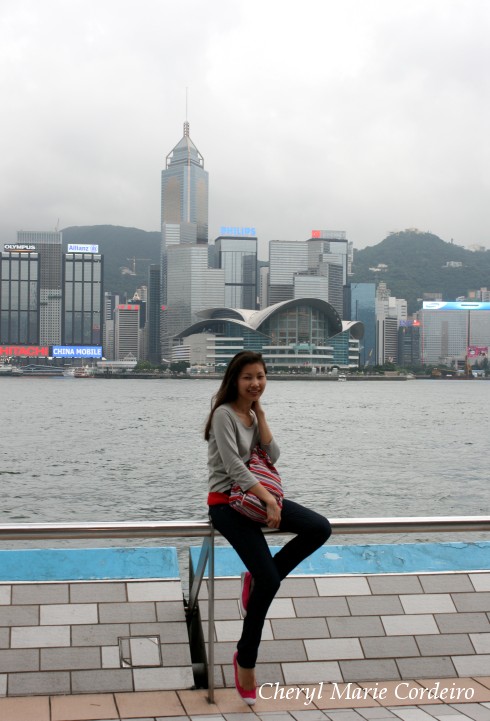
Cheryl Marie Cordeiro at Avenue of Stars, Victoria Harbour, Tsim Sha Tsui, Hong Kong.

Along Victoria Harbour, Tsim Sha Tsui’s Avenue of Stars (Chinese: 星光大道).
Photo © Cheryl Marie Cordeiro-Nilsson for CMC 2010

As you walk around Hong Kong, you realize that there are those who visit and who even do business in the country, but who never get involved, like a bystander that avoids the puddles when it rains, and then there are those who are living the very heartbeat of Hong Kong because they must.

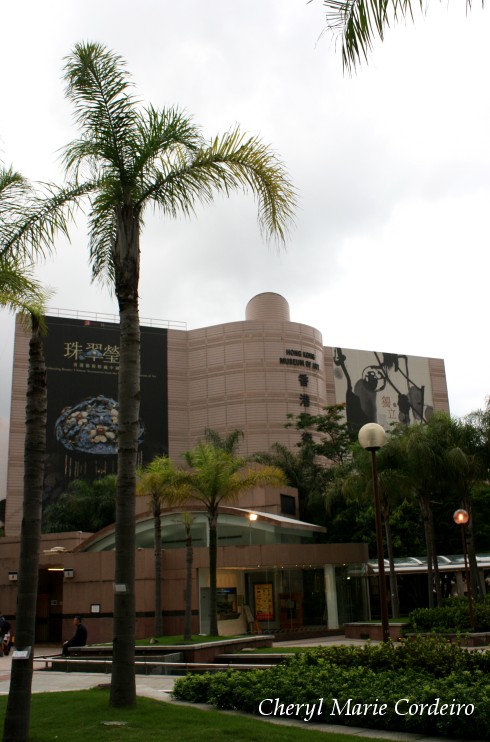
Hong Kong Museum of Art, Tsim Sha Tsui, Victoria Harbour.

Hong Kong Museum of Art, flanks one end of Avenue of Stars along Victoria Harbour, Tsim Sha Tsui, providing visitors a perfect starting point for walking down the waterfront.

These two sides of the same coin is most poignantly illustrated at Tsim Sha Tsui, along Victoria Harbour that shows the two facets of Hong Kong still meeting in this day and age, one of old China and one of what is modern China demonstrated literally by two vessels of different times passing each other. It is at this waterfront that western savvy gathering in The Peninsula, Intercontinental and Shangri-La meet eastern traditional that is just a stone’s throw from the harbour, down from Nathan Road at Mong Kok’s street stalls and wet markets.

Continue reading “Victoria Harbour, Hong Kong.”

Only in Hong Kong…

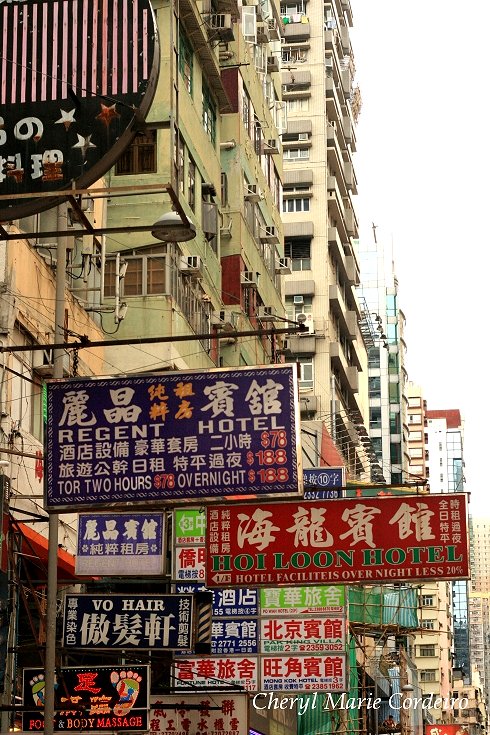
Signboards along road, Hong Kong.

Information overload along the streets of Mong Kok, Hong Kong.
Photo © Cheryl Marie Cordeiro-Nilsson for CMC 2010

Characteristic of Hong Kong is the information overload that greets you along its busy streets, not only from signboards that hang abovehead, but by all the minute happenings along the street and around every street corner. From the movement of goods from van to store, to the bargaining for the best prices and the rush for buses, taxis and the MTR, it’s tempting to want to observe everything when you’re there. For a first time visitor, it’s perhaps sometimes easier if you just ignored for the most part, the things that happen around you in order not to feel overwhelmed by it all, for Hong Kong like Singapore with a sliver of difference, seems also a city that hardly sleeps.

These pictures were taken mostly in Mong Kok, Hong Kong, with the wet market scenes most familiar and heartwarming to me.
Continue reading “Only in Hong Kong…”

ICMIT 2010 and the changing face of Singapore

conference_1

From left to right Keynote speaker, Professor Philip Phan, Dr. Cheryl Marie Cordeiro and Keynote speaker, Professor Michael Song, ICMIT 2010 in Singapore
Photo: Courtesy of ICMIT 2010

Behind the short and cryptic ICMIT stands the full title of the IEEE International Conference on Management of Innovation and Technology 2-5 June 2010. Originally a Singaporean initiative, this conference was now held for its fifth time.

Since my academic interest revolves much around Knowledge Management, Communication and Information Technology, I was happy to find towards the end of last year that a paper I had submitted to this conference had been accepted, and not only that but I was also invited to take a more active role in the conference by being part of the scientific review committee and indeed, actually chairing one of the sessions.

Even if I have spent my last ten years in Sweden, I did grow up in Singapore and spent my postgraduate years at the National University of Singapore (NUS) and the Nanyang Technological University of Singapore (NTU) respectively.

So this conference was a happy reunion of sorts since the organizers of this conference were mainly from NUS and NTU, so it gave me a chance to meet with several former professors, who were also my mentors. In particular a warm thank you goes to Dr. Chai Kah Hin (NUS) and Dr. Ravi Sharma (NTU) for a conference well organized, and to Dr. Chris Khoo Soo Guan (NTU) who besides a most impressive tour around the vast NTU campus also showed us the best new dessert and ice cream parlors in the area.

Conference themes
The main theme to this year’s ICMIT conference was Management of Innovation and Technology in its widest sense. My point and contribution was to discuss that technology when managed, packaged and sold as in whole industrial complexes for example, would fail if not accompanied by the tacit knowledge that is needed to make it work. My point was illustrated from the perspective of Swedish managers working in Swedish companies in Singapore.

lecture_4119

My paper was presented under Knowledge Management (1), 4/6/2010 13:30-15:00, Room: Jupiter, Chairs: Cheryl Marie Cordeiro and Ying Hsun Hung

As an example, a bicycle in a box however neatly packaged and sent somewhere, would still need someone to teach one how to use it, to be of any use at all. And how this tacit (implicit) knowledge transfer – by definition not possible to codify – could be investigated and assessed by the use of language.

When keeping up is not enough
What struck me when we circled down for landing in Singapore Airline’s (SIA) Boeing 777-212ER was how fast Singapore changes. Every time I come back, the landscape changes.

orchard_ion_building

The new ION shopping mall that opened July 2009 at Orchard Road, brings together “the world’s best brands’ flagship, concept and lifestyle stores within one development, with four levels above ground and four levels below – totaling 66,000 square meters of retail space.”

There is however, a price to pay for Singaporeans with these speedy changes. There are so many memory lanes that are just not there anymore to be walked and the financial and architectural development is done in such a rush, at such a breakneck speed, that it washes clean a sense of rootedness for Singaporeans to its land. Still, Singapore is indeed one of the major financial and administrative centers in South East Asia, a character trait that impresses upon visitors with the current architecture of the heart of the Central Business District. The goal of Singapore is to make it to the lead, and remain there.
Continue reading “ICMIT 2010 and the changing face of Singapore”

Swedish Midsummer’s dessert

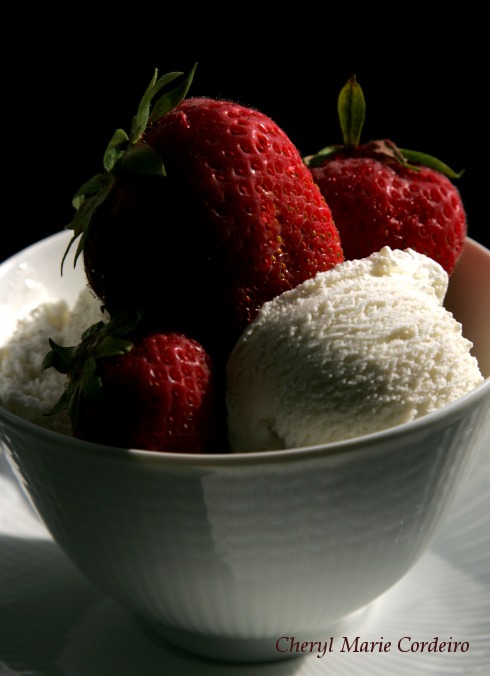
Fresh strawberries and ice cream dessert, the ideal midsummers party dessert. No preparation time at all leaves plenty of time for your friends.

Fresh strawberries and ice cream dessert, the ideal Midsummer’s party dessert. No preparation time at all leaves plenty of time for your friends.
Photo © Jan-Erik Nilsson for CMC 2010

The upcoming weekend is the traditional celebration in Sweden of the absolute longest day during the whole year and consequently the shortest night. Originally a pagan tradition, it is still celebrated with dancing around the midsummer’s pole – symbolizing fertilization of the soil – and in anticipation of bountiful harvest.

Nowadays the harvest is not so much the issue as a splendid opportunity to have a barbecue party in the garden and meet friends. With this in mind I would like to share one of the simplest ideas of the whole year as a perfect dessert – plain vanilla ice cream and fresh strawberries.

The strawberries however, not travel well and should be had ideally directly from the field.

All things considered this might actually be on of the few occasions where Scandinavia have an advantage over tropical Singapore. They might not have ripe mango, rambutan or lychee but – they do have sun ripened strawberries.