China changing gears towards sophisticated luxury

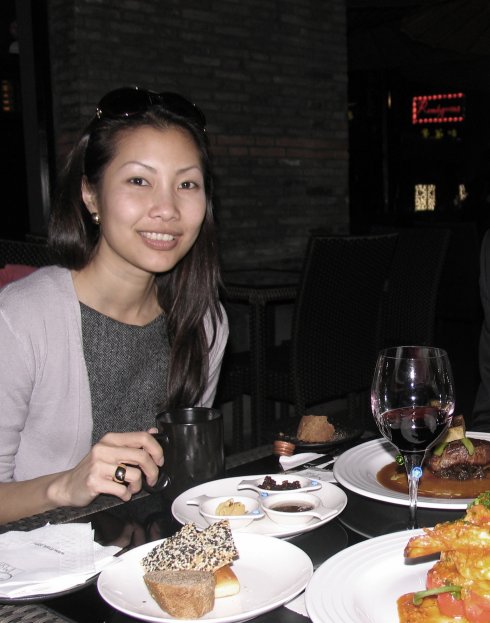
Dinner in Shanghai that is about ten hours by direct flight from Sweden.
Text and Photo © PO Larsson and CM Cordeiro 2012

Shanghai’s changing cityscape is reminiscent of the changing skyline of Singapore, where every time I visit I find myself looking at a skyline that is augmented in some manner especially in Lujiazui, which also most reminds me of the Singapore quiet in the Central Business District by Raffles Quay by night.
Continue reading “China changing gears towards sophisticated luxury”
Lulling hours in Shanghai, where old meets new…

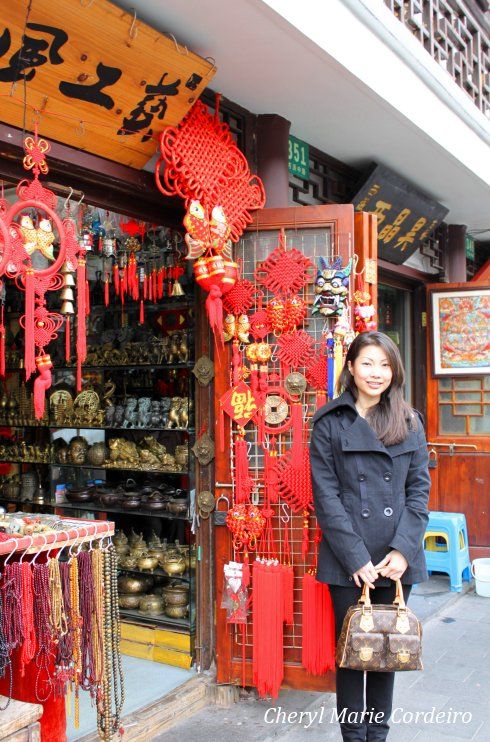
Cheryl Marie Cordeiro, Yuyuan, Shanghai 2011.

Along the streets at Yuyuan, Shanghai.
Text and Photo © CM Cordeiro 2011

Waking up in China’s largest city that is Shanghai, amongst its more than 24 million inhabitants certainly puts a perspective on how much of an impact you might make during a single day in your life when you finally step out the door and make your way around with your errands.

In just about twenty to thirty years, Shanghai as a city has grown at an amazing speed. The skyscrapers seen today along the Huangpu River, The Bund and Lujiazui were non-existent just a stone’s throw back in time, where it would’ve been difficult for most anyone to recognize the landscape and skyline of the central finance district between these decades if you were not at first shown pictures of the landscape from then till now.

The past decade alone has seen a paradigm shift in Shanghai from a city with Communist ideals to one that is cosmopolitan with a global outlook. Much of this is the fruitful result of the Chinese government’s efforts at economic reforms in China beginning in the late 1970s and early 1980s.

If any organization could trace and reflect an aspect of Shanghai’s modern history in global trade and the resulting impact of the Chinese government’s efforts at bringing China and its state-owned enterprises to the global scene, then Baosteel Group Corporation, the second largest steel producer in the world with approximate annual revenues of around USD $21.5 billion would be a good case study to examine. With 45 wholly owned subsidiaries in markets across the world, in countries with as diverse cultures such as Brazil, France, Germany, Russia and in Asian and Southeast Asian countries such as Japan, Hong Kong and Singapore , Baosteel reflects the speed and tenacity at which Chinese organizations are able to make themselves visibly global whilst simultaneously catering to their very demanding and highly competitive domestic market.

Still, amongst the city’s global ambitions supported and run by its busy inhabitants who seem to maneuver through the city via just as many noisy and exuberant vehicles that never cease their honking, you’ll find in Shanghai that some waking hours beckon a certain lull to the senses, and are in effect… quieter than others. And it is in these hours that you can sit, think and breathe the calmer soul of the city as a mist that invites you to contemplate its living as an artfully drawn landscape, one perhaps seen in Chinese watercolour on silk or paper. It is these brief lulling hours of Shanghai, at dawn or just after dusk, that paints a picture of the place both past and present, juxtaposed in front of your very eyes in material form.
Continue reading “Lulling hours in Shanghai, where old meets new…”

Yuyuan street eating and daily practicalities, Shanghai

Cheryl Marie Cordeiro 7 Dec 2011 Shanghai 03aWith the quick glances of distraction observed from tourists and a slight quickening of their pace past the local lunch scene at Yuyuan in Shanghai, where the local people seemed perfectly at east sitting along the roadside with their bowl of rice in one hand and chopsticks in the other, eating whilst waiting for their next customer to walk into the shop, I understood with clearing clarity that for most of Northern Europe, dining was a much more formal affair around a set table.

And the Northern European concept of dining was quite a contrast to this fairly common aspect of people eating on the move or simply eating outdoors in Asia in general. Whether in India or the various equatorial countries of Southeast-Asia such as Thailand, Vietnam, Singapore and Indonesia, or the more temperate regions of China, food sold along the streets in wheel carted food stalls and eating along the streets is as practical and nomadic as having all your goods for sale stacked onto a single bicycle or motorcycle and sold wherever you found a customer along the street.

Yuyuan wholesaler's street, Shanghai 2011.

Yuyuan Market, Shanghai.
Text and Photo © CM Cordeiro 2011

I grew up in the decades of Singapore where people did cart their goods around and sold them from their bicycles, and where food such as bowls of noodles, plates of fried kway teow and even cold food such as ice-shaved desserts called ice-kachang (a Singapore and Malaysian variation of ‘sorbets’ made from just rough shaven ice and sweetened with colourful syrup dripped all around the cone of ice shavings) were sold from wheel-carted trolleys. For warm dishes, burning charcoal was used for fuel in the mid-1900s for cooking and later on, small portable gas units were used.

Still, the scene in China is much more rustic and unaware – people just didn’t think if you stopped and stared at them eating, because for them, it was all part of the natural process of the day, just another practicality that you have to deal with, seamlessly interwoven into their main activity of the day, which is working. Living and working seamlessly – that is what you’ll witness at lunch hour at Yuyuan.

Continue reading “Yuyuan street eating and daily practicalities, Shanghai”

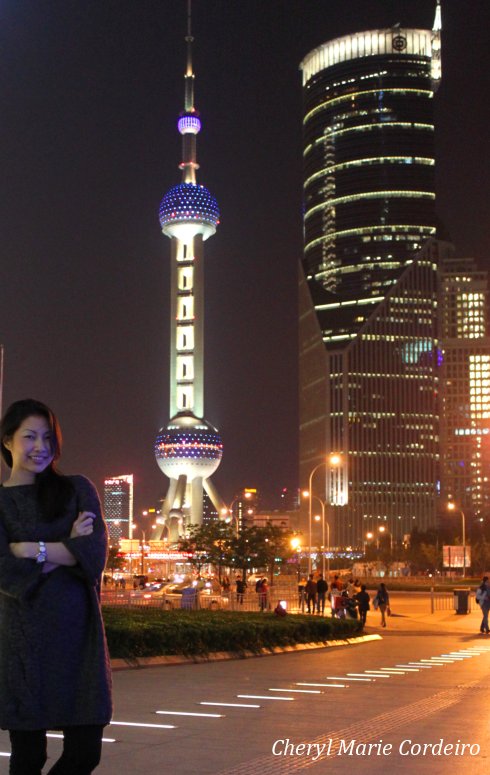
Lujiazui by night, Shanghai

Cheryl Marie Cordeiro at Lujiazui, Shanghai 2011

Lujiazui by night. In the background, lit blue, the Oriental Pearl Tower.
Text and Photo © K Meeks and CM Cordeiro 2011

When in Shanghai, the last place I expected to find myself exploring come sundown is Lujiazui, the city’s financial district, as the more popular of nightspots would include Xintiandi or even the quieter street of Hengshanlu lined with all sorts of eateries from Turkish and Thai to Hunan cuisine.

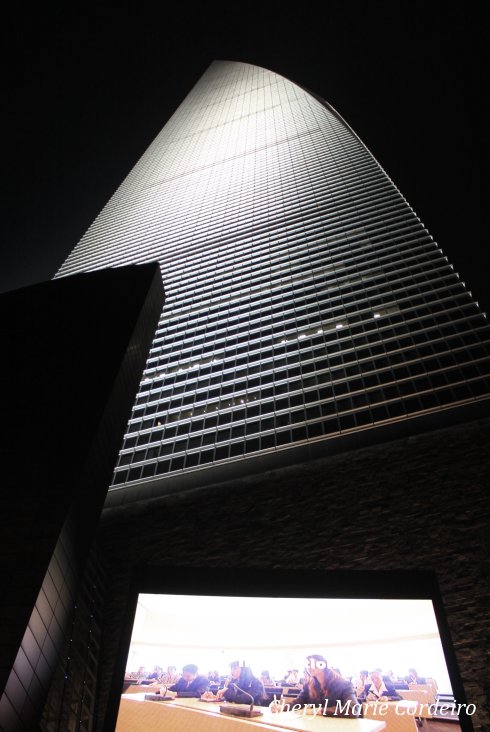
Shanghai World Financial Center

Shanghai Word Financial Center (SWFC).

Still, walking down the pristinely clean streets of Lujiazui lit blue and orange from the surrounding buildings, called to mind the quiet of Raffles Place and Singapore’s very own Central Business District by night, where all at once, despite the glittering globes of the Oriental Pearl Tower in festive blue ahead, I couldn’t help but feel at home, thinking – this is Asia! – and how much I miss its vibes when living and working in Scandinavia. Continue reading “Lujiazui by night, Shanghai”

The Swedish East Indiaman Gotheborg – and the tiger economy of Sweden

The Swedish East India Götheborg III was launched in 2003, in Gothenburg, Sweden.

In 2003, launching of the Swedish East Indiaman Gotheborg III
Photo © JE Nilsson and C M Cordeiro-Nilsson for CMC 2003-2011

My personal involvement in the Swedish East Indiaman Gotheborg III project was so early that I had not myself realized it back then. In the project newspaper GotheborgsPosten that was distributed in 360,000 copies throughout the entire western Sweden in 1996, it was outlined that one of the research objectives that would be targeted was Swedish-Chinese Business Communication. The Professor that in 2003 would arrange for me to receive the Anna Ahrenberg Research Funding Scholarship to help me start a PhD research (graduated in 2009) in doing precisely that, was interviewed. Strange indeed are the paths of life. Today, I go off to work everyday by ferry straight across Wargö Håla, the historic departure point of the Swedish East Indiamen in the western Swedish archipelago. In fact the house in which we live features one of the ship’s actual water provision wells in our very garden.

Currently at work, at the University of Gothenburg School of Executive Education AB, prevalent topics of discussion circle around Swedish-Chinese business relations and the future of work prospects with Sweden’s competitive growing economy that earned acknowledged nods from Swedish leaders, specifically that of its Finance Minister, Anders Borg, of the country being a Nordic tiger economy (ref. Di, DagensPS and Epoch Times). All this showing that the Swedish East Indiaman still has a relevant role to play, more so today than ever in its importance of growing global contacts. Its shared goodwill initially created by the East Indiaman Project is everywhere present.

In the media recently, a passionate discussion has arisen about what to do with the ship, now when its initiating ideas have been completed – the ship built and it has traveled to China and back. What now?

Many suggestions including turning it into a museum, an amusement park and why not – firewood – have come forth. Personally not even at today’s energy prices does the idea of firewood sound very brilliant.

Eventually, the original Founders of the project have chosen to step forth, and in this weekend’s local newspaper GP, have briefly presented their views of how the ship could continue to earn its keep and do much more than that.

The following article were published in GP, in January 22, 2011, as part of the ongoing debate about the future of the Swedish East Indiaman Gotheborg III ship.

H.R.H. the King Carl XVI Gustaf and Queen Silvia of Sweden disembark the Goteborg III and officially set foot on Chinese soil.

H.M. King Carl XVI Gustaf and H.M. Queen Silvia, disembark the Gotheborg III in Canton, China, 2006.

From the point of view of Anders Wästfelt and the Think Tank Gotheborg, the ship is far from done sailing:

In view of the past few days defensive debate in the media and our City Council, on the future of the East Indiaman Gotheborg, it is time to lift our eyes beyond the horizon. In the right hands the Götheborg III – our ship – is a regional and national asset with huge potential.

She has great future tasks, functioning as a symbol of our community, an inspiration for continued work and as a source of financial revenues. She is well-built and with proper maintenance, she can sail for another 20-30 years.

The project to build a replica of the 1700s Swedish East Indiaman began in 1992 as a private initiative. It was well thought through and enjoyed the support of international shipbuilding expertise, the best marketing specialists, lawyers, economists, politicians, sinologists, university faculties as well as members of the Swedish Ministry of Foreign Affairs and the Swedish Trade Council.

Continue reading “The Swedish East Indiaman Gotheborg – and the tiger economy of Sweden”

La Vie En Rose at The Astor House Hotel, Shanghai

Cheryl Marie Cordeiro-Nilsson, at La Vie En Rose, the Astor House Hotel, along the Bund, Shanghai.

Breakfast at La Vie En Rose, the Astor House Hotel in Shanghai, along the Bund.
Photo © Yina Huang, P O Larsson and C M Cordeiro-Nilsson for CMC 2010

Every New Year most people will find themselves writing new resolutions for the year ahead – a healthier year ahead, a more successful year ahead, new goals to be attained or renewed interests in old goals previously unattained – but for me, as 2010 passes and this night welcomes 2011, I can’t help but go back to what has been there for a very long time. A time when I was growing up, of photographs now a natural sepia in family albums.

One such place where time has seemingly stood still, and which now come to mind from my travels in the past year is The Astor House Hotel along the Bund in Shanghai.
Continue reading La Vie En Rose at The Astor House Hotel, Shanghai”

Visiting the Geely Holding Group in Hangzhou, November 2010

Geely headquarters, Hangzhou, China.

The Geely Holding Group headquarters in Hangzhou, November 2010
Photo: J E Nilsson and C M Cordeiro-Nilsson for CMC © 2010

It was with great expectations that I went to visit the Geely headquarters in Hangzhou, the Zhejiang Geely Holding Group Co. Ltd, as part of a Swedish delegation from the University of Gothenburg. Geely’s acquisition of the Swedish car manufacturer Volvo with their headquarters in Gothenburg was announced on Monday the 2 August 2010 and with that, the Zhejiang Geely corporation had concluded the largest ever acquisition of a foreign car company in the history of China.

Geely headquarters, University of Gothenburg visit 2010.

A warm sign at the Zhejiang Geely Holding Group headquarters that welcomed the visit by the Swedish delegation.

Geely headquarters, hallway.

Just inside the Geely headquarters entrance.

Having followed the Ford and Geely negotiations as well as could be done in the press, I expected this acquisition to be an important opportunity to study the process of top management knowledge transfer between modern China and the West.
Continue reading “Visiting the Geely Holding Group in Hangzhou, November 2010”

M on the Bund, Shanghai

Cheryl Marie Cordeiro-Nilsson and Yina Huang at M on the Bund, Shanghai.

Sunday lunch at M on the Bund with the Swedish delegates to Shanghai (pictured below) and Yina Huang, Associate Director, Global Local Public Relations Office, Shanghai University’s MBA Center.
Photo © Olof E Johansson, J E Nilsson and C M Cordeiro-Nilsson for CMC 2010

Shanghai is a remarkable city. Considering all vicissitudes this unfortunate city has seen over the last century it was with great expectations that I recently got to visit it, and to explore to what extent this city had regained its former glory. And in many ways it has.

The ebb and flow of great fortunes being made and lost ripples through the city, constantly changing its face. What is a constant is the river, and facing it is still the Bund however much widened. Across the river on the east bank, an entirely new skyline of Pudong greets us, the new skyscraper-laden financial and commercial district that also houses the new Pudong International Airport.

River view

Pudong area, just seen across the Huangpu River. To the left, the somewhat brutal outline of the ‘Oriental Pearl’ Tower.

What better place to take in all of this but at the fashionable restaurant, M on the Bund? As one review had it:

With superb Continental cuisine, an excellent wine selection and deft service, the fashionable M on the Bund sets the standard for other haute cuisine restaurants in Shanghai. As the place to see and be seen, the much-touted eatery attracts its fair share of Shanghai’s movers and shakers. Contemporary, airy and stylish decor complements sweeping views of the Bund. The food reaches equally high heights. Diners are recommended to try the Salt Crusted Leg of Lamb and the Crispy Suckling Pig. They should also leave room for dessert—the sinfully delicious pavlova is rightfully legendary.

But however much I had wanted that to be my impression too, I am forced to say I beg to differ.

I believe that if I were living in Shanghai, M could possibly be a place where I might want to bring friends and visitors. But it isn’t a place I would find myself craving to come back to, nor a place I would get addicted to as it stands right now.
Continue reading “M on the Bund, Shanghai”

Sunrise in Shanghai

The Hengshan Picardie Hotel, Shanghai

Morning skylight, at the Hengshan Picardie Hotel, Shanghai.
Photo © C M Cordeiro-Nilsson and Per-Olof Larsson for CMC 2010

And I thought I would walk into a city that would be so foreign to me that I would not have understood half of what was going on as soon as I landed. But I was wrong. In fact, the melding I felt to Shanghai was so immediate it was as if I had stepped off the plane, right back home.

One of the things I look forward to whether travelling or at home, is breakfast. Shanghai, being such a dynamic and cosmopolitan city, has no problems providing for all sorts of palates. In fact, settling for both a red bean steamed bun and a mini chocolate muffin at breakfast was just the sort of thing that a Singaporean for example, wouldn’t think twice about either.
Continue reading “Sunrise in Shanghai”

Dim Sum that touches your heart, in Hong Kong

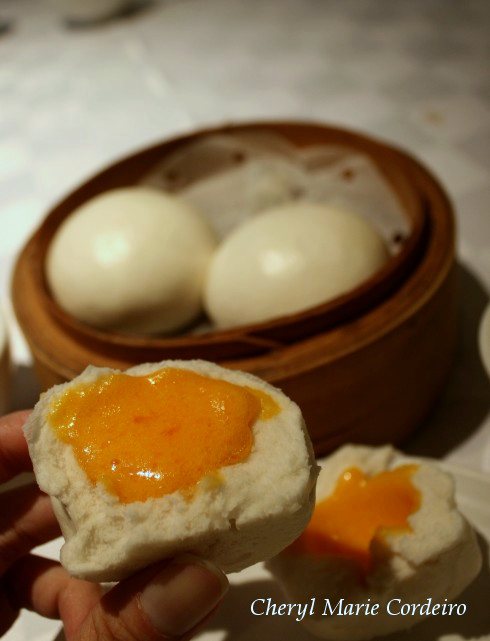
Steamed eggyolk buns, dim sum or yam cha in Hong Kong.

Steamed egg yolk buns, New Star Restaurant, Hong Kong.
Photo © Cheryl Marie Cordeiro-Nilsson for CMC 2010

I’ve far too often heard that Hong Kong has the best dim sum, so I was naturally excited about being in Hong Kong if only for the food.

But when in Hong Kong, like its so many shopping establishments, you’re confronted with so many eateries and interesting food choices that finding the recommended dim sum spots doesn’t even occur to you. You’ll find yourself pulled by interesting sights and smells to various foods on display, not the least amusing is watching people enjoy their meals standing at street corners, oblivious to heavy traffic not two feet from them. People stand and eat with the current rain on their shoulders, playfully dampening their fresh clothes and all of this plus the noise of the traffic and the rush of footsteps from others, makes you as a visitor want to get in on the act too – go completely local and tuck into some interesting food, standing in mud puddles and all.

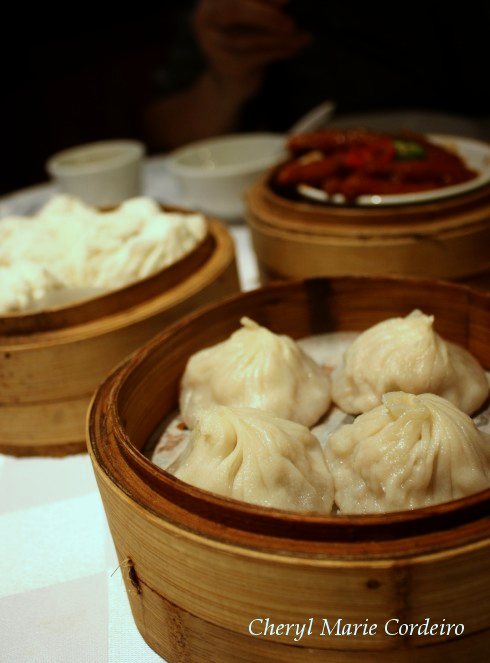
Steamed meat dumplings, dim sum, Hong Kong.

Steamed meat dumplings.

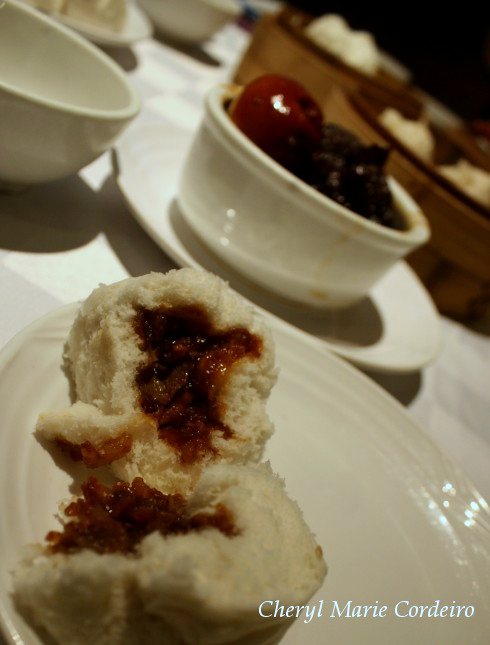
Charsiew pau, dim sum, Hong Kong.

Char siew bao.

After the first rush of excitement and confusion with authentic Hong Kong cuisine, I set about to find the Guide Michelin star dim sum restaurant, Tim Ho Wan (添好運點心專門店) which means “Add Good Luck” at Tsui Yuen Mansion, Kwong Wa St, Mong Kok. The place is notoriously tiny in seating capacity and has been described as literally, a hole-in-wall place to eat. Well, suffice to say, without much planning this time around for Hong Kong and worse, without a map, I didn’t manage to find that place but ended up at New Star Seafood Restaurant along Stewart Road that, to my serendipitous discovery, had some truly awesome dim sum!
Continue reading “Dim Sum that touches your heart, in Hong Kong”