Swedish apples in late autumn

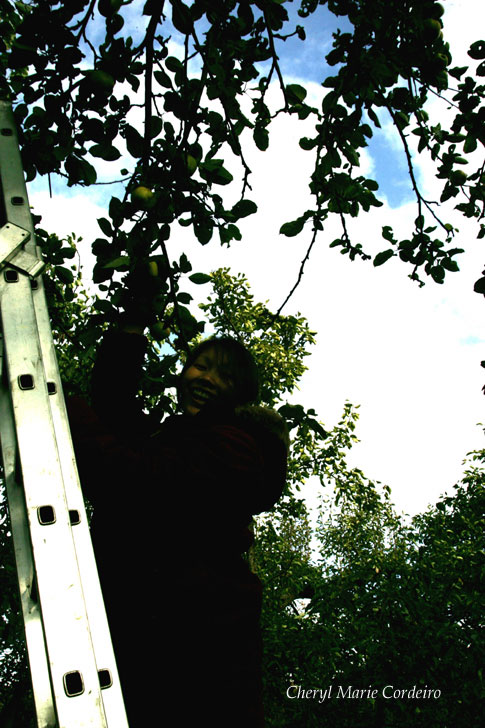
Apple picking in late autumn.

The end of autumn brings about all things Apple, because it is during the late autumn that Swedish apples ripen. Walking in an apple tree garden that is ripe for the picking is so dreamy that one can’t help but spontaneously pull out all old family recipes of apple pies, apple cakes and apple buns you got.

As it happened a neighbour of ours had an unexpected abundant crop of Gravenstein this year invited us over to basically help ourselves to as much as we wanted. It sounded like too much fun to miss out on, so we of course brought home as many apples that we felt we could possibly use over the winter.
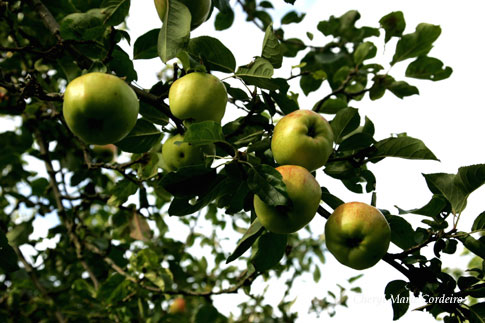
Gravenstein apples ripe for the picking.

The Gravenstein variety of apples has been around in Sweden for about 300 years. It has a wonderfully round personality, being fantastically fragrant, very juicy and of a size that fits generously into the palm of your hand. The Swedes consider this the Rolls Royce of Swedish apples and is ideal for cider but works well for pretty much anything you can do with apples.
Continue reading “Swedish apples in late autumn”

Surströmming, a traditional Northern Swedish dish

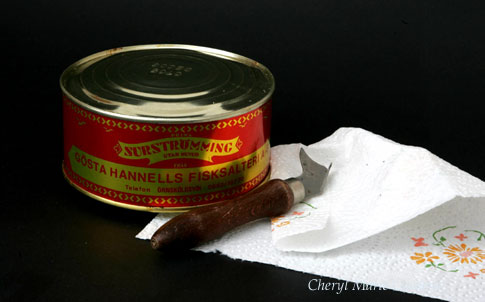
A bulging can of surströmming can strike lust in some Swedes and dread in others. The can of surströmming bulges with the fermentation process and some lovers of this dish would prefer to have it a year after its expiry date. This particular bulging beauty expired in December 2006.

Mention the word ‘surströmming’ or fermented herring to a Swede, and you’ll get an array of reactions that range of disgust to salivate rapture. There is hardly any neutrality when it comes to surströmming; one is either ardent or appalled.

In olden days this traditional northern Swedish dish was a poor man’s meal. It possibly came to be when the lack of salt while trying to preserve it led to its fermentation, with its resulting bouquet. Then eventually as with the bubbles in Champagne, the defect product turned into a desired specialty.

In my years in Sweden thus far, surströmming was the one dish that grew to be a legend with me; I’ve often heard of it but never encountered it. It was always suggested, “You should try surströmming”, but never executed because nobody wanted the stink of the fermented herring in their house.

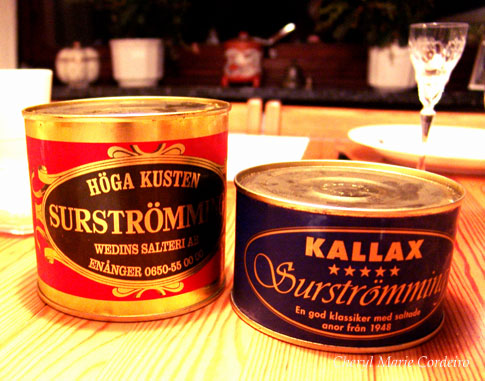
Surströmming come canned from a variety of producers, and can be bought off the shelves in the supermarkets in Sweden. Kallax, the blue can shown above did not fare too well in the consumer reviews this year, as reported by Göteborgs Posten. As can be seen from the flat – not bulging – lid, it was probably just not fermented long enough *tsk tsk*.

Apparently worse than the smell of baking belachan (a variety of Malay shrimp paste), opening a can of surströmming would stink up the entire household and half the street you’re living on. The pungent smell has a reputation of ruining everything from the taste of butter on the table to curtains in bedrooms. Continue reading “Surströmming, a traditional Northern Swedish dish”

Kueh Wajek with a Nonya twist

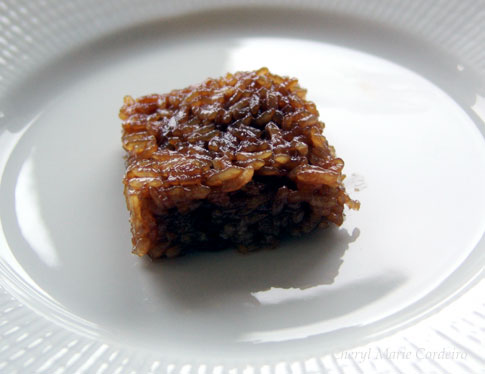
Kueh wajek (also, kuih wajik) is a sweet morsel of Malay origin, eaten at anytime of the day as a dessert.

Kueh or kuih is the term given to various bite sized food items in the Malay archipelago. Growing up in the region, I had tremendous opportunity to savour the various kinds of kueh-mueh or cakes.

Kueh wajek has always been one of my favourite desserts when growing up. Though a home-cooked dessert, Singapore, since its early immigrant days has had a burgeoning food culture, which allowed this cake to be easily found at the Malay stalls in most any Singapore hawker-center.

A paradigm shift in the Singapore home culinary scene also began thereabouts during the 1980s where city life picked up speed and fewer people of all races, found time to eat home. So even back then, I remember buying kueh wajek at hawker-center stalls, biting into it convinced that I would never need to learn how to make this in my lifetime. Besides which, the only person whom I knew, who knew how to make this had in true Peranakan tradition, taken both recipe and method with her to the grave.

Living in Scandinavia however, meant a different home culinary experience. Dining out is fairly costly on a day to day basis and people here enjoy eating at home. Of course, there are also no Malay stalls in sight that sells kueh wajek.

Luckily, my mother had grown up making this very dessert with my great grandmother, so with her help, we’ve brought back into our households, the Nonya way of making kueh wajek, which in true IT age and tradition, I’d like to share with you.

This specific recipe is a variation of the one found at Kuali.com, which is in original Malay style. The Nonya twist is that only coconut milk is used, for a richer taste to the glutinous rice and that the glutinous rice mixture is fried in a pan rather than steamed. The frying renders an overall different texture to the kueh wajek, with the grains of the glutinous rice still intact. Steaming the mixture would encourage the grains of rice to melt into each other, producing a different consistency to the kueh (or cake). Depending on preference, either way will render a deliciously sinful treat for that afternoon tea! Continue reading “Kueh Wajek with a Nonya twist”

Tiramisù

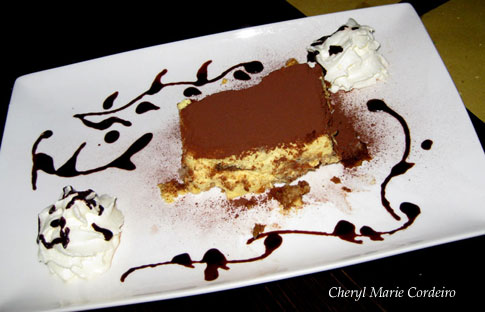
A piece of absolutely delightful Tiramisu’, served at a restaurant in Venice.

Mistaking this dessert to be Japanese in origin due to its name (it somehow reminded me of miso), I had the privilege of tasting my first Tiramisu’ in the 1990s in Singapore. I was not particularly swept off my feet by this dessert at that time and it was only a few years later that I learned it was Italian. Later still, I learned when I had it ordered at a restaurant in Venice, Italy, that this heavenly morsel originated from Venice in its modern form, during the 1970s.

For those passionate about Italian food, Anna Maria Volpi, chef and author of several cookbooks, has a website on Italian cooking. She has also researched the history of Tiramisu’ and gives a detailed history of the dessert where she traced its origins to Zabaglione custard.

Zabaglione. Picture from Simply Recipes by Elise.

According to Alan Davidson (1999), Zabaglione was not originally a custard but a “caudle”, a sauce used as a custard to fill pies or tarts. It was invented in 16th Century in Florence, in the Medici court and was originally a drink reminiscent of today’s eggnog. Made with wine / ale, thickened with egg yolks, Zabaglione explains why Tiramisu’ is sometimes still served as a parfait, in cups or glasses rather than in slices. Mascarpone cheese, which is of a decadently thick, creamy consistency, was only used as a much later addition to Tiramisu’, so that it could now be served sliced if you wished.

From Alan Davidson, here’s what you’ll need to make Zabaglione:

8 large egg yolks and 1 cup confectioners’ (powdered) sugar placed in a double boiler. Whisk till foamy and then add 1/2 cup of dry Marsala (or Sherry). Beat the mixture for a minute or two so that it thickens in consistency but not so much that it solidifies or ‘scrambles’.

Ever since the Tiramisu’ in Venice, I’ve come to love this Italian dessert, and enjoy the great variation in its recipe. For me, Tiramisu’, despite its alluring sugar-caffeine combination, isn’t so much a pick-me-up as it is an experience of the palette, where one is whisked away to a time of the Medicis in Florence and Giacomo Casanova in Venice. One tastes in this dessert, the ingenuity of Florentine cuisine and the romance of Venice. If there were a dessert for a candlelit dinner for two, a quiet moment to be shared, then Tiramisu’ embodies the very sentiment and charm unique to Venice’s waterwayed rhythm.

References

  • Davidson, A., 1999. The Oxford Companion to Food. Oxford University Press.

Discovering ‘Bistecca alla Fiorentina’, at Trattoria Quatro Leoni, Florence 2008

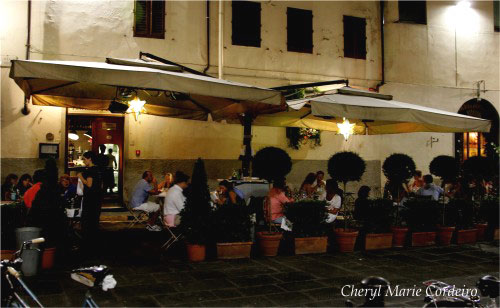
Our first decision in Florence was that we should go out to explore the city by foot. A good friend set out to book a table at her favorite place and after some time walking in and around the old streets of central Florence, we ended up at Trattoria Quatro Leoni at Via Dei Vellutini 1/R at Piazza Della Passera.


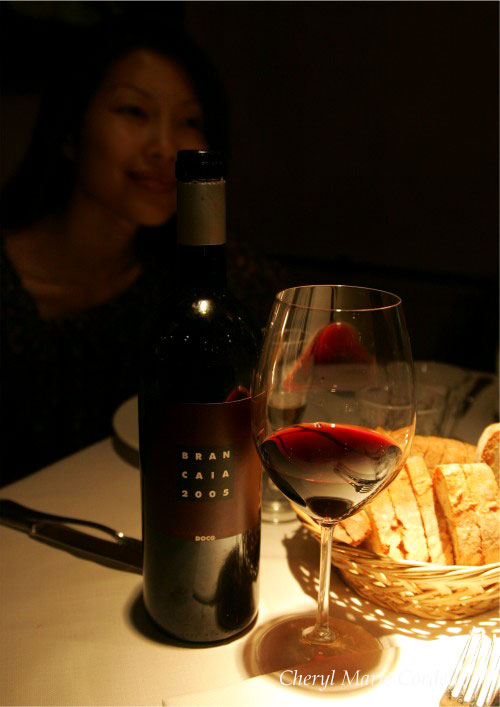
Our waiter and sommelier recommended us a Brancaia 2005 as well suited for our purpose and budget. It’s a full flavored red Tuscan wine of decent quality. In 2007 it received quite positive reviews in the Swedish newspaper, GP.

Quatro Leone or The Four Lions is a mind-bogglingly old restaurant. Having originally opened in 1550, both Dante Alighieri, members of the Medici family as well as Michelangelo himself could well have sat on these chairs before us. Well, maybe not. The chairs were probably replaced in the mid 1990s when the restaurant was renovated, restoring some of its old charm while removing centuries of kitsch.

The restaurant is central but still difficult to find, and it has a large proportion of locals in the eating crowd, both being good signs

For those unfamiliar with Florence in Tuscany, the region is famous for its true concern of the quality of the food ingredients, and traditionally alter as little as possible when cooking. Green and fruity olive oil, garlic, unsalted bread, parma ham and parmaggio cheese plus generous helpings of black pepper are expected staples of many Tuscan dishes.
Continue reading “Discovering ‘Bistecca alla Fiorentina’, at Trattoria Quatro Leoni, Florence 2008″

Scones, a warm and easy Sunday breakfast

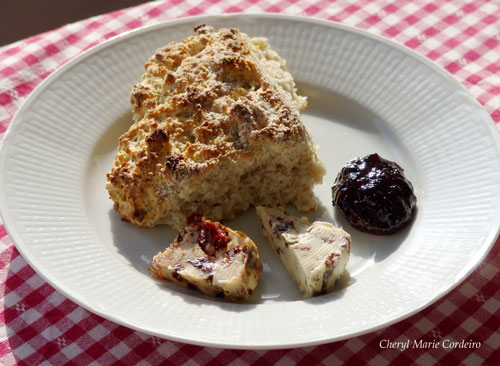
Scone on a plate with (right to left) homemade red currant jam, olive butter and sun-dried tomato butter.

On some days, you just feel like the smell of warm fresh bread in the kitchen with that morning hot chocolate. This lazy and very rainy Sunday is one such day for me, so I headed out to prepare scones, which is relatively easy to make, with a high success factor and a short preparation / baking time (about 30 -45 minutes all in all).

I love the taste of scones made with half full wheat flour (atah flour) as they remind me of chapatti. I’m a fan of that north-Indian flat bread because of its versatility with food, you can have with all sorts of curries or have on its own with butter.
Continue reading “Scones, a warm and easy Sunday breakfast”

Summer in Sweden – Strawberry and red currant pie in the sun!


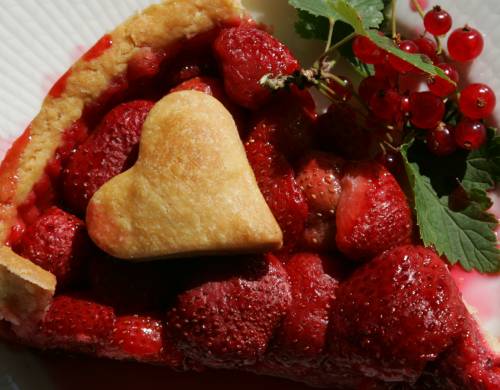
A strawberry and red currant pie.

Today’s sweltering heat of 28 deg C in the shades just wouldn’t allow a heavy meal to sit in the stomach. Snuggling up in the shade of the red currant bushes, plucking red currants in the garden also felt an inviting activity in this summer heat, and so a light strawberry and red currant pie was on the menu for lunch!


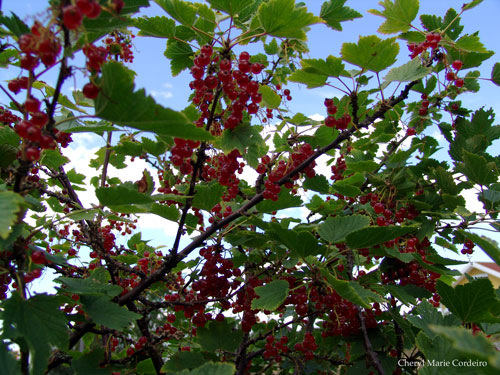
Good sun and an occasional summer drizzle is enough to give a generous harvest of red currants. Their fruits ripen around mid-July.

The currants are rather delicate and tend to squish at the slightest of touches. Still, it’s fastest in harvesting by running the stems of the currants between the fingers, so that a dozen land in your hand all at once each time.
Continue reading “Summer in Sweden – Strawberry and red currant pie in the sun!”

Ice-creams in high summer

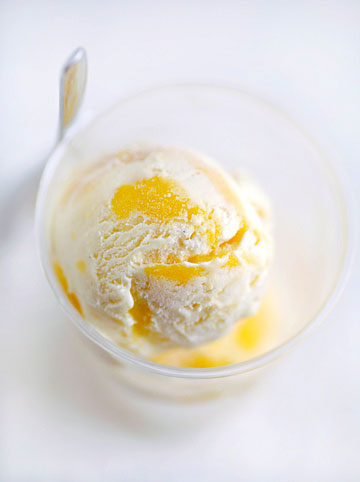
A picture of some home made ice-cream by Keiko, writer of Nordljus. More recipes and all about food can be found at the beautiful blog, Nordljus.

Come spring in Sweden and the newspapers begin to review the upcoming launches of new ice-creams for the summer, everything from tub ice-creams, ice-cream on sticks to ice-cream in cafés are reviewed, to get to know the crème de la crème of ice-creams for the summer. It’s high summer and I’ve been doing my fair share of ice-cream epicureaning, well alright, more like devouring. Continue reading “Ice-creams in high summer”

All-American bacon and cheese burger at Chili’s, New York

Nibbling the big apple XII

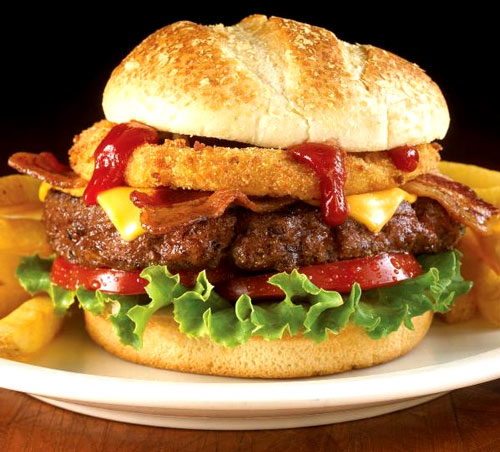
A farewell all-American bacon and cheese burger, at Chili’s in New York, served up with a tequila mind boggler!

It was during the 1980s that the catch phrase, “Where’s the beef?” became popular in the United States and Canada due to the television commercial for Wendy’s hamburger restaurants, by Joe Sedelmaier. Since it was first used, the phrase has also become an all-purpose phrase questioning the substance of an idea, event or product.

Well, when in New York, we never got the chance to visit Wendy’s, but we did go into Chili’s at the airport just prior to taking off, where we had our very last all-American bacon and cheese burger.

If Singapore has its chilli crabs and chicken rice, Sweden has its meatballs and lingon berry jam, then the United States has its beef burger – in all variations. We ate burgers for most of our meals in New York and when we deviated from the burger, we found that the meal hadn’t satisfied all that much. It was a quaint realization that the all-American beef burger, with all sorts of toppings, was my favourite meal when in New York. We even had burgers for breakfasts.

My absolute favourite burger served is found at Michael Jordan’s The Steak House NYC, along 23 Vanderbilt Ave, New York 10017, at 44th St – Grand Central Terminal. They served up 10 oz (283 g) burgers and 14 oz (396 g) steaks that were grilled to perfection! Being a beef person, Jordan’s Steak House made it an even easier choice of a juicy beef steak over fish anyday!

The classic burger.

We’re not letting go of our burger experiences and here, you’ll find a favourite breakfast burger recipe that is quick to prepare and beats fast-food burgers:

170 grams of ground sirloin beef meat mixed with some salt and black pepper.
Slow fry in butter until as rare as you want it.
Put on toasted hamburger bread on a bed of salad, tomato slices and a pickled cucumber.
Add a helping of melted flavoury cheese (Gouda or Cheddar) on top of 4-5 slices of crispy fried Bacon and a pineapple slice. Add a helping of mushroom stew. Serve with deep fried potato wedges on the side and maybe a fried egg.

Serves one.

Coke or a cold beer on the side.

Should keep you warm and fuzzy until lunch.

Western Swedish Academy of Gastronomy: prize giving ceremony and gala event, 2008

The setting makes half the event and what better fitting place is there in Göteborg for a grand dinner than the 350 year old Torstenson Palace, now the private residence of the Governor of Gothenburg and his wife, Lars and Ann-Christin Bäckström.

Every year, the Western Swedish Academy of Gastronomy holds a traditional dinner in recognition of the most outstanding chefs and all things gastronomical in Western Sweden.

Awards and prizes are given out, after which a dinner that seldom fails to impress the hardiest bon vivants, is served. Continue reading “Western Swedish Academy of Gastronomy: prize giving ceremony and gala event, 2008”