Rösti – turning raw potatoes into culinarian delight

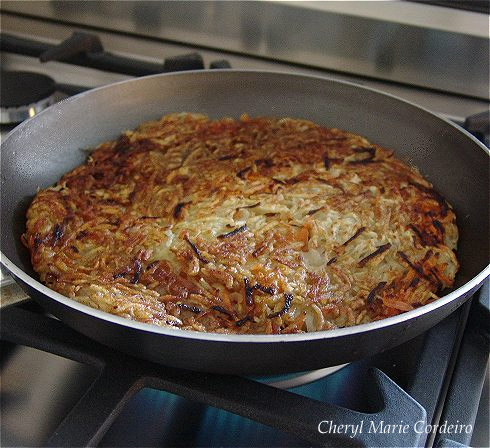
Rösti, made with potatoes and carrots

Grate fresh potatoes, flavour with garlic and some Italian hard cheese. Fry until golden brown in a generous dollop of butter. Done.
Photo © J E Nilsson for CMC, 2009

There are many aspects to cooking, from nutrition to economy, to pure lucullian joy. Ideally I try to combine all these aspects into all that we cook.

One of my favourite things to do is to take something simple and then add a twist and a half to it and see it turn into something both delicious and fun, that might even render you a couple of surprised looks at the table.

Today we needed something to go with a mouthwatering piece of beef, and we didn’t want to spend all day preparing the side dishes, so we settled for the Swiss staple, rösti. In a world of rice, pasta and french fries, rösti is not always ranked amongst our first choices.

Rösti was originally a breakfast dish, slightly related to the fried carrot cake or chai tao kway we find in Singapore, but one that will fit splendidly together with anything that benefits from the company of potatoes.

If you haven’t got around to actually cook this before, the basic recipe is pretty uncomplicated: grate fresh potatoes. Add salt and pepper. Fry. Done.

Depending on what kind of dinner you are planning rösti lends itself to many variations. Adding different ingredients such as garlic, onions, carrots, bacon or apple can turn this dish into something different, interesting and one that is to your liking.

Chef’s secret; How to flip it so that the nicely browned side is upwards when served? Use two pans. When the rösti is half done, put a similar sized pan on top of the first one as a lid, flip the whole thing, and fry until done in the second pan. Or just fry one side and do the flipp onto the serving dish.

Smaklig måltid!
On quality of life

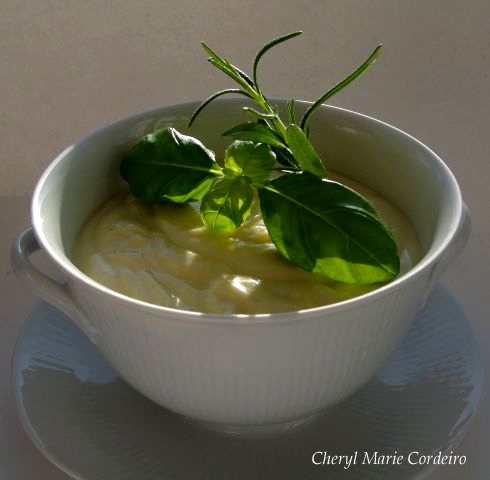
Aioli with some fresh basil and rosemary as decoration

A mild aïoli made entirely with natural ingredients,
topped with fresh rosemary and some basil

Photo © J E Nilsson for CMC, 2009

I grew up in Singapore with the assumption that good cooking based on fresh and natural ingredients was something that would never change. I assumed that there would always be someone there who took fresh fruits and newly harvested vegetables, flipping fishes, and fresh meat into their pots and pans to serve well cooked dishes at affordable prices.

The hawker centre concept in Singapore to me was equivalent to well-made home cooked food at very modest prices. For perhaps $1-2 USD you could sit down at a table and have a dish that would have taken hours of preparation to make yourself. Granted, the table was not your own and sometimes a bit wobbly and more often than not you would be seated outdoors, but that was a small price to pay compared to the returns of a local delicacy from the hands of someone who loved doing what they knew best.

Even simple things such as your daily coffee and tea from a coffee shop in Singapore rivals the choices of the mega coffee chain Starbucks, coming in a variety of servings such as kopi, kopi-O, kopi-si etc and teh, teh-O, teh-si, teh tarik etc. This philosophy and lifestyle towards affordable food made with fresh raw ingredients and a passion for a select dish, reflects what I think is quality of life in a modest setting.

Today however, Singapore is seeing the commercialisation and franchising of the hawker centre concept, Food Republic is one such concept where recipes are standardized and foods pre-processed before serving. It’s a concept that is a far cry from the traditional food hawkers I grew up with, even though they equip the interior of these franchise outlets with old style kopitiam (breakfast coffee house) furniture and tea cups. These days, the real food hawkers’ fare can be found in for example, Bangkok, Thailand where food hawkers cook along the streets right next to the wet markets.
Continue reading “On quality of life”

Mango season in Singapore

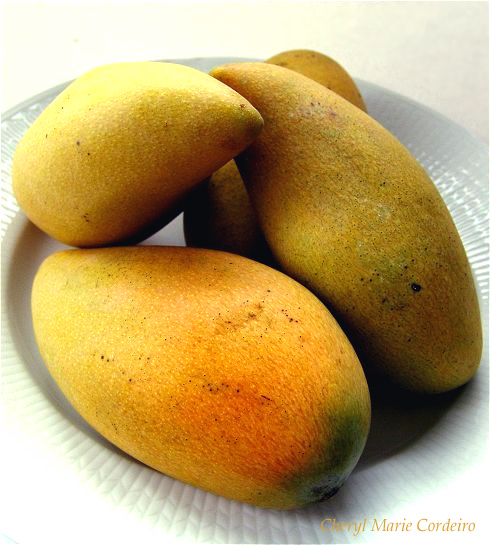
Ripened honey mangoes from Thailand, sold in Singapore

Honey mangoes from Thailand, found at the local grocers in Singapore.
Photo for CMC © Jan-Erik Nilsson, 2009.

Perfectly ripe mangoes such as these cannot be found in Sweden due to transportation costs, I guess. But what the food industry cannot give us, loving parents can, by dropping a few of these in a box and just sending them our way.

If you’re not living in a tropical climate, perfectly sunripened mangoes are difficult to come by, so I thought I’d share this with you in pictures.

For those of you who are in Southeast-Asia at the moment, now is the time to go shop for mangoes, because it’s blissful mango season out there!

I don’t think these mangoes could’ve lived a day longer, their flesh so ripe that it looked translucent. It would’ve gone perfect with just about anything at this moment, from ice-cream topping to yoghurt mix. We preferred to have these on their own.

Continue reading “Mango season in Singapore”

Cuneesi al liquore by Dulcioliva, the perfect chocolates for Easter!

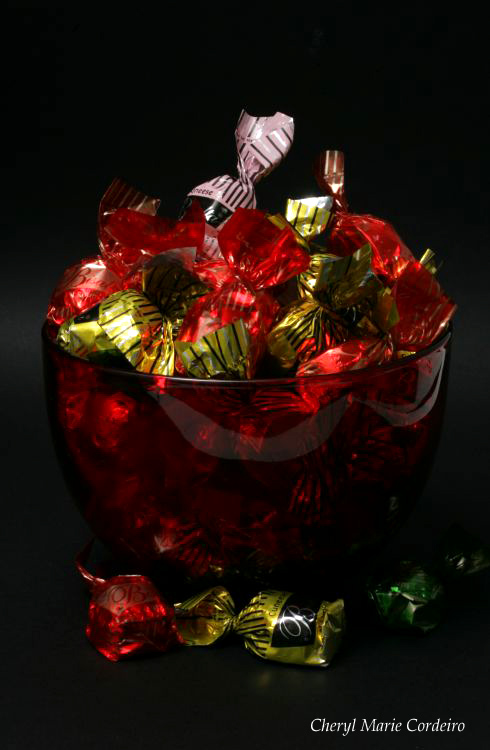
Dulcioliva, liquour filled chocolates from Italy

Cuneesi al liquore by Dulcioliva. Liquor flavoured chocolates from Italy.
Photo for CMC © Jan-Erik Nilsson, 2009.

I’m a chocoholic. As far as I can recall, I’ve always preferred chocolates over candy, and when given the choice between coffee or tea to breakfast, I would inevitably find myself asking if there was any hot chocolate on the menu.

At home, I keep boxes of plain cocoa powder for that morning cuppa and a stash of chocolates in the food cabinet for just when I need a quick chocolate fix!

Cheryl Marie Cordeiro with Benny Eriksson, owner of Beriksson, Sweden

Taking notes, with Benny Eriksson, owner of “Beriksson Import and Chocolate”, Sweden.

So imagine one of my wildest fantasies come true when I met Benny Eriksson at the recent foodfair Passion för Mat in Gothenburg a few weeks ago, who introduced me to his line of imported Italian made chocolates!

My eyes went wide with delight when I found myself in front of a little chocolate buffé at Benny’s exhibition stall, with assorted chocolates from Guido Castagna, Muzzi, Gardini and my absolute favourite (after all the sampling) – the Cuneesi al liquore from Dulcioliva!

Bite into a truffled Cuneesi al liquore (shown in the first picture above) and you’ll find yourself immediately taken by the soft consistency of the chocolate ganache found in the middle of the chocolate shelled conconction that melts in your mouth. The taste of this sweeter, liquored ganache is then complemented by the bitter dark chocolate shell on the outside of the confection.

What you’ll end up experiencing is a wonderful chocolate symphony that signals a celebration of sorts.
Continue reading “Cuneesi al liquore by Dulcioliva, the perfect chocolates for Easter!”

Sauce Béarnaise, simplified

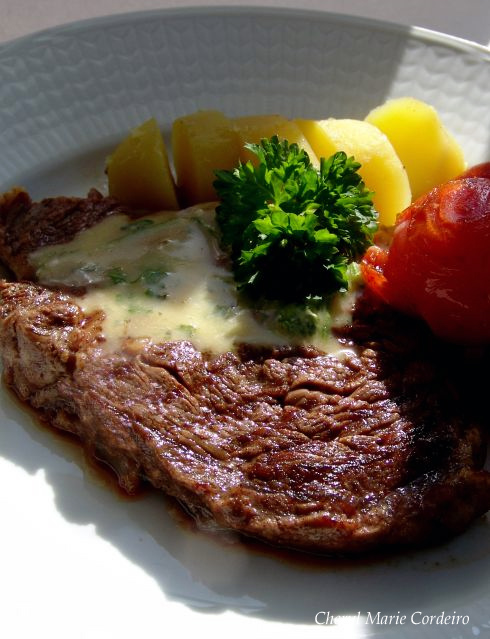
Entrecôte beef with bernaise sauce, almond potatoes, cherry tomatoes and parsley

A grill fried entrecôte served with a simplified Béarnaise sauce.
The sauce is based on all natural ingredients and takes about the same time to make as those that comes out of a bag.

Photo for CMC © Jan-Erik Nilsson, 2009.

Well, I am a meat person. However much I like good quality food in general and will immensely enjoy a well-prepared fish dish, given a choice, I would go for the beef anytime.

There is nothing that makes a steak more enjoyable than a number of nice side dishes and maybe a spread of good sauces to go with it.

This time I just wanted to see if it was possible to simplify the pretty tedious preparations that go into making a real Béarnaise sauce. The French chefs would say, sure you can simplify a Béarnaise, but “zen it ees not a zous Béarnaise”. Ok, so much for the help from zat side. But admittedly of course, the French are right.

The basis of this sauce is a couple of egg yolks, which you stir and then mix with butter. What you add after that pretty much decides what sauce you end up with, some examples are mayonnaise (mustard), aioli (garlic), hollandaise (lemon) or Béarnaise (white pepper, shallots and herbs). You can refer to your cookbooks for the proper recipes.

Anyway I was just curious about how this would work out and this is what I did:

First you will need two pans. In the first one; melt 50-75 grams of butter so it become liquid enough for pouring. Keep the temperature on the low side.

In the second pan; add two egg yolks and 1 tbsp of water. Whip slowly over low heat until it stiffens. Add the butter slowly. Stir until all has joined.

Add a few drops of vinegar, white pepper, salt, 1 tbsp chopped parsley and 1 tbsp chopped tarragon, all to flavour.

Keep the egg whites for another day.

Done. Goes perfectly with any beef. Barbecued or fried.

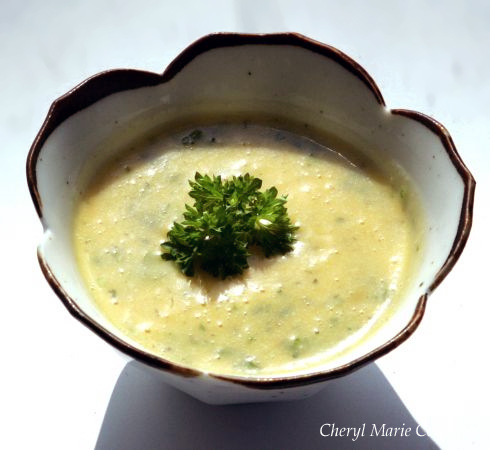
Bernaise sauce with parsley

Bernaise sauce, simplified.

My favorite homemade Cumberland sauce

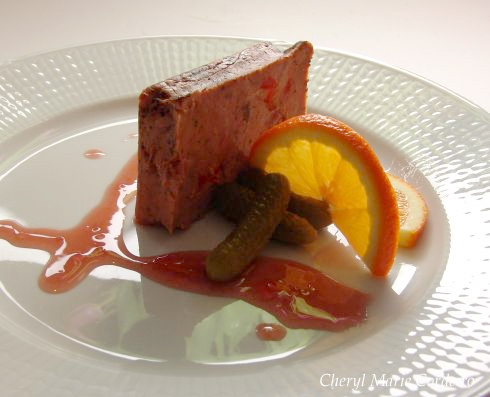
Plate of paté with pickles, orange and homemade cumberland sauce with port

Pâté served with homemade Cumberland sauce, pickled cucumbers “cornichons” and a slice of orange.
Photo for CMC © Jan-Erik Nilsson, 2009.

Just a few days ago while shopping, I ran into some really nice looking pâté, and I felt that was just the thing for an Easter lunch. After stopping by the delicatessen counter and checking out their version of Cumberland sauce, I found it was nothing like what I wanted out of a Cumberland sauce, so I decided to go home and make our own.

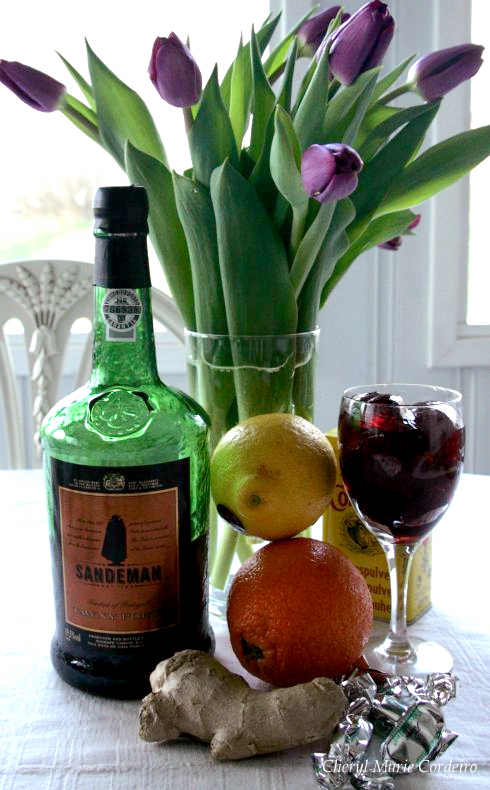
It is not very expensive and surprisingly easy to make. If you haven’t tried this before, you will find that it will only take a few minutes from start to finish. Here is what I used:

1 lemon
1 orange
1 jar of redcurrant jelly
1 glass of port
1 teaspoon mustard powder
1 table spoon grounded ginger

Ingredients to Cumberland sauce, port, lemon, orange and redcurrant jelly

Port table-setting: the ingredients to the Cumberland sauce.

Some good port to give the Cumberland sauce its personality, lemon, orange, ginger and redcurrant jelly. I used two wine glasses filled with redcurrant jelly in this recipe. Chocolate mints (in the foreground) and some rich purple tulips (flowers of the season) to complement the Easter season and brighten up the kitchen while cooking!

Preparation of orange and lemon rinds

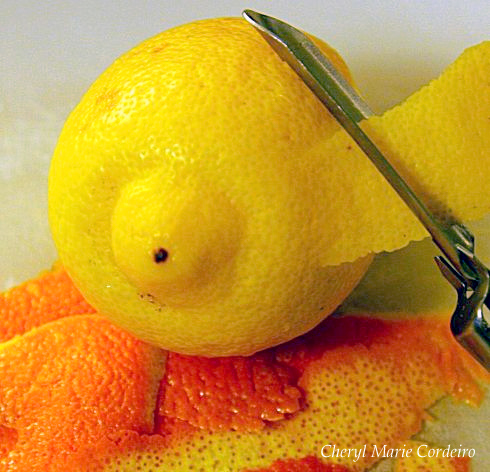
Peel off the absolute outer part of the rind – the zest – on the orange and the lemon. You will not need much of this. Avoid cutting into the white inner layer, the pith, since this is unpleasantly bitter. Slice finely and cook for 5 minutes to soften up and clean away anything funny that might be on the peel. Discard the water.

Peeling the zest off a lemon, orange rind in foreground

This is the only tricky part. Here I needed to be very careful not to cut too deep into the peel as I only wanted the outer, colorful layer of the rind, the zest.

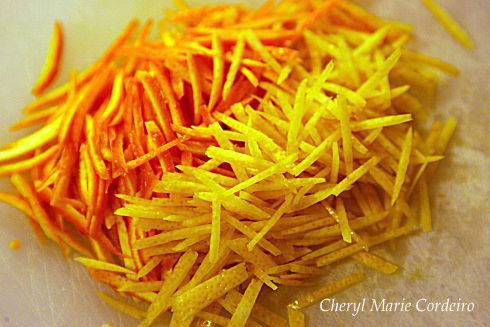
Orange and lemon rinds, sliced thinly

Lemon and orange zests, sliced thin.

This is much more than you will need, just take a few spoons of this after it is boiled.

Continue reading “My favorite homemade Cumberland sauce”

INVITATION to the Public Defense of my Doctoral Thesis, Gothenburg, Sweden

University of Gothenburg lawn, Cheryl Cordeiro jumping through ring

Me, outside of the University of Gothenburg
about 5 minutes after I have left the final version of my PhD thesis to the printers.
Photo for CMC © Jan-Erik Nilsson, 2009.


Cheryl Marie Cordeiro-Nilsson
requests the pleasure of your company at the

Public Defense of my Doctoral Thesis

on Saturday, 9th of May 2009 at 10:00 hrs
Hall T302, Gamla Hovrätten, Olof Wijksgatan 6,
Gothenburg, Sweden

and

Dinner

the same evening at 18:30 hrs (RSVP)


Title of Thesis

Swedish management in Singapore:
a discourse analysis study


Candidate
Cheryl Marie Cordeiro-Nilsson
Department of Philosophy, Linguistics and Theory of Science

Opponent
Assoc. Professor Kirsten Jaeger
Dept. of Languages, Culture and Aesthetics Aalborg University, Denmark

Supervisors
Professor Sally Boyd
Dean of Humanities, University of Gothenburg, Sweden

Professor Joseph A. Foley
Graduate School of English, Assumption University, Thailand


PROGRAM

10:00 – 12:00 Public Defense of Doctoral Thesis
Hall T302, Gamla Hovrätten, Olof Wijksgatan 6
This session will be conducted in English

12:00 – 13:00 Doctoral Examination Committee recess to a Closed Session
A light lunch buffé introducing the evening dinner theme, will be served in the Atrium, Olof Wijksgatan 6

13:00 Presentation of decision by the Doctoral Examination Committee
Champagne

DINNER

18:30 Dinner will be presented as a Gastronomic voyage,
“Between Tuscany and Provence”

Chef de Cuisine
Mikael Sande
Restaurant Matsmak
Drakegatan 1, 412 50 GÖTEBORG

Dress Code: Informal / Kavaj
Cost: 400 kr / person

R.S.V.P.


(preferably before 2 May 2009 via the reply form below or via email: cordeiro@ling.gu.se)

Salmon butterfly fillet and some on the philosophy of cooking styles in general

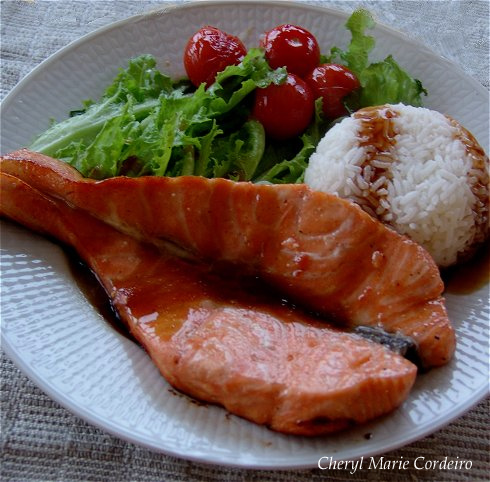
Salmon with teriyaki sauce, rice, lettuce and tomatoes

Salmon served with teriyaki sauce. On the side are rice, lettuce and tomatoes.
Photo for CMC © Jan-Erik Nilsson, 2009.

This is not much of a recipe, it’s more like a reminder that there are such simple and easily cooked dishes that combine luxury with a superb health aspect, such as this salmon plate that basically dribbles with heart friendly Omega 3 fat.

A butterfly fillet is a straight cut from a salmon fillet. You either buy them ready or cut the un-skinned thick fillet crosswise in about 3-4 cm (1-1.5 inch) wide slices. Then take each of these slices and make a cut down to (but not through) the skin. Fold out and you’re done.

Regarding how to fillet and tidy up a salmon, there are tons of short films available on Youtube. Since I have grown up in an Asian tradition where you take care of and use almost everything of your raw ingredients, I found myself noting how much of the salmon gets thrown away during the filleting process. Few videos for example, recommend keeping the salmon head and cooking with it.

While traditional Indian Fish Head Curry doesn’t use salmon head, my recent dining at an Indian restaurant in Gothenburg, where they served salmon curry indicated that perhaps salmon head could be used in that dish. Salmon skin is also often stripped and thrown away. In Japanese cooking, salmon skin is fried to a crisp and eaten in sushi rolls. The taste is fantastic! I would personally hate to think that one starts out with a healthy 40 lbs (20 kg) salmon and end up with maybe less than 5 kg worth of salmon fillet left to eat.

Of course there are different schools of thought in cooking, one of which is where you tidy up everything before you cook, and the other philosophy is that you cook as much as possible and tidy things up when or immediately before you eat. If you’re looking at a hypothetical dichotomy in schools of thought, then the results of the first method would produce close to industrially processed foods which could end up quite sterile and tasteless once you’ve de-boned, de-fatted and de-skinned everything, and the second would produce more home style home cooking that uses bones and skin etc. to produce thick broth bases that could be further used in the cooking process. And as one could expect, the latter school of thought produces food that are infinitely much more flavourful. Continue reading “Salmon butterfly fillet and some on the philosophy of cooking styles in general”

Shrimp bisque, an Easter dinner entrée

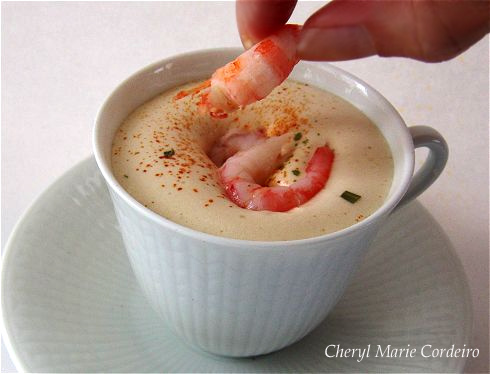
Shrimp bisque with cognac and peeled shrimps

Decorate with a dusting of cayenne pepper and tarragon and maybe a few neatly peeled shrimps.
Photo © Jan-Erik Nilsson for CMC, 2009

Easter is upcoming and I have already started to think about dishes I feel would fit the season. Right now I believe salmon would be great, lamb cutlets are always a temptation and maybe a chicken baked whole and stuffed with some crisp apples would be fine.

We’ll see. The options are many but I have already started planning and that is always a beginning. In the mean time, considering the world’s finance crisis, I thought I’d like to share my best luxurious and least expensive dish ever- Lobster Bisque on a shoestring.

What usually happens when preparing a shellfish meal is that the meaty parts are put to good use whilst the shells of these crustaceans are discarded. The economy in this is that you can use every bit of those crustaceans, separating the meat from the shells and saving the shells for this dish. Here we are replacing lobster with shrimps.

This is a delicate entrée or starter, or something you can serve in-between dishes as a surprise. It fits well to be served in a cup. The value of this dish lies in its exclusivity. It will be a magic wake up call to the guests, and make them very hungry for the next dish. Ideally it should be tied into the whole meal so that the meat parts of the shellfish appear somewhere else. Here I don’t use beurre manie as thickener but whipped cream instead. This is my preferred way of simplifying the cooking, improve the flavor and texture, and mystify my guests.

The following serves 4 to 6 persons.

Peel shrimps
Peel 500 grams (1 lbs) of cooked medium sized shrimps. Put heads and shells, and peeled shrimps in separate bowls. In Sweden shrimps will come salted and might benefit from a slight rinsing in cold water before peeling. If your shrimps are cooked without salt you will need to add some salt to the finished stock.

Prepare stock
Prepare the stock by peeling and dicing 3 shallots, (1 carrot and 1 celery stalk are optional). Melt 2 tbs butter in a pot. Braise until soft. Add the shells, roe, heads and all into the pot. Add 1-2 dried chillies, or less if you are not so used to spicy food, and 2 tbs tomato paste. Add 2 cups of water and 1 cup of white wine and braise under lid at low heat for 10 to 15 minutes. If you actually use lobster shells, extend the time to an hour.

Waffles Day in Sweden, the 25th of March, 2009

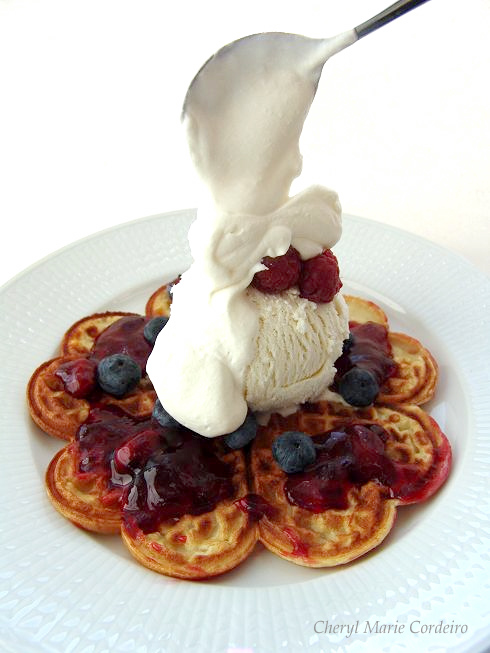
Homemade heart shaped waffles with raspberries, blueberries and cream

A homemade hearts waffle topped with blueberries, raspberries, vanilla ice-cream and generous whipped cream!
Photo © J E Nilsson for CMC, 2009

In Sweden, which might be the most secular nation on earth, the Annunciation is still celebrated the 25th of March every year by eating waffles.

The waffle day is however named as it is in Sweden due to a misunderstanding of the word Vår Fru, meaning Our Lady or in French, Notre Dame all referring to the Virgin Mary, but sounding like the word waffle or våffla in Swedish, albeit after some phonetical twists. So technically, waffles day in Sweden is a celebration of the visit of the angel Gabriel to Mary, with the news of Mary’s conception of Jesus. This happy revelation happened exactly nine months before the holy child Jesus was born on the night to the 25th of December, which we celebrate as Christmas.

Historically Sweden was pagan until the twelfth century. With the founding of modern Sweden some four hundred years later, the Swedes left Catholicism in favour for Protestantism. Religion wise it went pretty much downhill from then on however most feasts are still happily celebrated. The 16th century was also the first time that western people were allowed to read and hear the gospel in their own languages. Up until then, the Bible had been only available in Latin, so just maybe, the misunderstanding of the “Vår fru” dates back, all the way to that time too.

Today in Sweden, the celebration of waffles day is mostly concerned with how to make them as sinfully delightful as possible. Here are our suggestions:

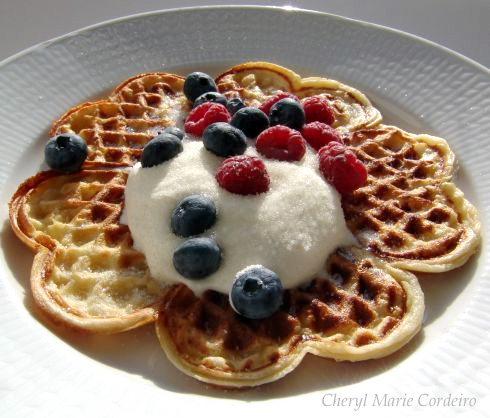
Waffle with whipped cream, blueberries and raspberries

A waffle topped with fresh blueberries, raspberries, whipped cream and a light dusting of icing sugar.