Teahouse in Hangzhou

Teahouse. 高山流水.
Tea-drinking at teahouses is a tradition in China that goes back to the Three Kingdoms of Wei, Wu and Shu, 220-280 AD.

Text & Photo © JE Nilsson, CM Cordeiro 2010-2013

Walking through the streets of Hangzhou, I could never quite grasp the sentimental feelings of its romantic past even as my eye caught the elegant lines of temples, the fine pagodas and the many intricately carved bridges that made the landscape so picturesque.

But arrive at the calm and mirroring waters of West Lake, and the realization sets in – that the city through numerous phases of transformations, carries within its aura a purity of natural beauty and a sense of timelessness. And it is perhaps this, that rocked the souls of the literati both past and present.
Continue reading “Teahouse in Hangzhou

Conversation about status symbols over cinnamon infused apple crumble

A mixture of sweet and sour apples render
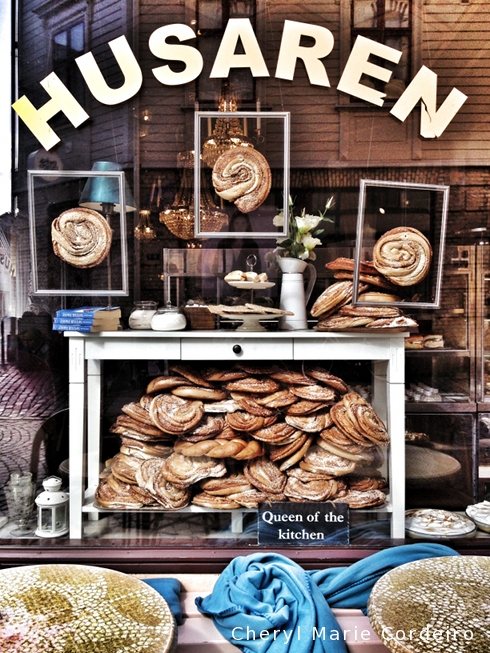
a nice balance to the flavour of this cinnamon infused creation.

Text & Photo © JE Nilsson, CM Cordeiro 2013

It was over a delicate apple crumble dessert served with whipped cream and cinnamon, in the plush setting of the Bar and Billiard Room at Raffles Hotel in Singapore, that the importance of the use of status symbols in Asia was explained to me as a series of unhappy events that a Nordic company experienced in its early years in Singapore, during the late 1990s.

Different views of what defines success

Asia and Scandinavia have different views of what defines success. They also have different ways of showing social / organizational affluence, a lack of understanding on either side on the effective use of such status symbols could well lead to an awkward situation of miscommunication, some small, others needing nothing less than a crisis management strategy.

Some ten years ago, part of how Nordic organizations expanded their operations was to send a core-team of top Scandinavian managers to oversee initial functions in Asia. Chances are, this modus operandi has not changed much since then.

The general idea was to bring with them a set of core cultural values and have them cascade through the new organization, in this case, a Singapore subsidiary.
Continue reading “Conversation about status symbols over cinnamon infused apple crumble”

The Gothenburg International Science Festival 2013

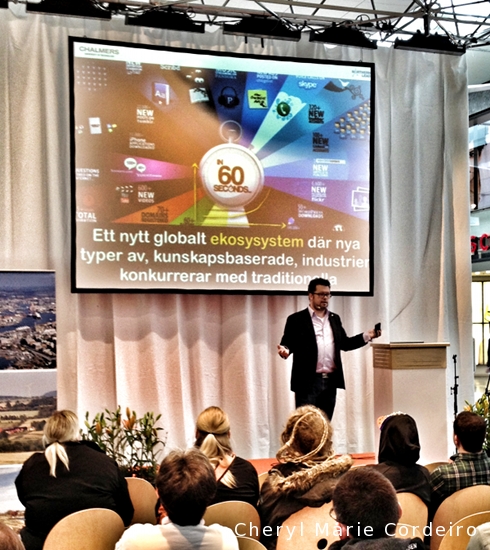
Per-Olof Arnäs on “Terminator, TinTin and Teleportation”, an variation of his lecture on “The digitization of transportation” at Vetenskapsfestivalen 2013.
Text and Photo © CM Cordeiro 2013

The 25th of April was the second day of the Gothenburg International Science Festival 2013, where in the public arena of Nordstan in Gothenburg, a lively presentation on the topic of transportation for the future was ongoing by Per-Olof Arnäs of Chalmers University of Technology in the morning. Colleagues from the University of Gothenburg would also be giving some presentations through the day, regarding the various aspects of the crisis in Europe and how that might have rippling effects on issues such as European state leadership and workforce migrations between countries in Europe.

This year’s theme at the science festival is Cruise and Control. In a multi-dimensional and multi-levelled approach, the event aims to address questions pertaining to the Individual such as personal health and fitness, to security controls by use (or abuse) of technology in Society, to larger Environmental issues such as finding balance between consumption and sustainable living.

Continue reading “The Gothenburg International Science Festival 2013”

Dining out at Senso, Singapore

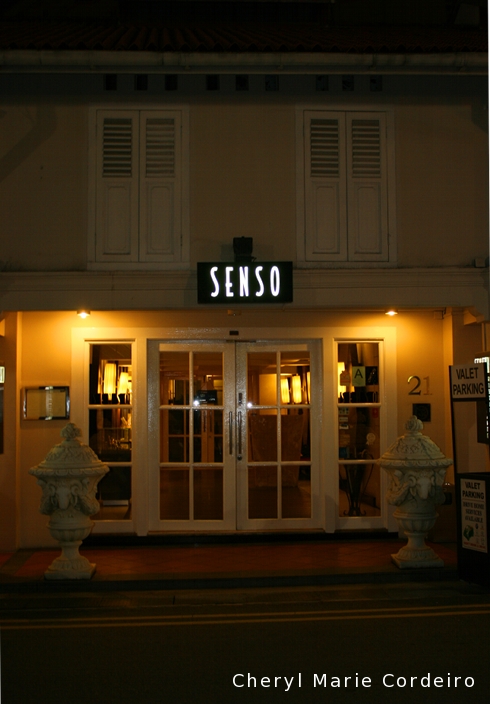
Senso Ristorante & Bar at 21 Club Street, Singapore.
Text & Photo © G Fernandez, JE Nilsson, CM Cordeiro 2010-2013

A few years ago in Singapore, I had the opportunity to accompany some friends on their apartment hunting. There were several newly built units to view and we drove from place to place, spending long days on the road, bouncing from northeast to east and then west of the tiny island state.

From growing up in Singapore I remember how my mother spent time in the kitchen, over the weekends and in the evenings when she got home from work. Sometimes we dined out, but very often it was wet marketing where possible and then home to cook.

What caught me by surprise on this round of apartment hunting was how much smaller the kitchens in Singapore had become. It was as if the architects did not think of kitchens as a working space that should be able to function. In these apartments, home cooking seemed a non-activity for the household’s engagement, the oven being relegated to a token that marks the minimal existence of the kitchen space.

But being in Singapore, and considering all its wonderful facets of dining out, I can see how the kitchen at home has literally been spatially re-configurated both in the minds of people and in material dimensions, simply because eating out in Singapore is so much more than, a necessity.

Continue reading “Dining out at Senso, Singapore”

Organization identity and the dialogic process of recreating corporate values

In SvD 19 April 2013, Näringsliv.
Conflict and powerplay between Volvo Cars and Geely.

Text & Photo © CM Cordeiro 2013

‘Five conflicts stirring Volvo in China’
Just recently this headline in war fonts headed the front page of the business section of one of Sweden’s most respected morning news papers. It was obvious that something had changed.

As one of many who keep a keen interest in the economic and geographic spatial reconfigurations of the global automobile industry, I did not expect a smooth process of acquisition of Volvo Cars by Geely from 2010 onwards.

Research literature charts a five times more likely narrative of a failed attempt at mergers and acquisitions than one of success. In the case of the Swedish then American owned Volvo Cars being acquired by Chinese Geely, language, culture, values and outlook on life per se are but the tip of the ice-berg to the multiple foundational layers of differences that need to be disentangled in this corporate marriage.

In studying Chinese and Swedish leadership and management styles, a field of research that I’ve worked with since 2004 (Cordeiro-Nilsson 2009), to say that China and Sweden have different cultures, is perhaps an appeal too much towards lex parsimoniae, where culture is here defined as a set of values, both explicit and implicit, shared by a collective of people with a shared ideology or mental framework that manifests itself in material action.

The overall picture is far more complex than what the media can at any one point in time represent. What is reflected in the media is often the result of much polishing and trimming of editorials and underlying narratives. And what is happening between Volvo Cars and Geely as reflected in the Swedish media, is but a synchronic snap-shot of a process that is inherently longitudinal in character. Organizational relations are ongoing dialogic processes that can be assessed in a more balanced perspective when placed in the context of a longitudinal timeframe, of years and decades past and what is also to come. As such, media representations of Volvo Cars – Geely relations need to be understood in the context of the larger socio-economic and political relations that have been built over time between their organizations, between Sweden and China.
Continue reading “Organization identity and the dialogic process of recreating corporate values”