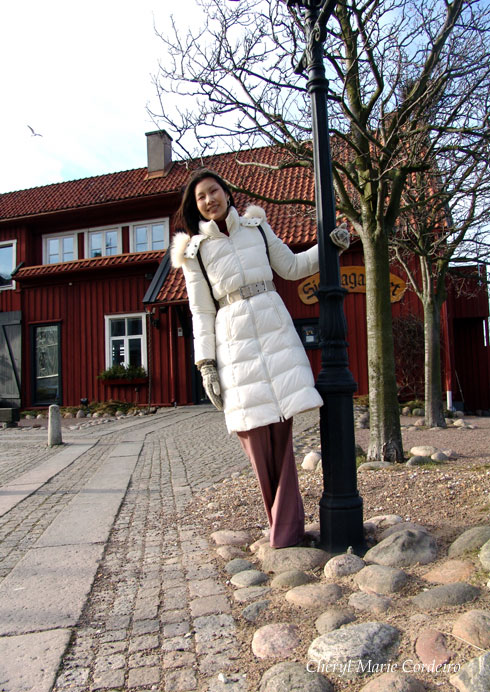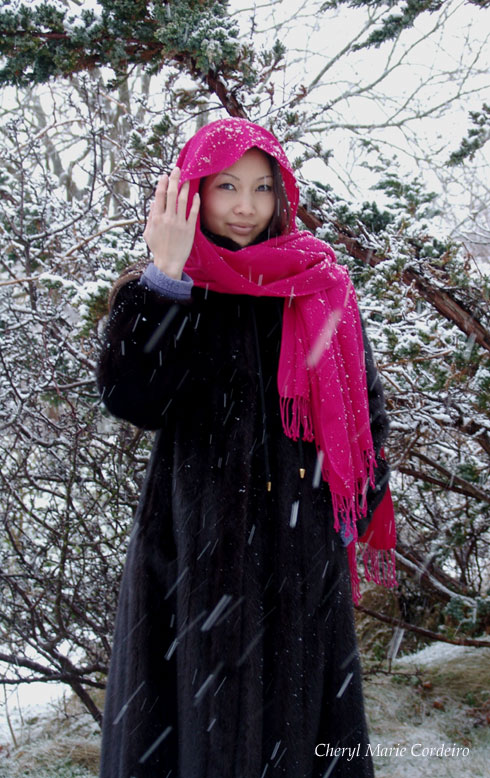
Snowfall in march, on the west coast of Sweden 2009

By a Juniper tree with a cerise cashmere scarf and wonderful vintage mink fur coat.
Photo for CMC by: Jan-Erik Nilsson © 2009.

In march in Sweden the weather is temperamental and just when you think that spring is on its way and that the snow has all but melted and gone, comes a sudden gush of snow so thick that you think you are in mid-December again, waiting for a white Christmas.
Continue reading “Snowfall in march, on the west coast of Sweden 2009”
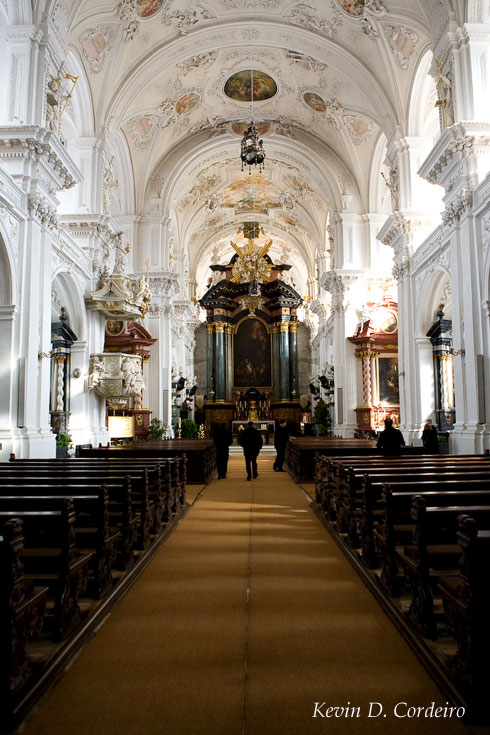
A photographic journey through the Schönenberg Church in Ellwangen, Germany by Kevin D. Cordeiro

The interior of the catholic Schönenberg Church in all its baroque glory. The lengthy and massive carpted aisle to the altar greets both faithfuls and visitors alike upon entering the church.
Photo for CMC by Kevin D. Cordeiro © Singapore 2009. Portfolio at modelmayhem.com. Kevin’s portfolio includes weddings, fashion shows and portraits

In this previous post, Kevin took you on a photographic tour of the outside of the Schönenberg Church in Ellwangen, Germany. In this post, he’ll take you through a photographic journey inside the baroque Catholic Church. Continue reading “A photographic journey through the Schönenberg Church in Ellwangen, Germany by Kevin D. Cordeiro”

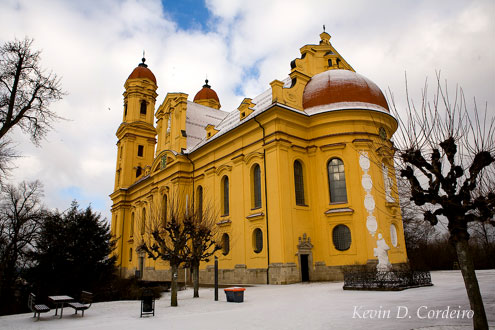
A visit to the Schönenberg Church in Ellwangen, Germany, by Kevin D. Cordeiro

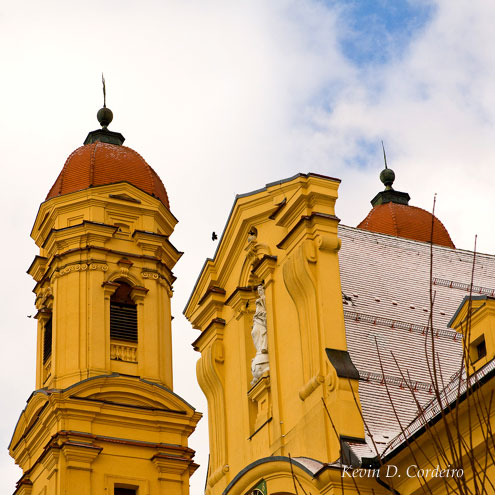
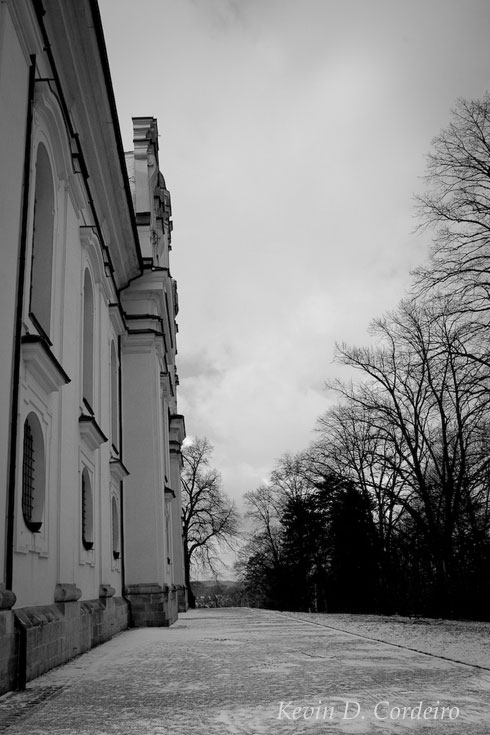
The Schönenberg Church, also the Wallfahrtskirche in Ellwangen, Germany.
Photo: Kevin D. Cordeiro.

The Schönenberg Church is a pilgrimage church that is also known as the Sanctuary of Our Lady. It’s a major church in the region of Ostwürttemberg in the southern regions of Germany. In years past, people made their pilgrimage voyages by foot in order to reach the churches and their sanctuary of prayer. These days however, pilgrims are more likely to arrive at their respective churches via buses. Just as well too since this particular church sits atop a 530 m climb.

Photo: Kevin D. Cordeiro.

The foundations to the church were laid in 1682 by Johann Christoph von Freyberg who was then the Bishop of Augsburg. The building’s architect was Michael Thumb Vorarlberger Munster whose design template for this church had great influence over other important buildings of Baroque design such as the baroque pilgrimage church of the Holy Cross built on Gottesberg hill in Bad Wurzach in 1709. Continue reading “A visit to the Schönenberg Church in Ellwangen, Germany, by Kevin D. Cordeiro”

Sjömagasinet’s team proves their metier beyond all things piscatorial. Gothenburg, Sweden 2009

Restaurant Sjömagasinet in Gothenburg, Sweden in early spring 2009, housed in a building, originally an 18th century ship’s furnishing storage.
Photo for CMC by: Jan-Erik Nilsson © 2009.

The restaurant Sjömagasinet in Gothenburg, Sweden, is well known, as is its iconic owner and Chef de Cuisine Leif Mannerström.

What might be less known is that the restaurant’s odd looking building at the immediate waterfront of the Göta River was originally an 18th century magazine, built by the Swedish East India Company (1731-1813) to house spare equipment for the huge sailing “East Indiamen” ships.

These frigates went on their yearly voyages to China and back for tea, silk, spices and porcelain during the best part of the 18th century, departing from just outside this building around February each year. They usually arrived back in the late summer after a voyage that took almost two years for each round-trip, if everything went well. If not, the arrival could be delayed. As a matter of fact, there are cargoes that still haven’t arrived as yet, but that’s a different story. Today we were just here to eat.

Luckily our careers give us the opportunity and occasion to travel quite some. Valentine’s Day last year was spent at the Peninsula Hotel in Bangkok, overlooking some fantastic fireworks reflecting to double effects in the black waters of the Chao Phraya River. This year we visited Sjömagasinet in Gothenburg, Sweden, immediately overlooking the near frozen Göta River. The differences in climate and temperatures could not have been greater.

Gothenburg is located at 57°43′ North latitude and 11°59′ East latitude meaning about three hours of flight northeast of London and much too far north for comfort for anyone preferring the tropical climate of Singapore. Luckily there are things here to compensate the endeavours.

The gourmet restaurant Sjömagasinet is one of them.

The history of the restaurant’s building is somewhat reflected in the menu but most of all, it shows to tell of Leif Mannerström’s great interest in gourmet preparation and serving of various piscatorial delights. What we chose for our Valentine’s day dinner was of course only a sample of what could be had at the restaurant.

The menu for the day is set on the day itself with not much advance notice. The availability of first class ingredients settles what the Mannerström team will work with for the day, so you can simply pop in and enjoy. If you like, you can discuss with the forthcoming staff, anything you’d like to have served from what is available in the kitchen for the day.

On the menu you can expect to find weever, plaice, pollack, halibut and herring served in classic and creative conconctions. During the Christmas season, the julbord or Christmas smorgasbord, serves up to more than sixteen types of herring.

The dishes we decided upon were what we felt right for the day. As we sat down at our table ready to enjoy ourselves, we brought with us three distinct impressions: that of the ice-cold weather of the Nordic climate, the ever present Göta River that flows just outside this restaurant and the warmth from the burning log fire that greeted us at the entrance of the restaurant, when we first came in.

Today I initially felt like the Fish Classic, a deep fried cod tail with sauce verte, lemon, asparagus and boiled potatoes. But while settling in and warming up to the mood of the place I started to feel somewhat more adventurous.

Contrary to my expectations the meat dishes seemed just as interesting as the fish and my curiosity was really aroused when I found elk among Mannerström’s Husmanskost.

I have only ever encountered a live elk once in my life, in a national park here in Sweden. These large creatures wander the vast forests of Sweden and are freely hunted for food. About 100 000 elks are shot in Sweden every year and at an average weight of about half a tonne (1000 lbs) each, it’s a lot of meat. With elk meat, the inherent problem I find is how to cook them. Apart from that they don’t exactly fit neatly into the oven, the meat is usually tough and gamey. My previous experiences of eating elk were not encouraging. But if there ever was going to be a chance I’d eat elk again then this would be the place. So elk, it was.

Fried, salted brisket of elk with potatoes and cream

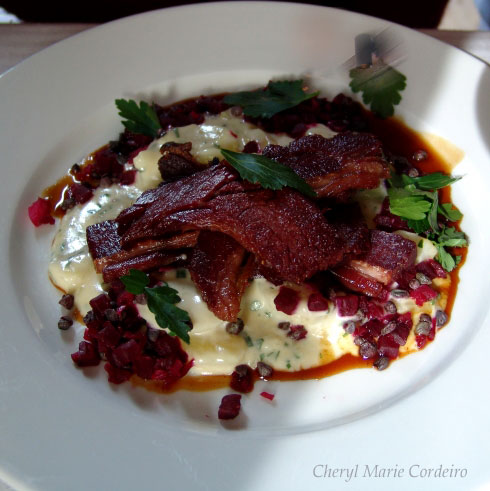
Fried, salted brisket of elk served with beet roots, capers and potatoes cooked in cream.

The elk briskets were tender, warm, juicy and inviting on a bed of beetroots and potatoes cooked in cream sprinkled with parsley leaves. The flavours combined and blended splendidly with one another to give a robustly warm and accommodating meal. The dish was also testament to what could be produced with basic ingredients that were none too fancy. Continue reading “Sjömagasinet’s team proves their metier beyond all things piscatorial. Gothenburg, Sweden 2009”

In black and white: Haus Schönenberg, Ellwangen, Germany

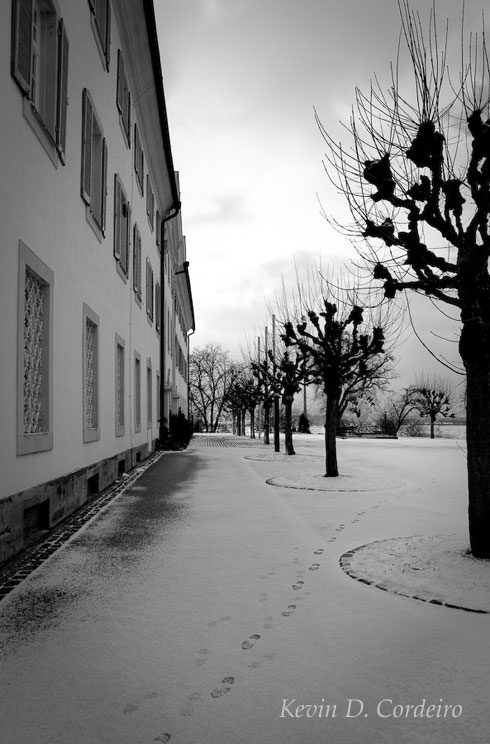
In black and white, by Kevin Dominic Cordeiro, cortenography, Haus Schönenberg, Ellewengen, Germany

The compounds around Haus Schönenberg in Ellwangen, Germany.
Photo for CMC by Kevin D. Cordeiro © Singapore 2009

Haus Schönenberg is a charming hotel located in the small historic German town of Ellwangen that lies east of Baden-Württemburg. It’s a throw back in time in its architecture, standing next to the renowned pilgrimage church, Wallfahrtskirche.

By Kevin Dominic Cordeiro in black and white photography, Cortenography

While the hotel isn’t one that is too luxe, visitors will be won over by its rustic appeal. Those who love the outdoors and nature can explore the rather generous grounds of the place. Continue reading “In black and white: Haus Schönenberg, Ellwangen, Germany”

You tiao in Penang, Malaysia

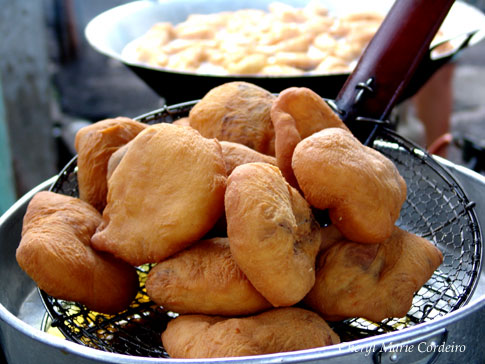
From a street-side hawker in Penang, these deep fried ham jing peng, which are deep fried buns with a sweet red bean paste as filling, are ready to go!

Deep fried bread sticks or youtiao and its variations such as the ham jimg pengs in the above picture are a simple treat in Southeast-Asia. They’re usually eaten at breakfast with a good cup of thick kopi-O (black coffee), but they can be enjoyed throughout the day as a finger food as well.

Fried bread sticks and fried buns with various fillings can most conveniently be found at hawker centers in Singapore and at street-side hawkers in Malaysia. They’re also found in other Asian countries such China, Philippines, Laos and Vietnam.

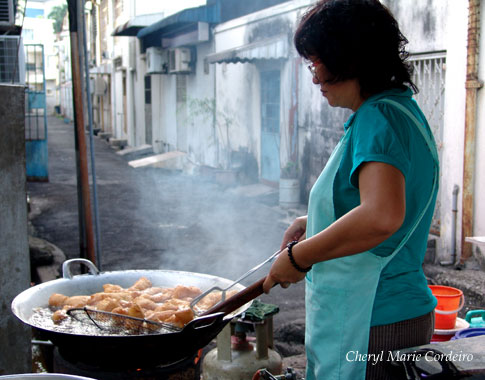
The lady with her street-side stall. Just behind her is the backstreet lane of several shophouses in Penang, Malaysia.

During my trip to Penang, Malaysia, late last year, I found some youtiao at a street-side hawker near the Pulau Tikus market. I stood and watched as the lady in a sky blue apron, expertly kneaded the dough into shape and dropped them gently one by one, into a wok filled with hot oil. She seemed to do this without effort, something of a testament perhaps, to the number of years she’s already been doing this. Continue reading “You tiao in Penang, Malaysia”

The restaurant Zum Dachs in Munich, Germany

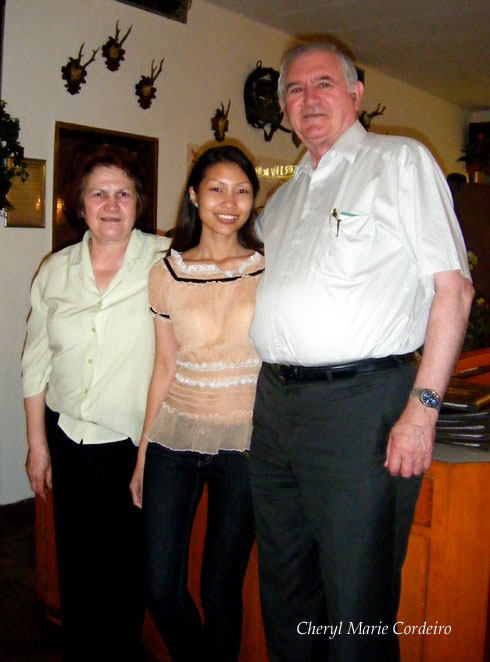
Standing near the entrance of Zum Dachs, with the owners of the restaurant, the Grbesas.

It was already early in the evening when we decided to stop in Munich for dinner. We had driven by car over the Alps, through the Bremer pass, all the way from Venice. We turned off the engine of the car in Austria and basically freewheeled down into Bavaria.

I eventually understood that it was time to take a break since my travel mates had gradually fallen more and more silent, and were by now answering my chirpy comments on nature and architecture with grunts. The only thing that appeared to catch their interest were occasional bovines grassing in the fields along the road, as if they were already fried and in-between two hamburger buns.

It was definitely time to stop for a meal.
 
Venice had left a distinct impression on me of ridiculous prices and bad food. The memory of the food experience in Venice lingers in my mind as something close to having been robbed in broad daylight and without really grasping what had happened, you realize that your wallet’s gone and you’re still hungry. Alright, perhaps that’s an exaggeration but to eat well in Venice you need personal recommendations guiding you to the few restaurants that haven’t as yet got tired of tourists. Continue reading “The restaurant Zum Dachs in Munich, Germany”

Chingay 2009, Singapore!

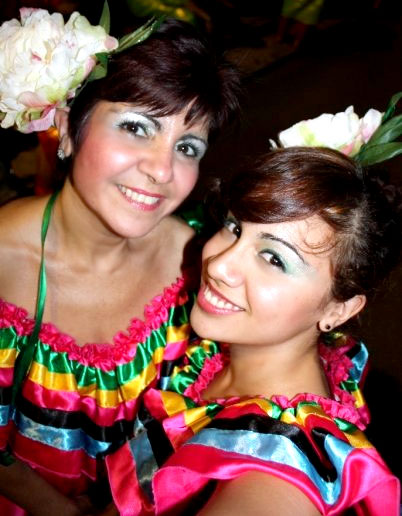
The beautiful people at Chingay 2009! L-R: Lanette Stuart, Sarah Nicole Conceicao from the Eurasian Association (EA), Singapore. Photo: Courtesy of Sarah Conceicao.

The logo on the left will bring you to the official Chingay Singapore 2009 website where you can purchase tickets to the event.

Chingay, one of Singapore’s most colourful annual street carnival is about to take place on 30th and 31st January, so I thought I’d share with you some pictures from pre-Chingay to whet your appetites before the real blast off of a show!

Having its roots in Penang, Malaysia and then moving south in celebrations to Johor and Singapore, Chingay, which is the Hokkien word for “the art of costume and masquerade”, originated as a simple procession of floats.

As a child, I remember having witnessed these floats, which were usually large vehicles, lorries or trucks that were colourfully decked with lights and transformed into mini-stages of sorts for those performing in them. Each float told a different story and had different accompanying music.

The first Chingay parade was launched in Singapore in 1973, and it was so well received by Singaporeans that it became an annual event. The parade didn’t always have a fixed location, with the procession touring diffrent housing estates annually. But since 1985, the permanent venue for the event is at Orchard Road which allows for tourists and Singaporeans alike to join in the festivities.

I loved Chingay as a child, and today, Chingay 2009 in Singapore is bigger than ever with invites to international performers and costumes so splendidly colourful!

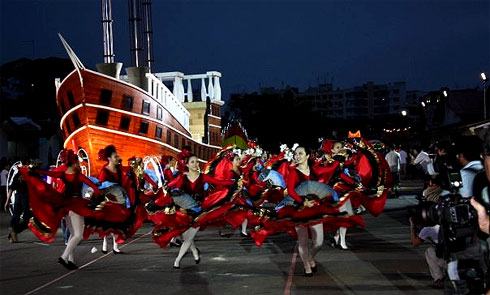
Dancers from Sylvia McCully’s dance school who form part of the EA dance troupe for this event, in front of a Portuguese Carrack. Photo: Courtesy of Sarah Conceicao

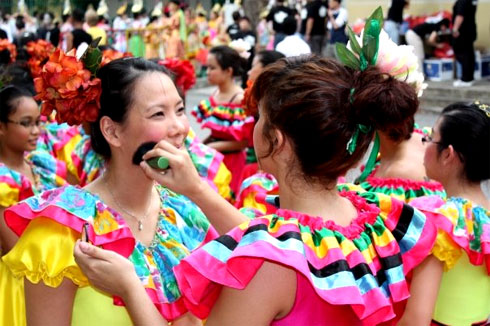
Perhaps more fun than watching the show is performing and being a part of it. This year, the Eurasian Association (EA) of Singapore has joined forces with Cedar Girls and Sylvia McCully’s dancers to form their troupe for Chingay 2009. The atmosphere is electric and the excitement is in the air for the performers!

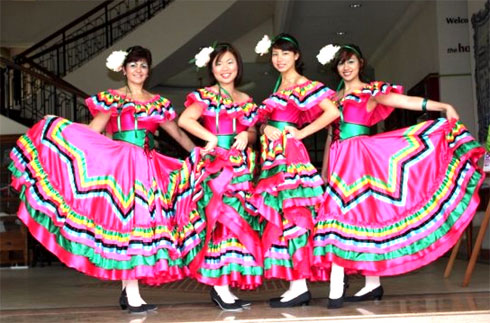
L-R: Lanette Stuart, Jamie Yun, Michelle Loh and Sarah Nicole Conceicao in their costumes of Spanish inspiration, is designed by Debra De Cotta. Photo: Courtesy of Sarah Conceicao

Sarah Conceicao who is part of the EA dance troupe fell in love with the costumes and dancing of the EA dance troupe:

Then came Chingay. My mum was actually in it last year, so this year I got my chance. There was no way I was going to give up the opportunity.

I also joined mainly because of the people that I’d meet along the way, full dress rehearsals and all…everyone has been really friendly throughout the whole process.

Its been alot of hard work. But its alot of fun.

Behind the scenes: putting on make-up in preparation for the full dress rehearsal of Chingay 2009. Photo: Courtesy of Sarah Conceicao.

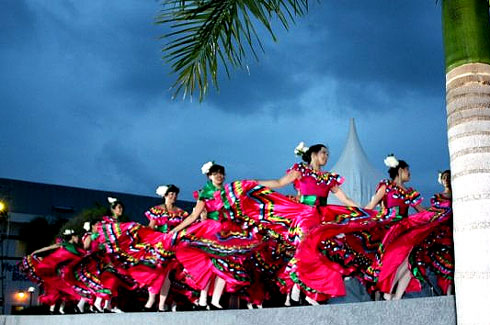
Practice for the event began in November 2008 with vividly alluring costumes specially designed by Debra De Cotta for the EA dance troupe. You can catch the EA dancers on a stage on the City Hall steps, on 30th and 31st January, 2009.

The dance to be performed at Chingay by the EA dance troupe is choreographed by Sylvia McCully. Photo: Courtesy of Sarah Conceicao.

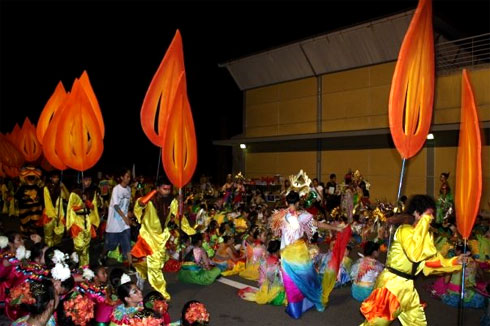
Some members of the 4,000 strong performers at Chingay 2009. Photo: Courtesy of Sarah Conceicao.

If you’re planning to be at Chingay 2009, you can expect 13 Floats with 4000 performers from 40 local organisations. Cultural groups from 8 different countries such as India, Philippines, Thailand, South Korea and China will also be part of this event.

There are after parties too at this year’s Chingay celebrations and the locations for the various parties / events can be found at the official website.

I think one can expect to have an absolutely smashing time at Chingay 2009!

Miss Universe 1999 pageant in Trinidad and Tobago – 6th from the 6th TAG

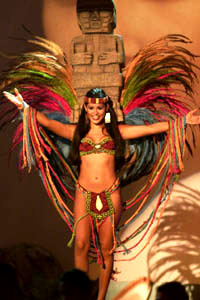
Miss Bolivia Universe, Susana Barrientos Roig in her National Costume for the international Miss Universe 1999 pageant held in Trinidad and Tobago. Her home town is Santa Cruz, Bolivia.

I had a tag from Chey of Stilettoed Praline to pick out the 6th picture from the 6th folder of my photo albums folder and write a story about it.
Continue reading “Miss Universe 1999 pageant in Trinidad and Tobago – 6th from the 6th TAG”

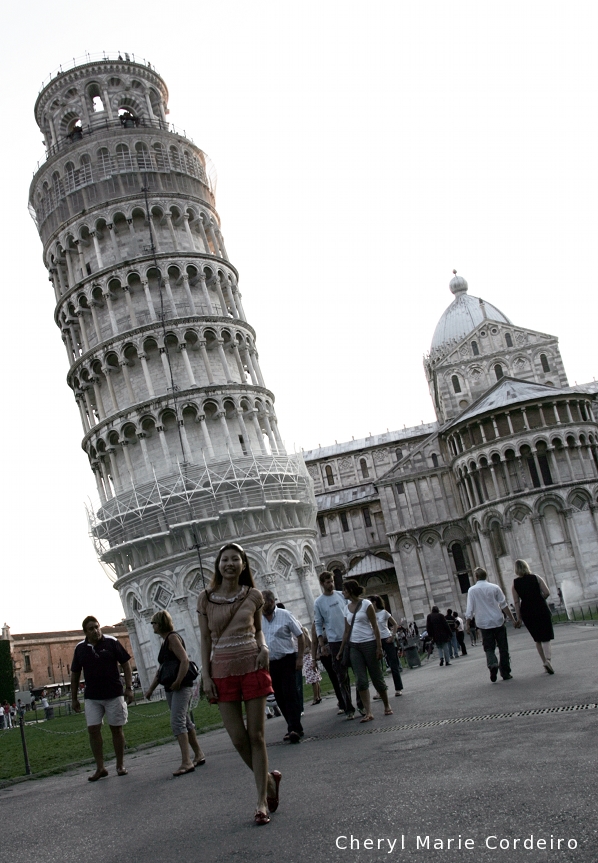
The Tower of Pisa, Piazza dei Miracoli, Italy

Cheryl Marie Cordeiro, Pisa, Italy. 02

In front of the Leaning Tower of Pisa, which up close, looks disconcertingly precarious. The beautiful symmetry of the stacked arches distracts some from the precarious leaning of the tower though.
Text & Photo © JE Nilsson, CM Cordeiro-Nilsson 2008

Pisa, the birthplace of Galileo Galilei the physicist and one of my favourite tenors, Andrea Bocelli (born in Lajatico, Tuscany), is a city that lies in the west coast of the Tuscan region of Italy. Tuscany in central Italy, is a most inspiringly beautiful place to visit in general, with the lands undulating with vineyards and restaurants atop hillocks. Florence is one of the more beautiful cities in Italy to visit, with fantastic food and scenary. The Tuscan region in Italy is like poetry, with its land sculpted via both the force of nature over time and its people.

An architectural marvel and personal curiosity is the Tower of Pisa that in my view, so elegantly leans to one side. Well. Alright, it was miscalculated, but still – beautiful.
Continue reading “The Tower of Pisa, Piazza dei Miracoli, Italy”